
Bain Resume Guide: Land Your Bain Interview (2026)
Author: Taylor Warfield, Former Bain Manager and interviewer
Last Updated: April 2, 2026

Your Bain resume determines whether you get an interview or a rejection email. Over 70% of Bain applicants are eliminated at the resume screening stage, and reviewers typically spend less than two minutes on each resume. This guide walks you through exactly what Bain looks for, how to structure each section, and how to write bullet points that stand out.
As a former Bain Manager and interviewer who screened thousands of resumes, I know the difference between a resume that gets a second look and one that gets passed over. I’ll share the specific qualities Bain scores, formatting rules to follow, and the most common mistakes that get candidates rejected.
But first, a quick heads up:
McKinsey, BCG, Bain, and other top firms accept less than 1% of applicants every year. If you want to triple your chances of landing interviews and 8x your chances of passing them, watch my free 40-minute training.
What Changed in 2026?
Bain’s screening process continues to become more competitive. The firm has expanded its use of online assessments (including the Bain TestGorilla assessment) alongside resume screening, making a strong first impression on your resume even more critical. We’ve updated this guide with new data on rejection rates, refreshed bullet point examples, added a dedicated section on common mistakes, and expanded guidance for experienced hires and non-target school candidates.
What Does Bain Look for in a Resume?
Bain looks for eight specific qualities when reviewing resumes. The first four are standard across most top consulting firms. The last four are specific to Bain’s culture and values. Understanding all eight gives you a clear checklist for what to highlight.
What Eight Qualities Do Bain Resume Reviewers Score?
The table below breaks down each quality, why Bain cares about it, and how to demonstrate it on your resume. According to Bain’s own careers page, the firm’s core values include passion, one team, results, and honesty. These values directly inform what reviewers look for.
Quality |
What Bain Wants to See |
How to Demonstrate It |
Intelligence |
High GPAs, test scores, academic awards |
List GPA if above 3.5, include SAT/GMAT/GRE scores if strong |
High Pedigree |
Prestigious schools and brand-name employers |
Highlight well-known companies you worked for or with |
Track Record of Success |
Promotions, project completions, job raises |
Show progression and increasing responsibility over time |
Relevant Skills |
Analytical + interpersonal skills for consulting |
Balance quantitative and qualitative bullet points equally |
Passion |
Deep expertise or long-term commitment to something |
Show depth in hobbies, activities, or subject matter areas |
Teamwork |
Ability to collaborate and be a strong team player |
Include bullets about cross-functional projects and team results |
Results Orientation |
Tangible, measurable outcomes from your work |
Quantify every bullet with a number, percentage, or dollar figure |
Honesty and Openness |
Intellectual honesty and transparent communication |
Highlight moments where you gave candid feedback or challenged assumptions |
You do not need a business degree or business work experience to get a Bain interview. Bain believes it can teach business skills on the job, so it focuses on hiring intelligent, driven people regardless of background. According to Glassdoor data, roughly 50% of Bain’s associate consultant hires come from non-business majors.
How Should You Structure Your Bain Resume?
A Bain resume has five core sections. The order of these sections depends on whether you are an undergraduate, MBA, or experienced hire. The table below shows the recommended ordering for each candidate type.
Section |
Undergrad |
MBA |
Experienced Hire |
Contact Information |
1st |
1st |
1st |
Professional Experience |
2nd |
2nd |
2nd |
Extracurricular Activities |
3rd |
5th (or omit) |
Omit |
Education |
4th |
3rd |
3rd |
Additional Information |
5th |
4th |
4th |
If you attend a non-target school, consider placing your Education section before Professional Experience so that reviewers see your academic credentials first. For target school students applying through on-campus recruiting, lead with Professional Experience since every resume in the pile will share the same school name.
What Goes in the Contact Information Section?
Your contact information should be the first thing on the page. Include your full name in a larger font size (at least 18pt), then your email, phone number, and city on one line below it. You can also include a link to your LinkedIn profile if it is polished and up to date.
Keep this section to two lines maximum. Every line you save here is a line you can use for content that actually differentiates you.
How Should You Write the Professional Experience Section?
This is the most important section of your Bain resume. Recruiters spend the majority of their review time here. Follow these rules to maximize impact.
Order your roles from most recent to oldest. Allocate space to each role roughly proportional to how long you held it. The exception is if you worked at a prestigious or brand-name company. In that case, give it more space even if the tenure was shorter. According to multiple former MBB recruiters, brand recognition on a resume significantly increases interview odds.
Each role should have a minimum of two bullet points and a maximum of five. List the most impressive bullet first since reviewers often read only the first one or two.
If you have only had one job over a long period, separate your bullets into different projects. This makes the content easier for reviewers to scan.
If you want step-by-step help crafting your bullet points and overall resume, check out my resume review and editing service. I’ll rewrite your resume directly with unlimited revisions and 24-hour turnaround.
What Should the Extracurricular Activities Section Include?
This section matters most for undergraduates with limited work experience. If you have substantial professional experience, keep this section short or omit it entirely.
Unlike the experience section, organize your activities from most impressive to least impressive rather than chronologically. Prioritize leadership roles over general memberships. A resume that shows you were president of one club with measurable results is stronger than one that lists membership in five clubs.
How Should You Format the Education Section?
Keep this section short to save space for your professional experience. List your school name, degree, major, and graduation date. If you have high test scores or a GPA above 3.5 (or equivalent), include them. According to data from top consulting recruiting communities, candidates with GPAs above 3.6 receive interview invitations at roughly twice the rate of those below 3.3.
Include one bullet summarizing notable academic honors, relevant coursework, or school leadership roles. Emphasize depth over breadth.
What Belongs in the Additional Information Section?
This is the final section and should be concise. Organize it into categories such as Skills, Languages, Certifications, Volunteer Work, and Interests. You will not have room for all of these, so choose the categories where you have the most to offer.
The Interests line is more important than most candidates realize. It is often the only part of the resume that is memorable and sparks conversation in interviews. If you have won ice cream-making competitions or climbed the seven summits, include it. Avoid generic interests like “traveling” or “cooking” without any specifics.
For skills, list tools that demonstrate analytical capability: SQL, Tableau, Python, R, or Alteryx. Do not list Excel or PowerPoint. Every candidate knows these, and listing them takes up space without adding value.
How Do You Write Strong Bain Resume Bullet Points?
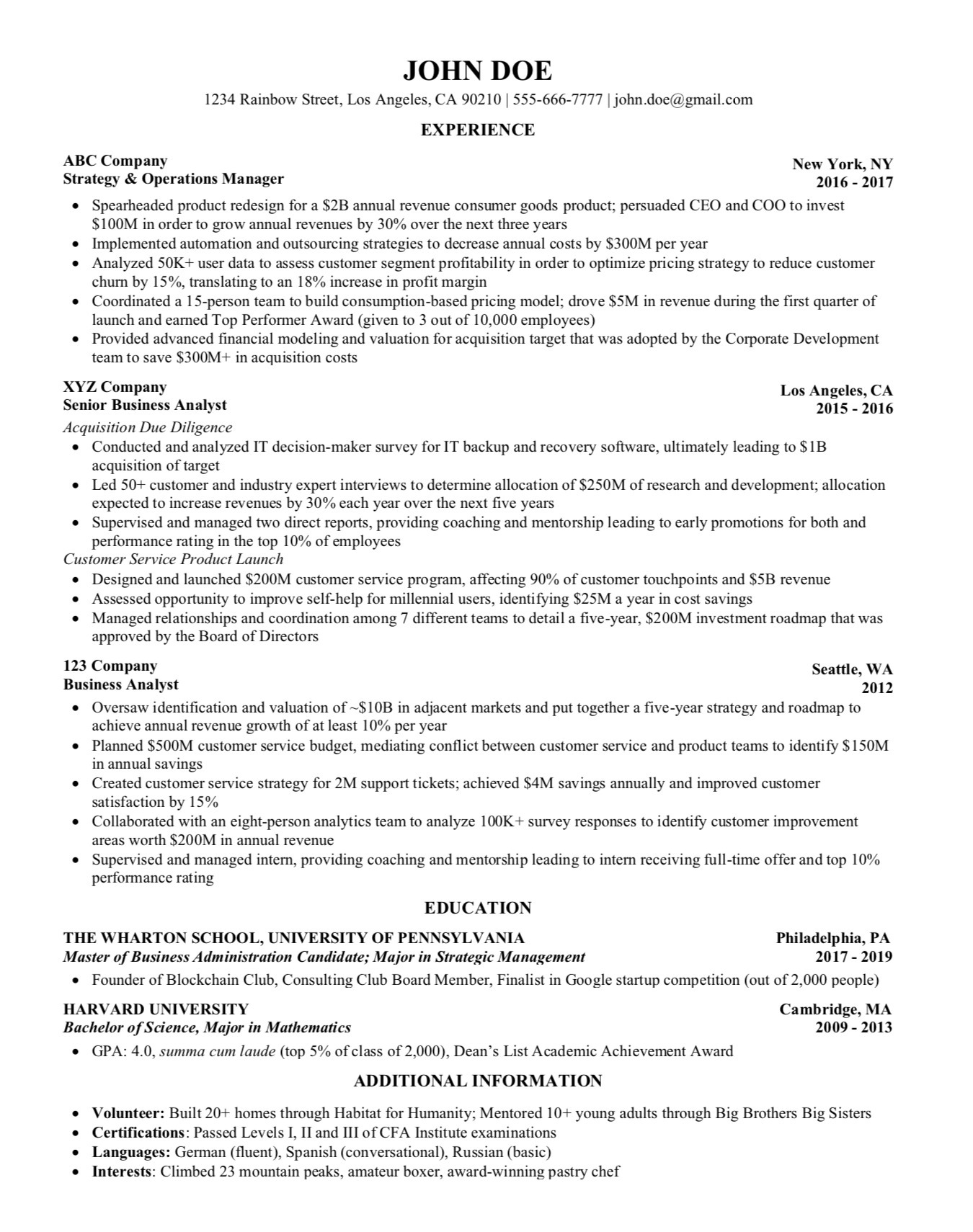
The quality of your bullet points is the single biggest factor that determines whether you get a Bain interview. Every bullet should follow a simple formula: start with a strong action verb, describe what you did and the scale, and end with a quantified result.
Here are three examples that show the difference between weak and strong bullets.
Weak Bullet |
Strong Bullet |
Analyzed survey responses to identify customer improvement areas |
Led an eight-person analytics team to analyze 100K+ survey responses, identifying improvement areas worth $200M in annual revenue |
Planned annual customer service budget |
Planned $500M customer service budget, mediating conflict between teams to identify $150M in annual savings |
Created customer service strategy for 2M support tickets |
Created customer service strategy for 2M support tickets, achieving $4M in annual savings and improving satisfaction by 15% |
Notice the pattern. Strong bullets include scale (team size, budget amount, number of tickets), specific actions (led, mediated, created), and quantified outcomes (dollar savings, percentage improvements). In my experience reviewing resumes at Bain, roughly 80% of rejected resumes failed to quantify the impact of their work.
Balance your bullets equally between quantitative accomplishments (analyzing data, building models, solving problems) and qualitative accomplishments (leading teams, collaborating across functions, mentoring others). Bain wants consultants who are both analytical and personable.
Examples of strong qualitative bullets:
- Supervised and mentored an intern, providing weekly coaching that led to a full-time offer and a top 10% performance rating
- Collaborated with 18 client teams across four countries to develop a 5-year, $100M investment roadmap targeting 40% revenue growth
- Communicated daily with field sales and product teams to qualify and ensure $18M+ in revenues were accurately quoted and entered
What Action Verbs Should You Use on a Bain Resume?
Every bullet should start with a different past-tense verb. Using varied verbs shows a range of skills. Here are 20 high-impact verbs that work well on consulting resumes:
Action Verbs (1–10) |
Action Verbs (11–20) |
Led |
Presented |
Developed |
Collaborated |
Analyzed |
Reduced |
Designed |
Generated |
Implemented |
Restructured |
Negotiated |
Evaluated |
Streamlined |
Optimized |
Identified |
Facilitated |
Launched |
Advised |
Managed |
Spearheaded |
Avoid starting multiple bullets with the same verb. If every bullet begins with “Managed,” it signals a narrow skill set. Variety shows versatility.
How Should You Tailor Your Resume for Bain?
The qualities Bain looks for are similar to those at McKinsey and BCG. You do not need to completely overhaul your resume for Bain specifically. However, making a few targeted adjustments can help if your resume is on the borderline between getting an interview and getting rejected.
- Emphasize teamwork and collaboration. While all consulting firms value teamwork, Bain places extra emphasis on it. When balancing quantitative and qualitative bullets, lean slightly toward showing team-based results.
- Show genuine passion. Bain’s culture values people who are deeply committed to something. Demonstrate this through long-term dedication to an activity, deep expertise in a topic, or tangible accomplishments in a personal interest.
- Mirror job posting language. For candidates applying from non-target schools or off-cycle, Bain uses Applicant Tracking Systems (ATS) to screen resumes. Find the specific job posting you are applying for and weave relevant keywords from the requirements into your bullets naturally.
- Address role-specific requirements. If you are applying to an international office, highlight language proficiency. If the posting emphasizes digital or analytics, foreground technical skills and data-driven projects.
How Does Resume Strategy Differ for Undergrads, MBAs, and Experienced Hires?
Your resume strategy should shift depending on where you are in your career. According to Bain’s careers page, the firm recruits associate consultants (undergrads), consultants (MBAs), and experienced professionals through distinct tracks.
- Undergraduates: Lead with Professional Experience, then Extracurricular Activities, then Education. Extracurriculars carry real weight because you have limited work history. Show leadership roles with quantified impact.
- MBA candidates: Lead with Professional Experience, then Education. Your pre-MBA work experience matters most. Show career progression and increasing scope of responsibility. Extracurriculars are optional and should be brief.
- Experienced hires: Lead with Professional Experience and dedicate 60% or more of your resume to it. Show a clear pattern of promotions, expanding scope, and measurable impact. Omit extracurriculars unless they are exceptional. Experienced hires with 10+ years may include a two-line profile summary at the top.
What Should You Do If You Have a Low GPA?
If your GPA is below 3.3 on a 4.0 scale, do not include it on your resume. A missing GPA is better than a low one that creates a negative first impression. For more strategies, see our guide on getting into consulting with a low GPA.
If your GPA is low because of extenuating circumstances (such as working full-time through college), consider writing a one-paragraph GPA addendum on a separate PDF. Briefly explain the context and highlight your resilience. This tactic is used by roughly 10–15% of successful non-target school applicants, according to consulting recruiting community data.
How Do You Optimize for Bain’s ATS?
Bain uses Applicant Tracking Systems for candidates applying outside of on-campus recruiting. To optimize for ATS screening:
- Use a standard font (Arial, Times New Roman, or Calibri) with no images, graphics, or text boxes
- Avoid headers and footers for key content since many ATS systems cannot read them
- Include keywords from the job posting in your bullet points, not just in a skills section
- Save your resume as a PDF unless the application specifically requests a Word document
What Formatting Rules Should Your Bain Resume Follow?
Formatting mistakes are one of the fastest ways to get your Bain resume rejected. Resume reviewers see thousands of resumes, and anything that looks sloppy or non-standard will stand out for the wrong reasons. Follow these specifications exactly.
Element |
Specification |
Page Length |
Exactly one page. No exceptions. |
Margins |
0.5 to 1.0 inches on all sides |
Font |
Times New Roman, Arial, or Calibri |
Body Font Size |
10–11pt (no smaller than 10) |
Name Font Size |
14–18pt, bold or capitalized |
Bullet Points |
Use bullet points, not paragraphs. 2–5 bullets per role. |
Date Format |
Consistent throughout (e.g., Jan 2024 – Dec 2025) |
File Format |
PDF (unless told otherwise) |
File Name |
FirstName_LastName_Resume_2026.pdf |
Use clear section headings (Professional Experience, Education, Additional Information) with bold formatting or subtle divider lines. Maintain consistent font style, size, and date formatting throughout. Even small inconsistencies signal carelessness.
What Are the Most Common Bain Resume Mistakes?
Having coached hundreds of candidates preparing for Bain, I see the same resume mistakes repeatedly. Avoiding these will put you ahead of most applicants.
- Writing task descriptions instead of impact statements. "Conducted market research" tells the reviewer nothing. "Conducted market research across 12 markets, identifying a $50M revenue opportunity" tells a story.
- Leaving bullets unquantified. If you cannot attach a number, percentage, dollar figure, or scale metric to a bullet, reconsider whether it belongs on your resume.
- Exceeding one page. No matter how experienced you are, keep it to one page. Bain recruiters will not read page two.
- Using industry jargon or acronyms. A resume reviewer may not know what GTM, DTC, or B2B means. Spell things out in plain language.
- Listing generic interests. "Traveling" and "cooking" are on thousands of resumes. "Competed in three amateur barbecue championships" is memorable.
- Inconsistent formatting. Mixing date formats, font sizes, or bullet styles makes your resume look careless. Consistency signals attention to detail.
- Including a photo or objective statement. Neither is standard for consulting resumes. An objective statement wastes space, and a photo can introduce bias.
- Over-indexing on quantitative bullets. Many resumes are 90% analytical accomplishments. Bain explicitly values teamwork and leadership. Aim for a 50/50 split between quantitative and qualitative achievements.
What Final Checks Should You Do Before Submitting?
Before you submit your Bain resume, complete these final checks.
- Read your resume out loud. This catches typos, awkward phrasing, and grammatical errors that silent reading misses.
- Verify every number. Double-check that all metrics, dollar figures, and percentages are accurate. Interviewers sometimes ask about resume claims, and a number you cannot defend damages your credibility.
- Color-code your bullets. Mark quantitative bullets in one color and qualitative bullets in another. Check that the balance is roughly even. Change all text back to black before submitting.
- Get feedback from at least two people. Ideally, one should be a current or former consultant who understands what Bain looks for. Other good reviewers include career services advisors, classmates who have been through consulting recruiting, and alumni at consulting firms.
- Check your contact details. Verify your phone number, email address, and LinkedIn URL are correct and active.
- Save as PDF and review formatting. Open the PDF on a different device to confirm that fonts, spacing, and alignment look correct. Word processor files can shift formatting between devices.
If you want expert eyes on your resume, our consulting resume review and editing service gives you unlimited revisions with 24-hour turnaround from someone who has sat in Bain recruiting meetings.
Frequently Asked Questions
How Long Should a Bain Resume Be?
A Bain resume should be exactly one page. This applies to undergraduates, MBAs, and experienced hires. Even candidates with 15+ years of experience are expected to fit everything on a single page. If your resume is longer, make your content more concise and prioritize the most impactful roles and achievements.
Does Bain Require a Cover Letter?
Bain does not always require a cover letter, but submitting one is strongly recommended. A well-written Bain cover letter can differentiate you from candidates with similar resumes, especially when your application is on the borderline. Focus the cover letter on why Bain specifically (not just consulting in general) and what unique perspective you bring.
What GPA Do You Need for Bain?
Bain does not publish a minimum GPA requirement. However, based on recruiting community data, most successful candidates have a GPA of 3.5 or above on a 4.0 scale. Candidates with GPAs between 3.0 and 3.5 can still get interviews if they have strong work experience, leadership credentials, or attend a target school. See our guide on getting into consulting with a low GPA for specific strategies.
Should I Include a Photo on My Bain Resume?
No. Including a photo on a consulting resume is not standard in the United States and can introduce bias. In some European and Asian markets, photos are more common, but for US-based Bain applications, leave the photo off. Use that space for content that showcases your qualifications instead.
Can I Get a Bain Interview from a Non-Target School?
Yes. Bain hires candidates from non-target schools, though the path is more competitive. Focus on networking with Bain consultants to get referrals, which significantly increase your chances of having your resume reviewed by a human rather than filtered by ATS. Ensure your resume has strong brand-name work experience, quantified impact in every bullet, and a standout Interests line that makes you memorable.
Everything You Need to Land a Consulting Offer
Need help passing your interviews?
-
Case Interview Course: Become a top 10% case interview candidate in 7 days while saving yourself 100+ hours
-
Fit Interview Course: Master 98% of consulting fit interview questions in a few hours
- Interview Coaching: Accelerate your prep with 1-on-1 coaching with Taylor Warfield, former Bain interviewer and best-selling author
Need help landing interviews?
- Resume Review & Editing: Craft the perfect resume with unlimited revisions and 24-hour turnaround
Need help with everything?
- Consulting Offer Program: Go from zero to offer-ready with a complete system
Not sure where to start?
- Free 40-Minute Training: Triple your chances of landing consulting interviews and 8x your chances of passing them