
BCG Online Case: The Complete Guide (2026)
Author: Taylor Warfield, Former Bain Manager and interviewer
Last Updated: March 20, 2026

BCG online case is a digital assessment that uses a chatbot named Casey to walk you through a full business case in 25 to 30 minutes. You will answer 8 to 10 questions and record a 1-minute video recommendation at the end.
If you have an upcoming BCG online case, this guide covers exactly what to expect, how the test is scored, and how to prepare. It includes BCG’s official sample questions with step-by-step solutions so you can practice before your real test.
But first, a quick heads up:
McKinsey, BCG, Bain, and other top firms accept less than 1% of applicants every year. If you want to triple your chances of landing interviews and 8x your chances of passing them, watch my free 40-minute training.
What Changed in 2026?
The biggest change is that BCG has fully retired the old Potential Test. As of early 2026, the Casey Chatbot is now the standard assessment globally. The Potential Test had 23 questions in 45 minutes. The current Casey format has 8 to 10 questions in 25 to 30 minutes.
Some German offices have started using an alternative Cognitive Test, but these remain the minority. If you are unsure which assessment you will face, check with your BCG recruiter before you start preparing.
The video recommendation section also tightened. You now get 1 minute to prepare and 1 minute to record, with only 1 attempt allowed. Earlier versions offered 2 attempts.
What Is the BCG Online Case?
The BCG online case is a digital screening tool that simulates a real consulting case interview. Instead of sitting across from a human interviewer, you interact with a chatbot named Casey through an instant messenger style interface. Casey presents a business problem, shares data exhibits, and asks you a series of questions.
BCG developed the Casey Chatbot in partnership with HireQuotient, a Singapore based startup co-founded by a BCG alumnus. The test evaluates the same core skills as a live BCG case interview: structured thinking, quantitative reasoning, data interpretation, business judgment, and communication.
How Does the Casey Chatbot Work?
Casey introduces a client scenario at the start of the test. You are then guided through the case question by question. Unlike a traditional case interview where you can drive the analysis, Casey controls the flow. This makes the experience more like an interviewer-led case.
You will see a split screen layout. The left side shows the question and answer options. The right side shows the data, charts, or exhibits you need to answer the question. Once you submit an answer, you cannot go back.
Where Does the BCG Online Case Fit in the Hiring Process?
You will encounter the BCG online case early in the interview process. In most offices, it serves as a pre-interview screen after your resume passes initial review. In other offices, it is paired with your Round 1 live interviews.
A typical BCG recruiting timeline looks like this: you submit your application, pass resume screening, complete the online case assessment, and then move to Round 1 live interviews (1 to 2 cases with human interviewers). Strong performers advance to Round 2 final interviews.
You will typically receive the online case invitation within a few days of applying. Most offices give you about one week to complete it, so start preparing before you submit your application.
Which BCG Offices Use the Online Case?
As of 2026, the Casey Chatbot is used by the vast majority of BCG offices worldwide. Offices in the US (including New York, New Jersey, Washington DC), Southeast Asia, Europe, and Latin America all report using the Casey Chatbot format.
A few offices are exceptions. Some German offices now use a Cognitive Test instead. The London office has occasionally used a Quantitative Reasoning test. If your recruiter’s email does not specify which test you will take, clarify with HR before you prepare.
What Is the Format of the BCG Online Case?
The BCG online case has two sections: the Casey Chatbot case (25 to 30 minutes, 8 to 10 questions) and a video recommendation (1 minute prep, 1 minute recording). The entire assessment takes roughly 35 minutes.
How Does the Casey Chatbot Section Work?
Casey presents a single business case. Your first task is usually a dataset selection question where you choose the most relevant data sources from a set of about 8 options. After that, you answer 7 to 9 additional questions in a mix of formats: multiple choice (single select and multi select), short text (typically numerical answers), and long text (written explanations).
The clock runs continuously from the moment you start. There is no option to pause and you cannot return to previous questions once you submit an answer. According to Glassdoor data, roughly 70% of the questions involve quantitative reasoning or data interpretation.
How Does the Video Recommendation Work?
After the chatbot section, you record a 1-minute video presenting your final recommendation. You get 1 minute of preparation time before recording begins. You have only 1 attempt, so you cannot re-record.
In my experience coaching candidates, the most effective video structure is: state your recommendation in one sentence, support it with 2 to 3 key findings from the case, then briefly mention one risk or next step. Keep it tight. One minute goes faster than you think.
Component |
Details |
Time |
Casey Chatbot Case |
8 to 10 questions (MC, short text, long text) |
25 to 30 minutes |
Video Recommendation |
1-minute recorded presentation |
1 min prep + 1 min record |
Total Assessment |
Case + Video |
~35 minutes |
What Types of Questions Are Asked in the BCG Online Case?
The BCG online case includes five main question types: dataset selection, structuring and business sense, quantitative and math, graph and data interpretation, and critical thinking. Each type tests a different consulting skill.
What Are Dataset Selection Questions?
The case usually opens with a dataset selection question. You are given about 8 data sources and asked to choose the 3 to 4 most relevant ones for solving the case. This tests your ability to identify what information matters before diving into analysis.
A common mistake is choosing two datasets that overlap. For example, picking both an itemized profit and loss statement and a separate cost breakdown when the P&L already contains cost data. Always check for redundancy before submitting your selections.
What Are Structuring and Business Sense Questions?
These questions present a business scenario and ask you to identify the best course of action, the most useful type of information, or what the team should investigate next. They test your ability to think like a consultant and prioritize the right analysis.
For these questions, building an issue tree or using a case interview framework will help you quickly organize the answer choices and eliminate irrelevant options.
What Quantitative and Math Questions Should You Expect?
Math questions are the backbone of the BCG online case. According to candidate reports, roughly 60 to 70% of the assessment involves quantitative reasoning. You will be asked to calculate figures like gross margins, growth rates, break-even points, and weighted averages.
You are allowed to use a calculator during the online case. This is a major advantage over traditional live case interviews. However, the math problems tend to be more complex than what you would see in a live interview because BCG knows you have a calculator.
Make sure you are comfortable with these formulas before test day:
Formula |
What It Calculates |
Profit = Revenue - Costs |
Basic profitability of a business or product line |
Gross Margin = (Revenue - COGS) / Revenue |
Percentage of revenue retained after direct production costs |
Weighted Average = Σ(Value × Weight) / Σ(Weights) |
Average that accounts for different proportions or volumes |
Break-Even = Fixed Costs / (Price - Variable Cost) |
Number of units needed to cover all costs |
Growth Rate = (New - Old) / Old × 100 |
Percentage change between two time periods |
Expected Value = Σ(Outcome × Probability) |
Probability-weighted average of possible outcomes |
If you want to sharpen your case interview math skills, practice these calculations until they feel automatic. Speed matters when you only have 25 to 30 minutes for the entire case.
What Are Graph and Data Interpretation Questions?
Expect to analyze bar charts, line graphs, scatter plots, and data tables. Some questions require you to interpret a single exhibit. Others ask you to combine insights from 2 to 3 exhibits simultaneously.
When facing a graph question, follow three steps. First, read the axes and labels to understand what the chart is showing. Second, identify the key trend or data point the question is asking about. Third, connect your finding back to the business problem. For more practice, check out our guide on case interview charts and graphs.
What Are Critical Thinking Questions?
Critical thinking questions test your ability to evaluate scenarios, identify cause-and-effect relationships, and choose the most logical conclusion from given information. These are similar to the logical reasoning questions you might find on the GMAT.
For example, you might be asked which factor would most likely explain a decline in sales, or which strategy would have the greatest impact on customer retention given a set of constraints.
How Is the BCG Online Case Scored?
The BCG online case uses a points system. You earn 3 points for each correct answer and lose 1 point for each incorrect answer. Unanswered questions receive 0 points. This means random guessing can hurt your score. Unless you can confidently eliminate at least 2 to 3 answer choices, it is better to leave a question blank.
BCG evaluates your performance across multiple dimensions: structured problem solving, quantitative accuracy, business judgment, critical reasoning, communication quality (video), and time management. You are assessed holistically, so a weakness in one area can be offset by strength in another.
What Is the Pass Rate for the BCG Online Case?
BCG does not publish official pass rates, but industry estimates based on candidate feedback suggest approximately 20 to 30% of candidates advance past the online case. This aligns with BCG’s broader hiring selectivity, where roughly 1 to 2% of all applicants ultimately receive offers.
The most common reasons candidates fail are running out of time, misinterpreting data exhibits, making math errors, and delivering a weak video recommendation.
What Happens If You Fail the BCG Online Case?
If you do not pass the BCG online case, you will receive a rejection email. You will typically need to wait 1 to 2 years before you can reapply to the same BCG office. You only get one attempt at the assessment per application cycle, so preparation matters.
BCG Online Case Example Questions and Solutions
BCG provides four sample questions in their official interviewing website. Below are step-by-step solutions for each one. These are the only official practice questions BCG has released, so study them carefully.
BCG Online Case Example Question 1
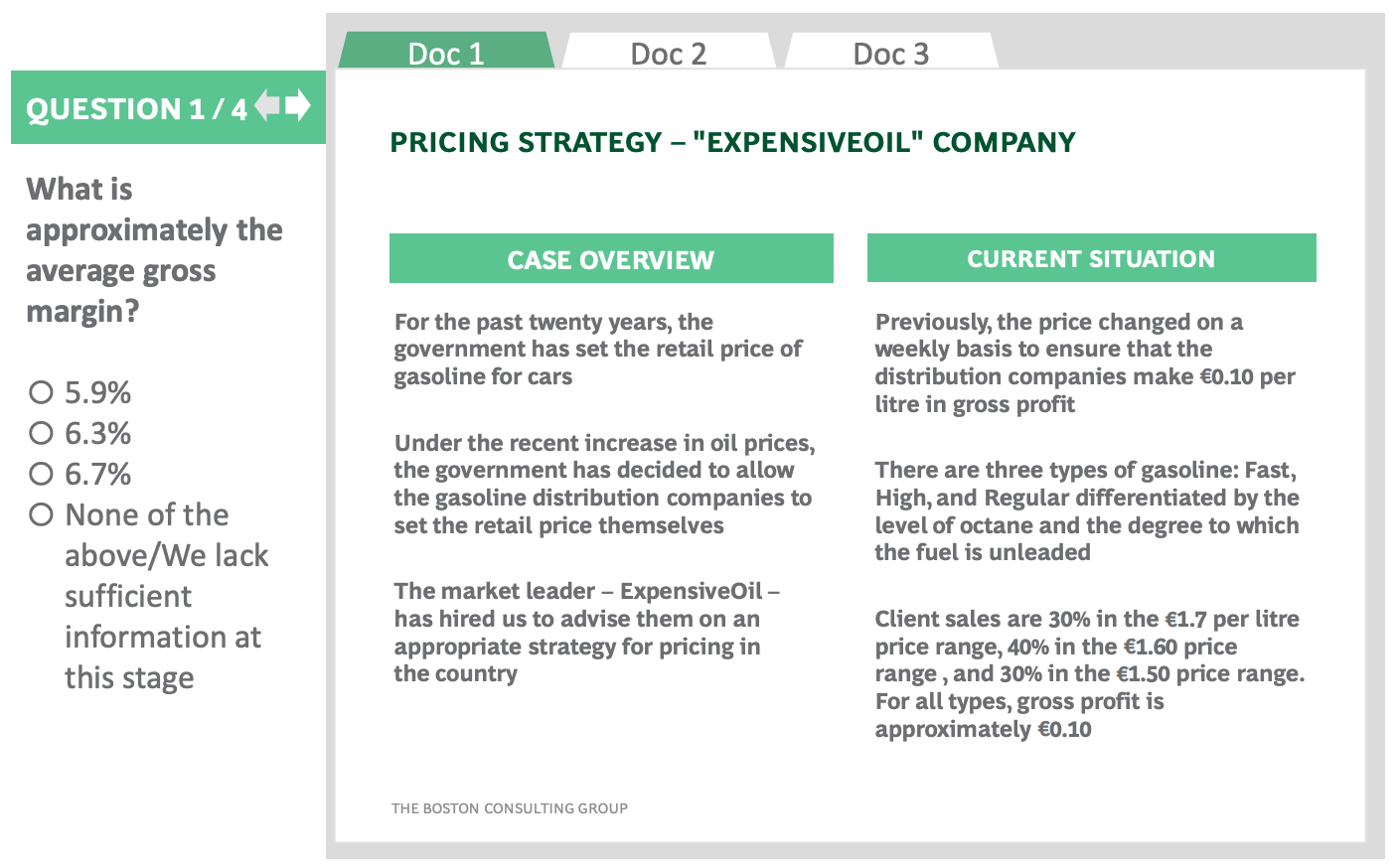
This question asks you to calculate the average gross margin across three types of gasoline, given that each type has a profit of €0.10 per liter and different selling prices and sales mix percentages.
Solution: To find the average gross margin, calculate the weighted average of individual profit margins. Each gasoline type has a €0.10 profit, so the margin for each type equals 0.10 divided by its selling price.
Average gross margin = (0.3 × 0.10/1.70) + (0.4 × 0.10/1.60) + (0.3 × 0.10/1.50) = 0.0626
The correct answer is 6.3%.
BCG Online Case Example Question 2
This question shows a supply and demand graph and asks you to find the price point that maximizes profit.
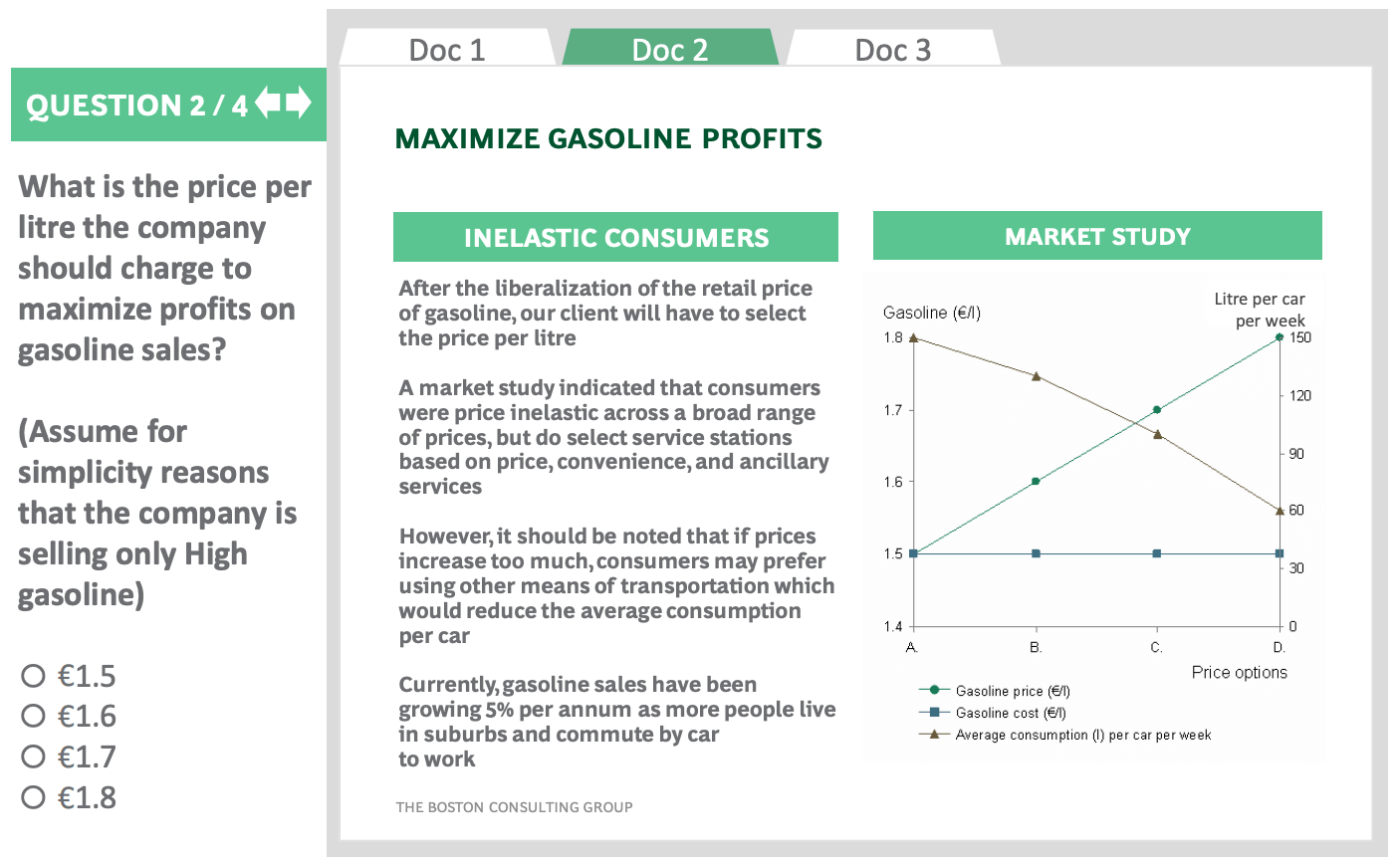
Solution: Profit is maximized where the supply and demand curves intersect, because that is where you sell the highest volume at a profitable price. The intersection occurs just below €1.70.
The correct answer is €1.70.
BCG Online Case Example Question 3
This question provides industry research data showing the number of cars per week and average retail sales per car at different gasoline prices. You need to maximize retail revenue.
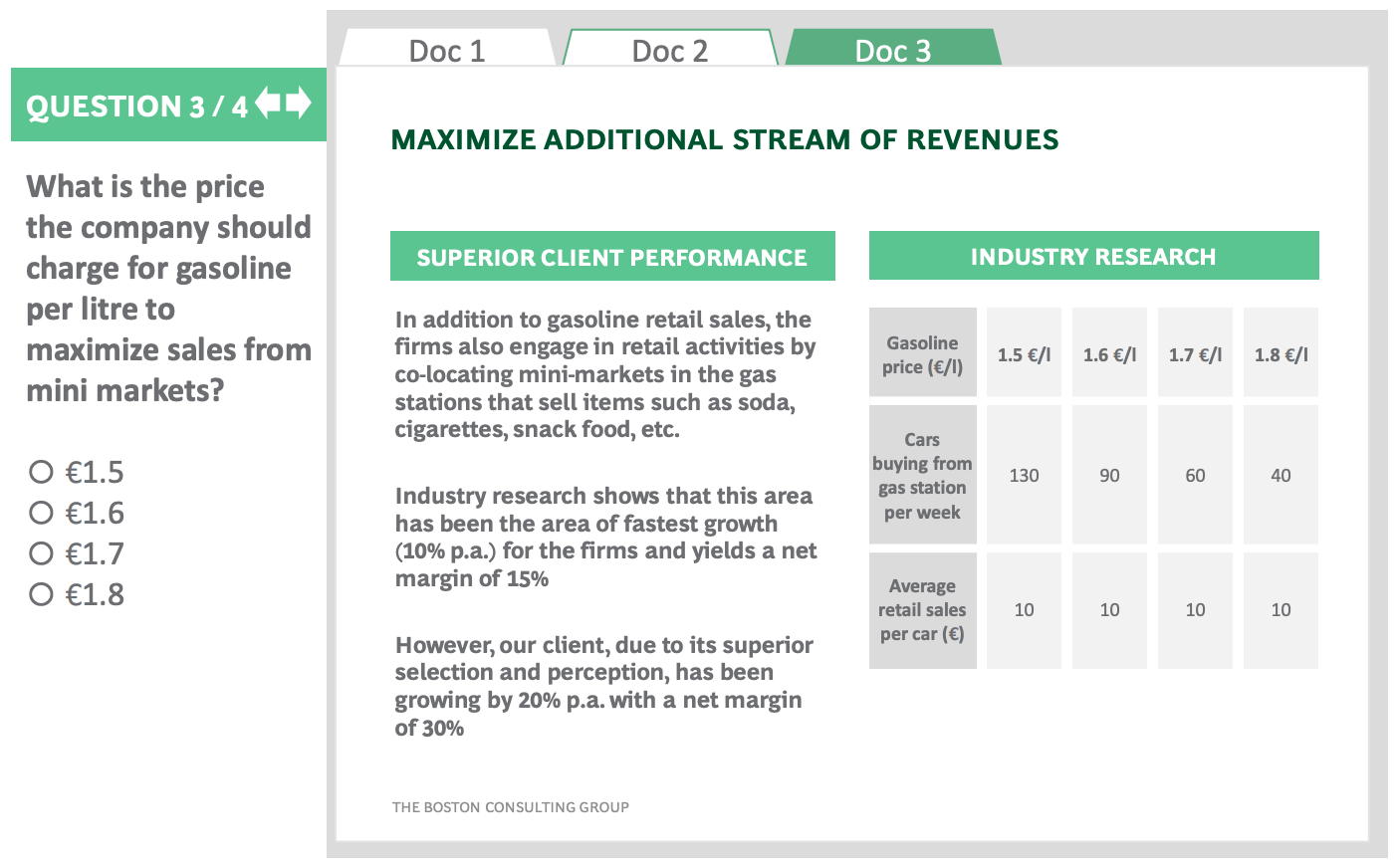
Solution: The data shows that average retail sales per car does not change with gasoline price. Therefore, total retail revenue depends entirely on the number of cars. Choose the gasoline price that attracts the most cars.
The correct answer is €1.50 because this price brings in the highest number of cars per week.
BCG Online Case Example Question 4
This question asks you to find the price that maximizes combined profits from gasoline and retail sales. You must calculate total profit at each of four price points.
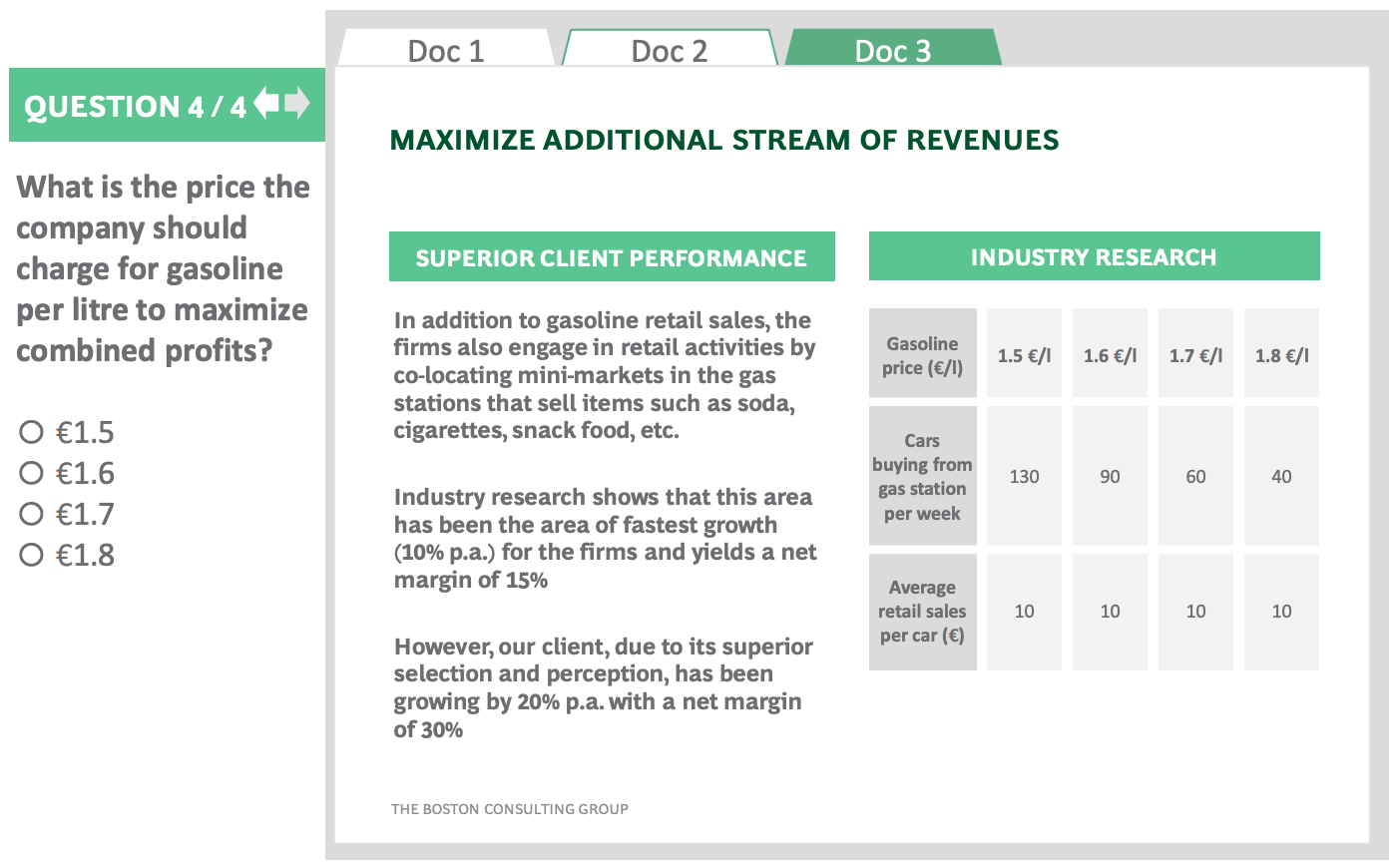
Solution: Calculate gasoline profit and retail profit at each price, then add them together.
- At €1.50/L: Retail profit = 130 × €10 × 0.3 = €390. Gasoline profit = €0 (sold at cost). Total = €390
- At €1.60/L: Retail profit = 90 × €10 × 0.3 = €270. Gasoline profit = 90 × (0.1 × 130) = €1,170. Total = €1,440
- At €1.70/L: Retail profit = 60 × €10 × 0.3 = €180. Gasoline profit = 60 × (0.2 × 100) = €1,200. Total = €1,380
- At €1.80/L: Retail profit = 40 × €10 × 0.3 = €120. Gasoline profit = 40 × (0.3 × 60) = €720. Total = €840
The correct answer is €1.60 because it generates the highest combined profit of €1,440.
BCG Interactive Case Walkthroughs
BCG previously published two interactive cases on their website that served as early versions of the online case. While these have been removed from BCG’s site, full video walkthroughs are available:
- Airline Case: A profitability case focused on helping a low-cost carrier airline improve profitability.
- Drug Company Case: A pricing case focused on helping a pharmaceutical company determine the optimal price for a new drug.
These cases are excellent additional practice because they use the same question styles and data interpretation patterns you will see on the real assessment.
What Other Case Types Might Appear on the BCG Online Case?
The business scenarios on the BCG online case draw from the same pool of case types you would encounter in a live interview. Common types include:
- Market entry cases that assess the viability of entering a new market or geography
- Profitability cases that identify drivers behind declining profits and recommend fixes
- M&A cases that evaluate whether a company should acquire another business
- Growth strategy cases that develop plans to achieve revenue or market share targets
- Pricing cases that optimize pricing strategies for products or services
How Does the BCG Online Case Compare to a Traditional Case Interview?
The BCG online case and the traditional BCG case interview test the same underlying skills, but the format creates several important differences.
Factor |
BCG Online Case |
Traditional Case Interview |
Format |
Chatbot on a computer |
Face-to-face with an interviewer |
Duration |
25 to 30 minutes + 1-min video |
30 to 45 minutes |
Questions |
8 to 10 structured questions |
Open-ended discussion |
Candidate Control |
Low (interviewer-led by chatbot) |
Higher (can ask clarifying questions) |
Calculator |
Allowed |
Not allowed |
Real-Time Feedback |
None |
Interviewer guides you |
Math Difficulty |
Higher (calculator compensates) |
Standard mental math |
Communication |
Written answers + 1-min video |
Verbal throughout |
The biggest adjustment for most candidates is the lack of real-time feedback. In a live interview, an interviewer can nudge you back on track. With Casey, a wrong interpretation early in the case can snowball because later questions may build on previous answers.
How Should You Prepare for the BCG Online Case?
Preparing for the BCG online case takes most candidates 1 to 3 weeks. Follow these five steps to build the right skills efficiently.
Step 1: Master Traditional Case Interview Skills
The BCG online case tests the same analytical skills as a live case interview. If you can solve traditional cases confidently, you already have 80% of what you need. Practice structuring problems, building frameworks, performing case interview math, and interpreting data exhibits.
If you want to learn case interviews quickly, my case interview course covers proven strategies that 82% of students use to land consulting offers. It can get you interview-ready in as little as 7 days.
Step 2: Practice Under Timed Conditions
Time pressure is the number one reason candidates fail the BCG online case. Set a timer for 3 minutes per question when practicing and force yourself to commit to an answer. Build the habit of working quickly and decisively.
Step 3: Sharpen Your Math Speed
Even with a calculator, you need to set up problems correctly and quickly. Practice weighted averages, percentage changes, margin calculations, and multi-step problems until they are second nature. Spend at least 15 minutes per day on timed math drills in the 2 weeks before your test.
Step 4: Get Comfortable with Data Exhibits
The BCG online case is data heavy. Practice reading charts and graphs quickly. For every exhibit, train yourself to identify: what the axes show, what the main trend is, and what it means for the business question. The faster you can extract insights from visuals, the more time you save for calculations.
Step 5: Rehearse Your Video Recommendation
Record yourself giving a 1-minute recommendation for every practice case you do. Use this structure: state your recommendation, give 2 to 3 supporting points, mention one risk or next step. Review your recordings to check for filler words, unclear reasoning, and time management. Having coached hundreds of candidates, I can tell you that the video often separates borderline candidates from those who advance.
What Are the Most Common Mistakes to Avoid on the BCG Online Case?
In my experience coaching candidates for consulting interviews, I see the same mistakes come up repeatedly on the BCG online case. Avoiding these will put you ahead of most test takers.
- Misunderstanding the case objective. If you misread the client’s goal in the opening prompt, every answer downstream will be wrong. Spend an extra 30 seconds reading the scenario carefully before you touch any question.
- Selecting redundant datasets. Choosing two data sources that contain the same information wastes one of your limited selections. Always check for overlap before submitting.
- Spending too long on one question. You have roughly 3 minutes per question on average. If a question is taking more than 4 minutes, make your best guess and move on. One missed question hurts less than running out of time on the last three.
- Guessing randomly on multiple choice. Remember the scoring penalty: wrong answers cost 1 point while blank answers cost 0. Random guessing will likely lower your score unless you can eliminate at least half the options.
- Neglecting the video recommendation. Some candidates treat the video as an afterthought. It tests synthesis and communication, which are core consulting skills. A strong video can compensate for a weaker chatbot section.
- Not testing your technology beforehand. Technical issues mid-test will eat into your limited time. Test your internet connection, browser compatibility, webcam, and microphone before you start the assessment.
BCG Online Case Tips to Maximize Your Score
Follow these tips on test day to perform at your best.
- Take notes on paper. Keep a pen and paper next to you. Write down the case objective, key data points, and your answer to each question. These notes will make your video recommendation significantly easier to deliver.
- Use your calculator strategically. You are allowed to use a calculator, so take advantage of it. But set up the calculation on paper first so you know exactly what numbers to plug in. This prevents input errors.
- Read all answer choices before selecting. On multiple choice questions, read every option before choosing. The BCG online case sometimes includes answer choices that are close to correct but differ in one important detail.
- Track your time. Keep a clock visible. After every 3 questions, check whether you are on pace. If you are behind, speed up on the next question rather than rushing everything at the end.
- Stay calm when stuck. You will encounter at least one question that feels difficult. Take a breath, eliminate obviously wrong answers, and make your best informed choice. Panicking wastes time and hurts your performance on later questions.
- Prepare your environment. Find a quiet room with reliable internet. Close all other browser tabs. Make sure your laptop is fully charged or plugged in. Have your calculator and notepad ready before you click start.
Frequently Asked Questions
Can You Use a Calculator on the BCG Online Case?
Yes. Unlike a traditional live BCG case interview, you are allowed to use a physical calculator or calculator app during the BCG online case. This is a significant advantage, so make sure you are familiar with your calculator before test day. However, the math problems tend to be more complex than live interview math because BCG accounts for calculator usage.
How Long Do You Have to Complete the BCG Online Case?
The Casey Chatbot section takes 25 to 30 minutes, followed by a 1-minute preparation period and a 1-minute video recording. The entire assessment takes roughly 35 minutes. Once you start, you cannot pause or stop the timer.
Is the BCG Online Case the Same as the BCG Potential Test?
No. The BCG Potential Test was an older assessment with 23 multiple choice questions in 45 minutes. It has been phased out and replaced by the Casey Chatbot format globally as of 2026. The Casey format has fewer questions (8 to 10), a shorter time limit (25 to 30 minutes), includes open-ended questions, and ends with a video recommendation.
How Many Times Can You Take the BCG Online Case?
You get one attempt per application cycle. If you fail, you typically need to wait 1 to 2 years before reapplying to the same BCG office. This makes preparation especially important since there are no second chances.
What Is the Best Way to Practice for the BCG Online Case?
The best approach is to combine traditional case interview practice with timed online simulations. Start by mastering core case interview skills: structuring, math, and data interpretation. Then practice under timed conditions that mirror the real test. BCG’s official sample questions are a must. Beyond that, practice with case interview frameworks and work through a variety of case types to build broad business judgment.
Everything You Need to Land a Consulting Offer
Need help passing your interviews?
-
Case Interview Course: Become a top 10% case interview candidate in 7 days while saving yourself 100+ hours
-
Fit Interview Course: Master 98% of consulting fit interview questions in a few hours
- Interview Coaching: Accelerate your prep with 1-on-1 coaching with Taylor Warfield, former Bain interviewer and best-selling author
Need help landing interviews?
- Resume Review & Editing: Craft the perfect resume with unlimited revisions and 24-hour turnaround
Need help with everything?
- Consulting Offer Program: Go from zero to offer-ready with a complete system
Not sure where to start?
- Free 40-Minute Training: Triple your chances of landing consulting interviews and 8x your chances of passing them