
Case Interview Frameworks: The Ultimate Guide (2026)
Author: Taylor Warfield, Former Bain Manager and interviewer
Last Updated: June 2, 2026

Case interview frameworks are tools that break a complex business problem into smaller, organized parts so you can solve it step by step. The best candidates do not memorize frameworks and force them onto every case. They learn a few core frameworks deeply, then build a custom structure for each problem.
This guide teaches you five strategies to create a tailored framework for any case in under two minutes. You will also learn the 12 most useful frameworks, from profitability to Porter's Five Forces, and how to present your structure like someone who already has the job.
As a former Bain Manager and interviewer, I have watched hundreds of candidates pass or fail based on the quality of their framework in the first few minutes.
But first, a quick heads up:
McKinsey, BCG, Bain, and other top firms accept less than 1% of applicants every year. If you want to triple your chances of landing interviews and 8x your chances of passing them, watch my free 40-minute training.
What Changed in 2026?
The biggest shift in 2026 is that interviewers now actively penalize memorized frameworks. McKinsey, BCG, and Bain interviewers report that one of the top reasons they reject candidates is applying a generic framework without adapting it to the case.
This update reflects that change. I added new sections on what makes a framework strong, how to present your framework out loud, and the most common framework mistakes, plus a quick-reference table for choosing the right framework.
What Is a Case Interview Framework?
A case interview framework is a tool that helps you structure and break down a complex problem into simpler, smaller components. Think of a framework as a way to brainstorm ideas and organize them into clear categories.
Let's look at an example. Coca-Cola is a large manufacturer and retailer of non-alcoholic beverages, such as sodas, juices, sports drinks, and teas.
They are considering entering the beer market in the United States. Should they enter?
To decide, you likely have many questions you want to ask:
- Does Coca-Cola know how to produce beer?
- Would people buy beer made by Coca-Cola?
- Where would Coca-Cola sell its beer?
- How much would it cost to enter the beer market?
- Will Coca-Cola be profitable from selling beer?
- How would Coca-Cola outcompete competitors?
- What is the size of the beer market in the United States?
This is not a structured way to think through the case. The questions are in no particular order, and many of them are similar enough to group together.
A framework organizes these questions into a few main categories, often called buckets. For the Coca-Cola case, four buckets cover everything you need to know:
- Market attractiveness: Is the beer market large, growing, and profitable?
- Competition: How strong are the existing beer companies?
- Capabilities: Can Coca-Cola actually produce and sell beer well?
- Profitability: Will entering the market make money?
This framework tells you what areas to explore and what questions to answer under each one. That is the power of a framework. It turns a messy problem into separate pieces you can tackle one at a time.
Should You Memorize Case Interview Frameworks?
No. You should not memorize a framework for every case type and force it onto the problem in front of you. Instead, master a handful of core frameworks deeply, then build a custom structure for each case.
Interviewers can tell within seconds when a candidate is reciting a memorized template.
There are two common mistakes candidates make. The first is memorizing one framework and using it for every case. The second is memorizing 15 or 20 frameworks and trying to recall the right one under pressure.
Both fail for the same reason. A pre-made framework is rarely a clean fit for the specific case, and the gaps show. When you get an unusual business problem, a memorized framework leaves you with buckets that do not match the question.
So how many frameworks should you actually know? Aim to understand 6 to 8 core frameworks well enough to adapt and combine them. Depth beats breadth, and the candidates who get offers know fewer frameworks but think more clearly.
The foundation underneath every good framework is the MECE principle, which means your buckets are mutually exclusive and collectively exhaustive.
If you want a structured way to learn frameworks fast, my case interview course walks you through every framework type with practice drills.
What Makes a Strong Case Interview Framework?
A strong case interview framework is MECE, relevant to the specific case, and tailored rather than generic. It breaks the problem into 3 to 5 buckets that do not overlap, cover everything that matters, and point directly at the client's question.
Every framework you build should pass four quick tests:
- MECE: Your buckets do not overlap and together cover the whole problem. There is no double counting and no gaps.
- Relevant: Each bucket connects directly to the case question. A framework about geography does not help when the problem is product quality.
- Tailored: The framework fits this specific company and industry, not a generic template you could paste onto any case.
- Insight-driven: The framework points toward an answer. The best candidates lead with a hypothesis and structure their buckets to test it.
A framework can be perfectly MECE and still be useless if the buckets are not relevant to the case. Relevance always beats a textbook structure.
How Do You Create a Case Interview Framework?
There are five strategies to create a tailored framework for any case. Learn all five, then pick whichever one fits the case you are given. Each strategy produces a unique structure, so two strong candidates can build different frameworks for the same case and both be correct.
- Strategy 1: Create the framework from scratch
- Strategy 2: Memorize 8 to 10 broad business areas
- Strategy 3: Break down the stakeholders
- Strategy 4: Break down the process
- Strategy 5: Use a two-part MECE structure
Strategy 1: Create the Framework From Scratch
This strategy works for any case. It is the most time-consuming, but it produces the most tailored framework.
To build a framework from scratch, ask yourself what 3 to 4 statements must be true for you to be fully confident in your recommendation. Those statements become the buckets in your framework. Once you have your buckets, brainstorm a few questions under each one that you need answers to.
Return to the Coca-Cola case. What must be true for Coca-Cola to enter the beer market? Four statements:
- The beer market is attractive
- Competitors in the market are weak
- Coca-Cola has the capabilities to produce great beer
- Coca-Cola will be profitable from entering
Then add detail under each bucket. To judge whether the market is attractive, you need the market size, the growth rate, and the average profit margins.
To judge competition, you need to know who the competitors are, their market share, and whether they have any real advantages. To judge capabilities, you need to know whether Coca-Cola has any capability gaps or any synergies it can use.
To judge profitability, you need expected revenues, expected costs, and how long it would take to break even. That is your framework, and you can repeat this process for any case to build a strong, tailored structure.
Strategy 2: Memorize 8 to 10 Broad Business Areas
Building from scratch every time is slow. This strategy speeds it up while still producing a tailored framework, and you do not have to memorize multiple full frameworks.
First, memorize a list of 8 to 10 broad business areas, such as market attractiveness, competition, company capabilities, profitability, customers, products, risks, and strategic alternatives.
When you get a case, run through the list and pick the 3 to 5 areas most relevant to the problem. That becomes your framework. If the list does not give you enough areas, add your own.
Return to the Coca-Cola case. Running through the list, six areas stand out:
- Market attractiveness: Is the beer market attractive?
- Competition: How tough is the competition?
- Company capabilities: Can Coca-Cola enter the market?
- Profitability: Will Coca-Cola make money?
- Risks: What are the risks of entering?
- Strategic alternatives: Are there better markets to enter instead?
Pick 3 to 5 of these as your framework. Even if you and a friend used the same strategy, you might end up with different frameworks, and that is fine.
As long as your buckets are major areas and relevant to the case, your framework will be stronger than most candidates' work. This strategy works for over 90% of cases. For the rest, you will need the next three strategies.
Strategy 3: Break Down the Stakeholders
Some cases turn on the different parties involved in running a business. For these, your buckets become the major stakeholders.
Here is an example. Your client is a nonprofit blood bank.
Volunteer nurses collect blood from donors at schools and companies, and the blood bank sells that blood to hospitals for emergencies.
Right now the blood bank is not profitable because it cannot collect enough blood to meet hospital demand. What should it do?
This case involves several stakeholders:
- Volunteer nurses
- Blood donors
- Schools and companies
- Hospitals
When many parties are involved, look at each one and ask what it could do to address the problem. Each stakeholder becomes a bucket, and under each one you brainstorm specific actions.
Strategy 4: Break Down the Process
Some cases ask you to improve or optimize a process. For these, your buckets become the major steps of that process.
Here is an example. Your client is a waste disposal company with a fleet of trucks that collect garbage from homes and dump it at city landfills.
The client must collect each home's garbage once a week, but lately it has fallen behind. What is causing the backlog and how should the client fix it?
For process cases, break the work into its steps:
- Get into the garbage truck
- Drive the designated route
- Collect garbage at each stop
- Dump the garbage at the landfill
Once you list every step, you can find the pain points or bottlenecks causing the problem and look for ways to fix each step.
Strategy 5: Use a Two-Part MECE Structure
The fastest way to build a framework that is 100% MECE is to use a two-part structure. Start with an X and Not X split. Common examples include:
- Internal and external
- Short-term and long-term
- Quantitative and qualitative
- Direct and indirect
- Supply-side and demand-side
- Benefits and costs
These structures are MECE by definition. X and Not X never overlap, and together they cover every possibility.
The X and Not X split alone is enough for many brainstorming questions. If you are asked to cut costs, split your answer into variable costs and fixed costs. If you are asked for barriers to entry, split into economic barriers like cash and equipment and non-economic barriers like brand name and distribution.
To take the structure further, add a second layer of X and Not X. Say a city is deciding whether to host the summer Olympics. Start with benefits and costs, then add short-term and long-term.
Now your framework has four buckets: short-term benefits, long-term benefits, short-term costs, and long-term costs. That is a 100% MECE structure that covers every consideration.
What Are the 6 Most Common Case Interview Frameworks?
Six frameworks come up again and again in case interviews: profitability, market entry, merger and acquisition, pricing, new product, and market sizing. Knowing how each one works lets you build a tailored version quickly when that case type appears.
Framework |
When to Use It |
Core Buckets |
Profitability |
Profits are declining or below target |
Revenue and costs |
Market entry |
A company is deciding whether to enter a new market |
Market, competition, capabilities, profitability |
Merger and acquisition |
A company or investor is deciding whether to buy another company |
Target market, target company, synergies, returns |
Pricing |
A company needs to set or change a price |
Cost-based, competition-based, value-based |
New product |
A company is deciding whether to launch a product |
Market, customer need, capabilities, profitability |
Market sizing |
You need to estimate the size of a market or a figure |
Top-down or bottom-up estimate |
How Does the Profitability Framework Work?
Profitability frameworks are the most common type you will use in first-round interviews. A profitability case might be: an electric car maker has seen profits decline, what should it do?
There are two steps. First, find quantitatively what is driving the decline. Second, find qualitatively why it is happening.
Start with the profit formulas:
- Profit = Revenue minus Costs
- Revenue = Quantity times Price
- Costs = Fixed Costs plus Variable Costs
On the revenue side, is the decline from selling fewer units or from a lower price? If volume dropped, is it concentrated in one product, region, or customer segment?
On the cost side, did variable costs or fixed costs rise, and which specific costs went up?
Then look at the qualitative drivers. Have customer needs changed?
Have new competitors entered or made big moves? Are there market trends like new technology or regulation?
Once you understand both what is causing the decline and why, you can brainstorm fixes and prioritize them by impact and ease of implementation.
How Does the Market Entry Framework Work?
Market entry frameworks are the second most common type. A market entry case might be: should Coca-Cola enter the United States beer market?
Four statements usually need to be true to recommend entering:
- The market is attractive
- Competition is weak
- The company has the capabilities to enter
- The company will be profitable from entering
Note the logical order. First confirm the market is attractive. Then check that competition is weak enough to win meaningful share.
Then confirm the company can actually enter, and finally verify it will be profitable.
How Does the Merger and Acquisition Framework Work?
Merger and acquisition frameworks come up when a company wants to buy another company, or when an investor wants to acquire a business, grow it, and sell it later for a return.
Most cases involve acquiring an attractive, successful company. You can always clarify the goal with the interviewer before you start.
To recommend an acquisition, four statements need to be true:
- The target's market is attractive
- The target is an attractive company
- The acquisition creates meaningful synergies
- The price is right and the deal generates strong returns
Synergies belong in every M&A framework. A deal can create revenue synergies and cost synergies.
Revenue synergies include access to new customers, new markets, and new distribution channels, plus cross-selling and up-selling. Cost synergies include cutting redundancies, consolidating functions, and gaining buying power with suppliers.
How Does the Pricing Framework Work?
Pricing frameworks apply when you need to set the price of a product or service. There are three ways to price:
- Cost-based pricing: add a margin on top of the cost to produce the product
- Competition-based pricing: price based on what competitors charge for similar products
- Value-based pricing: price based on the value the product creates for customers
Your answer usually blends all three. Cost-based pricing sets the floor.
Value-based pricing sets the ceiling. Competition-based pricing tells you where to land in between.
To win the sale, the value a customer gets from your product at your price must be at least as good as the value they get from a competitor at its price.
How Does the New Product Framework Work?
New product frameworks help a company decide whether to launch a product or service. They look a lot like market entry frameworks.
To recommend a launch, these statements should be true:
- The product targets an attractive market segment
- The product meets customer needs and beats competitor products
- The company can successfully launch the product
- The launch will be profitable
How Does the Market Sizing Framework Work?
Market sizing questions ask you to estimate the size of a market or a specific figure. There are two approaches:
- Top-down: start with a large number and break it down until you reach your answer
- Bottom-up: start with a small number and build it up until you reach your answer
To build your framework, write out the exact steps you would take to calculate the figure, then work through them with round numbers.
What Consulting Frameworks Should Every Candidate Know?
Beyond the case-specific frameworks above, six classic business frameworks come up in interviews: Porter's Five Forces, SWOT, the 4 Ps, the 3 Cs, the BCG 2x2 Matrix, and the McKinsey 7S. Do not recite these word for word in a case. Use them to build business intuition, then create your own tailored structure.
What Is Porter's Five Forces?
Porter's Five Forces, created by Harvard professor Michael Porter, measures how attractive an industry is. Five forces decide it:
- Competitive rivalry: more or stronger competitors make an industry less attractive
- Supplier power: fewer suppliers gives them pricing power and makes the industry less attractive
- Buyer power: fewer buyers gives them pricing power and makes the industry less attractive
- Threat of substitution: many substitutes make the industry less attractive
- Threat of new entry: low barriers to entry make the industry less attractive
You will rarely walk through all five in a case. Pull in the one or two forces that matter most for the problem in front of you.

What Is the SWOT Framework?
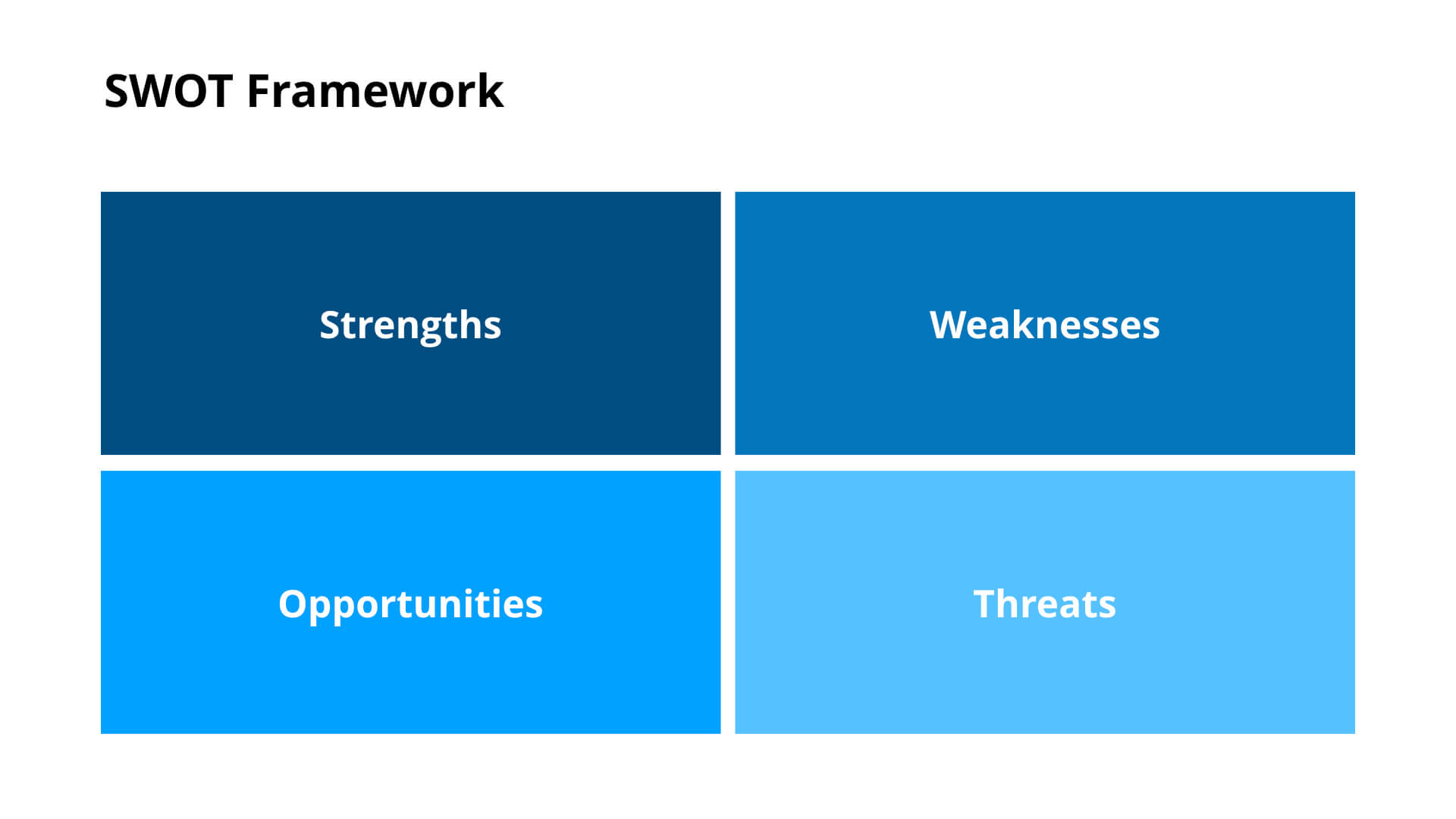
A SWOT framework assesses a company's strategic position. SWOT stands for strengths, weaknesses, opportunities, and threats.
- Strengths: what the company does well and what sets it apart
- Weaknesses: what the company does poorly and what competitors do better
- Opportunities: where the company can grow or improve
- Threats: the biggest competitive risks and market dangers
Strengths and weaknesses are internal. Opportunities and threats are external.
What Is the 4 Ps Framework?
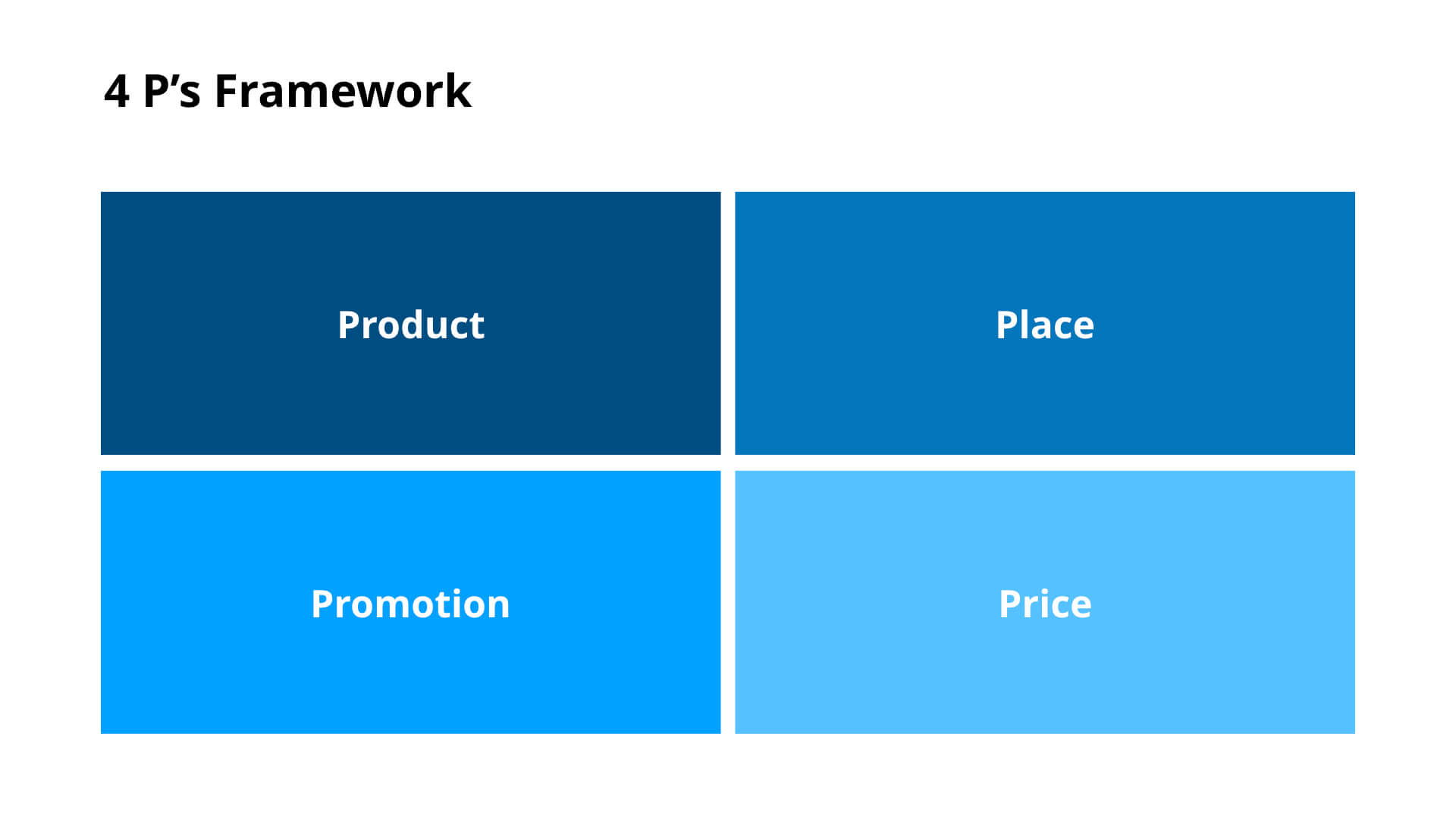
The 4 Ps framework builds a marketing strategy for a product. The four Ps are product, place, promotion, and price.
- Product: which product to market, based on its benefits and points of difference
- Place: where to sell it, based on how your customers like to buy
- Promotion: how to spread the word, based on where your customers consume media
- Price: how to price it, based on costs, competitor prices, and customer value
Price too high and you lose sales above your customers' willingness to pay. Price too low and you give up profit and can even signal low quality.
What Is the 3 Cs Framework?
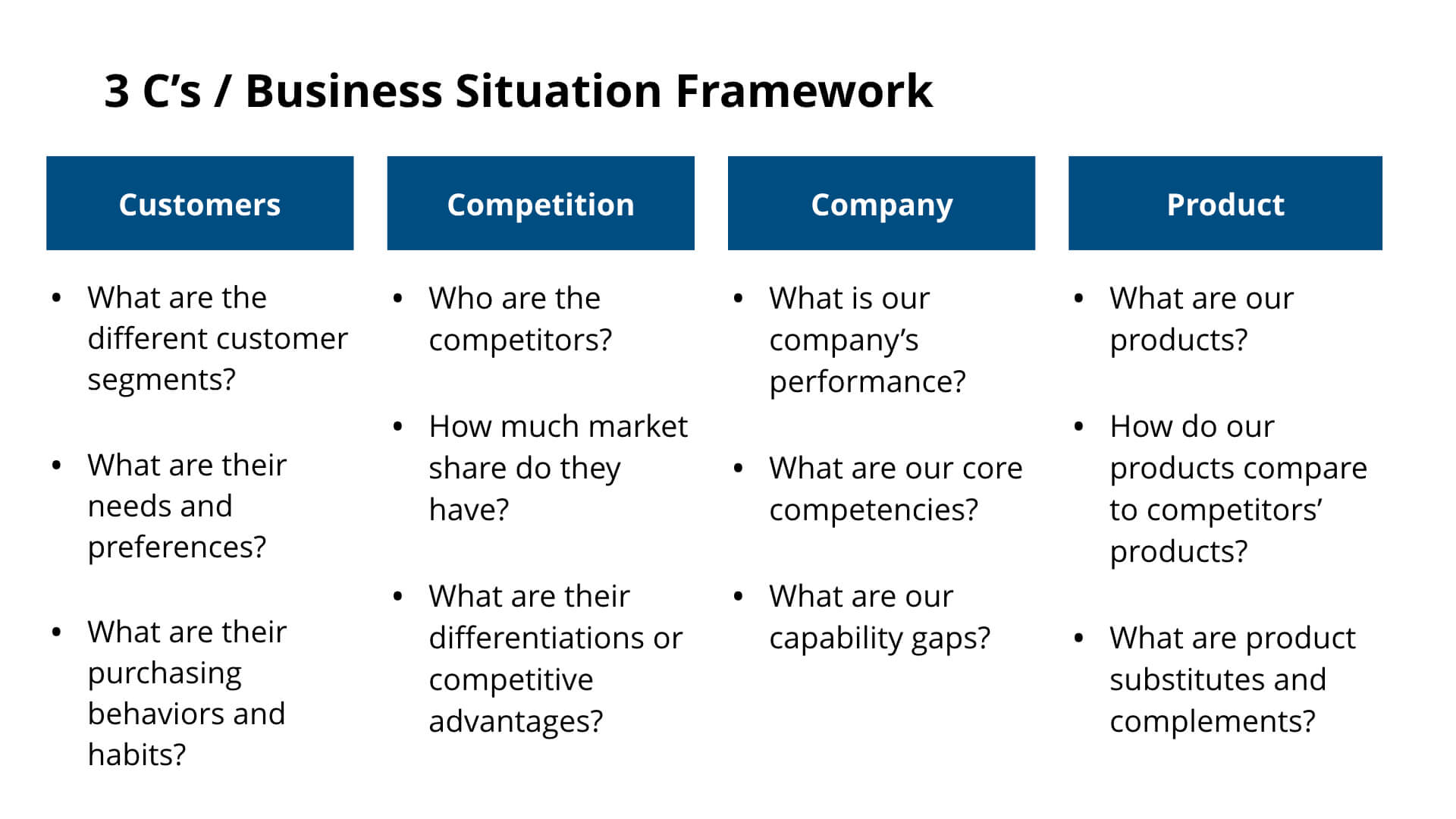
The 3 Cs framework builds a business strategy. The three Cs are customers, competition, and company.
A former McKinsey consultant added a fourth component, product, creating the business situation framework. Both are used for situations like market entry, new product launches, and acquisitions.
A related framework, the 4C framework, expands the 3 Cs into customer, competition, capabilities, and cost.
What Is the BCG 2x2 Matrix?
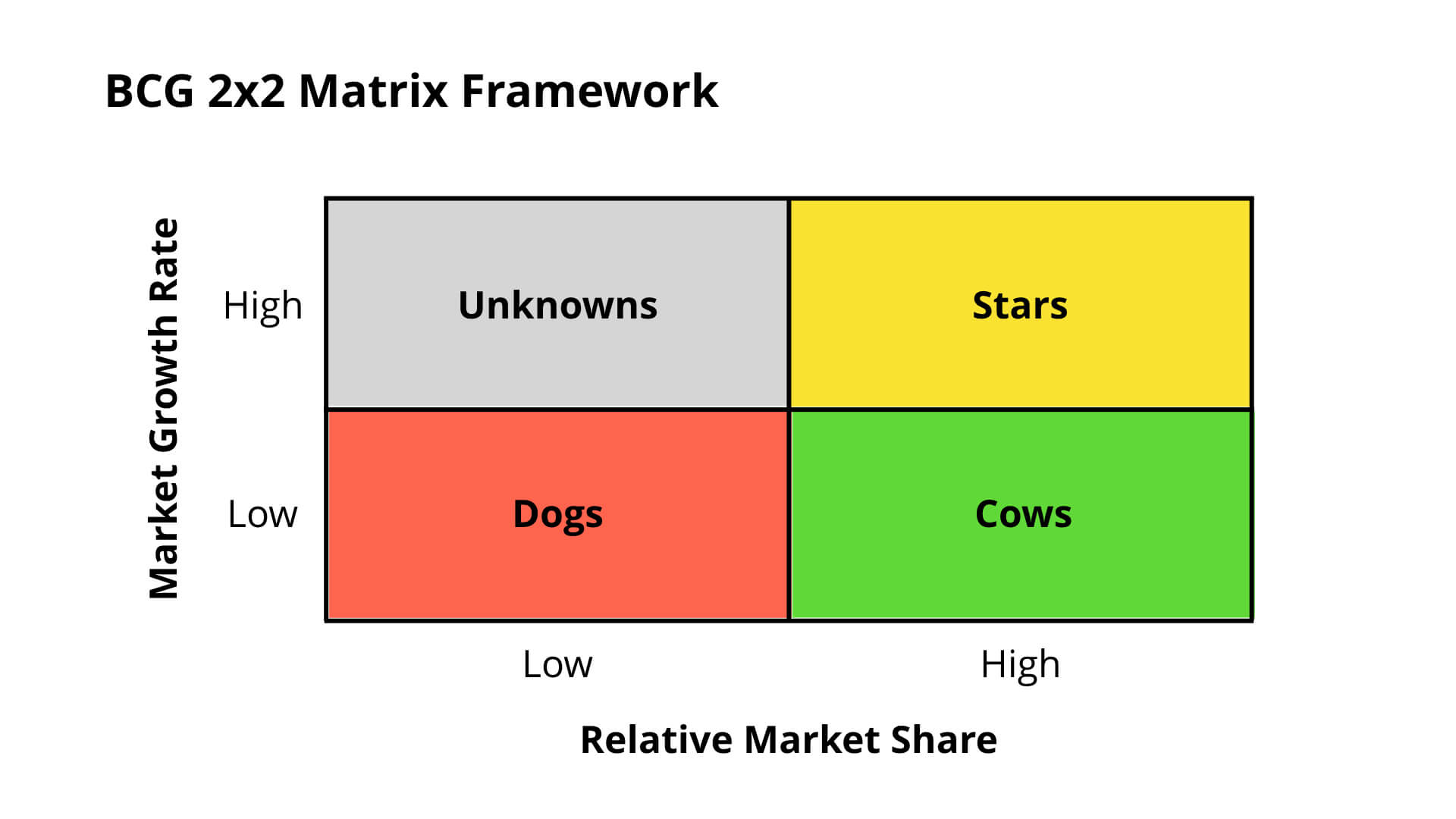
The BCG 2x2 Matrix, created by BCG founder Bruce Henderson, helps a company decide which of its businesses to invest in. It uses two dimensions:
- Market growth: how fast the market is growing
- Relative market share: how much share the business has versus competitors
Plotting each business on these two dimensions creates four quadrants:
- Stars: high growth and high share. Invest heavily so they keep growing.
- Cash cows: low growth but high share. Maintain them as stable, profitable businesses.
- Dogs: low growth and low share. Avoid investing and consider divesting.
- Question marks: high growth but low share. With investment they can become stars, or they can fade into dogs.
What Is the McKinsey 7S Framework?
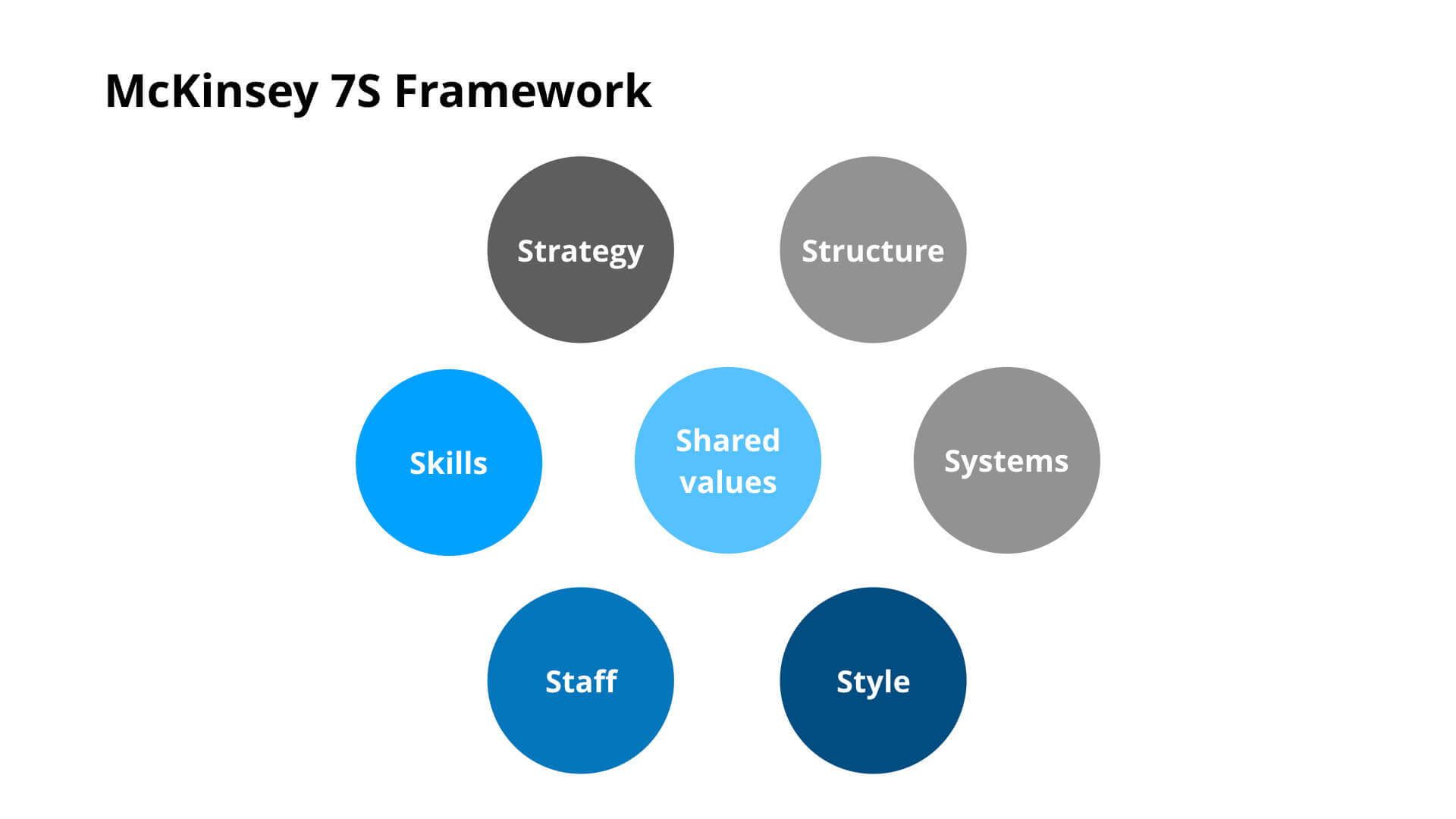
The McKinsey 7S Framework, created by former McKinsey consultants Tom Peters and Robert Waterman, names seven elements a company must align to succeed:
- Strategy: the plan to grow and outcompete rivals
- Structure: how the company is organized
- Systems: the company's daily activities and processes
- Shared values: the core beliefs and mission
- Style: the leadership and management approach
- Staff: the people the company hires
- Skills: what those people can do
How Do You Present Your Framework in a Case Interview?
Building a great framework is only half the job. You also have to present it clearly. Ask for a short pause to think, sketch your structure on paper, then walk the interviewer through it from the top down.
Follow these steps to present your framework like a consultant:
Step 1: Ask for time to think. When you get the case, ask the interviewer for a moment to gather your thoughts. This is expected, and they will almost always say yes. Take 30 to 60 seconds, no more, and sketch your framework on paper.
Step 2: Start with an overview. Before the details, give a one-sentence overview of your structure. Tell the interviewer the buckets you plan to cover and the order you will walk through them, so they know what to expect.
Step 3: Walk through each bucket. Go through each bucket in order and name 3 to 5 specific things you want to investigate under it. This shows depth without turning into a random list.
Step 4: Turn your paper toward the interviewer. Spin your paper around so the interviewer can follow your structure. A clean visual makes your thinking much easier to understand.
Step 5: Summarize and prioritize. After walking through the full framework, state which bucket you want to start with and why. Leading with a hypothesis here signals strong, structured thinking.
An issue tree is the cleanest way to draw this structure on paper, with the main question on the left and the buckets branching to the right.
What Are the Most Common Case Interview Framework Mistakes?
The most common framework mistakes are announcing the framework by name, forcing a memorized template onto the case, listing too many factors, and freezing after a small error. Avoiding these puts you ahead of most candidates.
Mistake 1: Announcing your framework. Saying 'I am going to use the 4 Cs' tells the interviewer you are reaching for a template instead of thinking. Build a custom structure and walk through it without naming a textbook framework.
Mistake 2: Forcing a framework that does not fit. If you have a profitability case and start reciting Porter's Five Forces, you will lose the interviewer fast. Match the structure to the actual problem.
Mistake 3: Going too broad. You do not get credit for listing every possible factor. You get credit for finding the few that matter most and explaining why. Three sharp causes beat fifteen shallow ones.
Mistake 4: Building a structure that is not MECE. If your buckets overlap or leave gaps, your whole analysis has holes. Check the top layer of your framework for overlaps and missing areas before you start.
Mistake 5: Freezing after a mistake. Every candidate makes small errors. Interviewers care more about how you recover than whether you slip. Correct your course and keep going.
If you want feedback on where your frameworks fall short, my case interview coaching pairs you with a former MBB interviewer for live practice.
Frequently Asked Questions
How many case interview frameworks should I memorize?
You should not memorize a framework for every case type. Instead, understand 6 to 8 core frameworks well enough to adapt and combine them. Depth beats breadth, and interviewers reward candidates who build a custom structure over those who recite a template.
What is the most important case interview framework?
The profitability framework is the single most useful one because profitability cases make up roughly 30% to 40% of first-round cases. Profit equals revenue minus costs, and almost every business question traces back to that equation. Master it first, then learn market entry and market sizing.
How long should it take to build a framework?
Aim to build your framework in 30 to 60 seconds of quiet thinking, then take about a minute to present it. In a typical 30-minute case you will only have time to investigate three or four buckets, so prioritize the areas most likely to hold the answer.
Are case interview frameworks the same as issue trees?
They are closely related. A framework is the set of buckets you use to analyze a problem, and an issue tree is the diagram that organizes those buckets and their sub-questions. When you build a framework on paper, you are essentially drawing an issue tree.
Do McKinsey, BCG, and Bain accept memorized frameworks?
No. Interviewers at all three firms report that applying a generic framework without adapting it is one of the top reasons candidates fail. They want to see you build a structure that fits the specific case, not recite one from a book.
Can I combine multiple frameworks in one case?
Yes, and strong candidates do this often. A market entry case might pull the market attractiveness lens from Porter's Five Forces, the capability lens from the 3 Cs, and the math from a profitability framework. Combining frameworks into a custom structure is exactly the skill interviewers look for.
What is the best way to practice building frameworks?
Practice with real case prompts and build a custom structure for each one, rather than rereading framework lists. Set a timer, sketch your framework in under a minute, then check whether your buckets are MECE and relevant. After 20 to 30 reps, building a strong framework on the spot becomes natural.
Everything You Need to Land a Consulting Offer
Need help passing your interviews?
-
Case Interview Course: Become a top 10% case interview candidate in 7 days while saving yourself 100+ hours
-
Fit Interview Course: Master 98% of consulting fit interview questions in a few hours
- Interview Coaching: Accelerate your prep with 1-on-1 coaching with Taylor Warfield, former Bain interviewer and best-selling author
Need help landing interviews?
- Resume Review & Editing: Craft the perfect resume with unlimited revisions and 24-hour turnaround
Need help with everything?
- Consulting Offer Program: Go from zero to offer-ready with a complete system
Not sure where to start?
- Free 40-Minute Training: Triple your chances of landing consulting interviews and 8x your chances of passing them