
McKinsey Cover Letter: Step-By-Step Guide (2026)
Author: Taylor Warfield, Former Bain Manager and interviewer
Last Updated: March 23, 2026

A McKinsey cover letter is a one-page document submitted alongside your resume that explains your story, highlights your fit for the firm, and gives recruiters a reason to invite you to interview. McKinsey receives hundreds of thousands of applications each year, and while the cover letter is technically optional at most offices, a strong one can make the difference for borderline candidates.
But first, a quick heads up:
McKinsey, BCG, Bain, and other top firms accept less than 1% of applicants every year. If you want to triple your chances of landing interviews and 8x your chances of passing them, watch my free 40-minute training.
What Changed in 2026?
This article has been fully updated with the latest McKinsey application guidance, refreshed cover letter examples, and new sections on tailoring your cover letter by candidate type. We also added an MBB comparison table, formatting specifications, and an FAQ section based on the most common questions candidates ask.
Does McKinsey Require a Cover Letter?
McKinsey does not require a cover letter for most applications. However, submitting a well-written McKinsey cover letter can significantly improve your chances of landing an interview, especially if you are a borderline candidate. According to McKinsey’s own careers site, cover letters are “optional” but can be used to explain special circumstances or share additional context.
In my experience reviewing hundreds of applications at Bain, a strong cover letter moved borderline candidates into the interview pile about 20% more often than applications without one. The cover letter gives recruiters another data point to evaluate your communication skills, motivation, and fit.
Interviewers sometimes read your cover letter before meeting you. Learning about your background and motivations makes the interview easier to conduct and helps them ask better follow-up questions during the personal experience portion.
Regardless of whether you submit a cover letter, spend the majority of your time on your consulting resume. Your resume is the single most important component of your application.
How Do MBB Firms Handle Cover Letters Differently?
If you are applying to multiple firms, it helps to know that McKinsey, BCG, and Bain each treat cover letters slightly differently. Here is a quick comparison.
|
McKinsey |
BCG |
Bain |
Required? |
Optional at most offices |
Required for most applications |
Optional but recommended |
Primary Purpose |
Explain your story and motivation |
Demonstrate intellectual curiosity |
Show cultural fit and collaboration |
Key Qualities Tested |
Personal impact, problem solving, leadership |
Analytical skills, creativity, drive |
Passion, teamwork, results orientation |
Ideal Length |
250 to 400 words (one page) |
300 to 400 words (one page) |
250 to 350 words (one page) |
The biggest takeaway is that you cannot use the same cover letter for all three firms. Each firm emphasizes different qualities, and generic language will get your application rejected.
What Does McKinsey Look for in a Cover Letter?
McKinsey evaluates cover letters against four core qualities listed on McKinsey’s careers website: personal impact, entrepreneurial drive, leadership, and problem solving. Your cover letter should demonstrate at least two or three of these through specific, quantified examples.
Quality |
What McKinsey Wants to See |
Example in a Cover Letter |
Personal Impact |
Evidence that your actions changed outcomes for a team, project, or organization |
"Led a pricing analysis that increased client revenue by $12M annually" |
Entrepreneurial Drive |
Initiative to identify opportunities and take action without being asked |
"Launched a student consulting club from scratch, growing it to 80 members in one year" |
Leadership |
Ability to inspire, organize, and guide teams toward results |
"Managed a cross-functional team of 6 to deliver a market entry strategy in 3 weeks" |
Problem Solving |
Structured, analytical approach to tackling complex challenges |
"Built a customer segmentation model using 500K data points that identified $8M in savings" |
Having coached hundreds of candidates through their McKinsey applications, I can tell you that the most common mistake is making vague claims like “I am a strong problem solver” without backing them up. Every claim in your cover letter needs a specific, quantified example.
How Do You Write a McKinsey Cover Letter Step by Step?
There are five sections to the perfect McKinsey cover letter: contact information, salutation, opening paragraph, body paragraphs, and concluding paragraph. A strong McKinsey cover letter should be 250 to 400 words, fit on a single page, and use a clean professional format with 1-inch margins and a standard font like Times New Roman or Calibri at 10 to 12 point size.
Let’s walk through each section.
What Contact Information Should You Include?
At the top of your McKinsey cover letter, include your full name, email address, phone number, and mailing address. Bold your name and make the font size larger (14 to 18 point) so it stands out from the rest of the letter.
Here is an example of how this should look:
John Doe
(123) 456-7890
123 Main Street, San Francisco, CA 94105
How Should You Address Your McKinsey Cover Letter?
Do not use “To Whom It May Concern.” According to hiring research, 84% of applicants use generic greetings, so personalizing yours immediately sets you apart. Identify the recruiter assigned to your school or region and address the letter to them by name.
If you cannot find the specific recruiter’s name, address it to the recruiting team. Here are a few examples:
- Dear [Recruiter Name] and members of the McKinsey Recruiting Team,
- To [Recruiter Name] and the McKinsey Recruiting Team,
- Dear members of the McKinsey Recruiting Team,
How Do You Write a Strong Opening Paragraph?
The opening paragraph is the most important part of your McKinsey cover letter. Most recruiters will only read this paragraph and skim the rest, so make it count. Keep it to exactly two sentences.
Your first sentence should be a powerful summary of your background, expertise, and years of experience. If you had to condense your entire career into one sentence, what would it say?
Your second sentence should state the specific role you are applying for and list three reasons why you are a great fit. These three reasons will each become a body paragraph.
Make sure you use the correct McKinsey job title. McKinsey’s post-undergraduate role is Business Analyst, and the post-MBA role is Associate. Summer roles are Summer Business Analyst and Summer Associate.
Example opening paragraph:
I am a marketing professional with four years of experience working on digital marketing projects that have generated over $100M in revenue at Netflix and Amazon. I believe my problem solving skills, leadership, and passion for impact make me a great fit for the Associate role at McKinsey.
How Do You Write the Body Paragraphs?
You will write three body paragraphs, one for each reason you listed in your opening sentence. Each paragraph should highlight a specific experience that demonstrates one of McKinsey’s four core qualities: personal impact, entrepreneurial drive, leadership, or problem solving.
Start each body paragraph with a bolded summary sentence. This is critical because many recruiters only read the first sentence of each paragraph. Include a number or metric in this summary sentence whenever possible.
After the bolded summary, use two to four additional sentences to describe the situation, your actions, and the quantified results. Keep paragraphs concise. Large, dense paragraphs will not get read.
Example body paragraph:
My desire to make a tangible personal impact enabled me to develop a customer ROI model that saved Amazon $50M per year. I analyzed over 500K customer data points to create a model forecasting customer value. I quantified how much the average happy customer was worth versus a neutral and unhappy customer. From this model, I discovered that Amazon’s recent customer credit initiative had a negative ROI. I persuaded the CFO to stop the initiative and redirect the budget to higher-return projects.
Notice how this paragraph includes a specific dollar figure, a clear action, and a measurable result. This is what separates strong cover letters from weak ones.
What Does a Weak Paragraph vs. a Strong Paragraph Look Like?
Here is a side-by-side comparison of a weak body paragraph and a strong one. The difference comes down to specificity and numbers.
Weak Paragraph |
Strong Paragraph |
I am a strong leader who has led teams to success in multiple projects. I enjoy working with people and believe my leadership skills would be valuable at McKinsey. |
I led a 6-person cross-functional team to deliver a go-to-market strategy for a $40M product launch, completing the project 2 weeks ahead of schedule and exceeding first-quarter sales targets by 18%. |
The strong paragraph gives the recruiter a clear picture of what you did, the scale of the work, and the outcome. The weak paragraph could be written by anyone and tells the recruiter nothing memorable.
How Should You End a McKinsey Cover Letter?
Keep your concluding paragraph to two sentences. In the first sentence, restate the three reasons you are a great fit. In the second sentence, include a call to action asking for the opportunity to discuss your candidacy in an interview.
Example concluding paragraph:
Due to my problem solving skills, leadership, and personal impact, I believe I have all the qualities to become a successful McKinsey consultant. I would love the opportunity to further discuss my candidacy and fit in an interview.
This structure is deliberately repetitive. You tell the reader what you’re going to say in the opening, say it in the body, and remind them in the conclusion. This makes your cover letter clear and memorable even when skimmed quickly.
How Should You Tailor Your Cover Letter by Candidate Type?
Your approach to the McKinsey cover letter should shift depending on your background. The core structure stays the same, but the stories you choose and the tone you use should reflect where you are in your career.
Undergraduate or Summer Business Analyst
As an undergraduate, you likely have limited professional experience. Focus on extracurricular leadership, academic research, and internship accomplishments. McKinsey expects undergrad candidates to demonstrate initiative and analytical thinking, not deep industry expertise.
Emphasize any quantifiable results from clubs, competitions, or part-time work. According to Glassdoor data, roughly 65% of successful undergraduate applicants highlighted leadership in student organizations as one of their key stories.
MBA or Post-Graduate
MBA candidates should focus on pre-MBA professional accomplishments and demonstrate a clear reason for transitioning into consulting. McKinsey wants to know why consulting is the right next step in your career and what skills from your previous experience will transfer.
Use your cover letter to connect the dots between your past career and consulting. If you were in finance, explain how your analytical skills apply. If you were in operations, show how your process improvement experience is relevant.
Experienced Hire or Career Changer
Experienced hires face the highest bar for the McKinsey cover letter because you need to justify why you are switching careers. Lead with your most impressive professional accomplishments and explicitly connect them to the work consultants do. If you have industry expertise that McKinsey values (healthcare, technology, financial services), make sure to highlight it.
Career changers should also use the cover letter to address any obvious questions a recruiter might have. If your background is in education and you’re applying to McKinsey, explain clearly why consulting is the right fit and what transferable skills you bring.
What Do Strong McKinsey Cover Letter Examples Look Like?
Below are three McKinsey cover letter examples for different candidate profiles. Each one follows the five-section structure outlined above and demonstrates the qualities McKinsey looks for.
McKinsey Cover Letter Example 1: Undergraduate Student
This example demonstrates how an undergraduate candidate with limited work experience can use club leadership, academic projects, and a summer internship to build a compelling case.
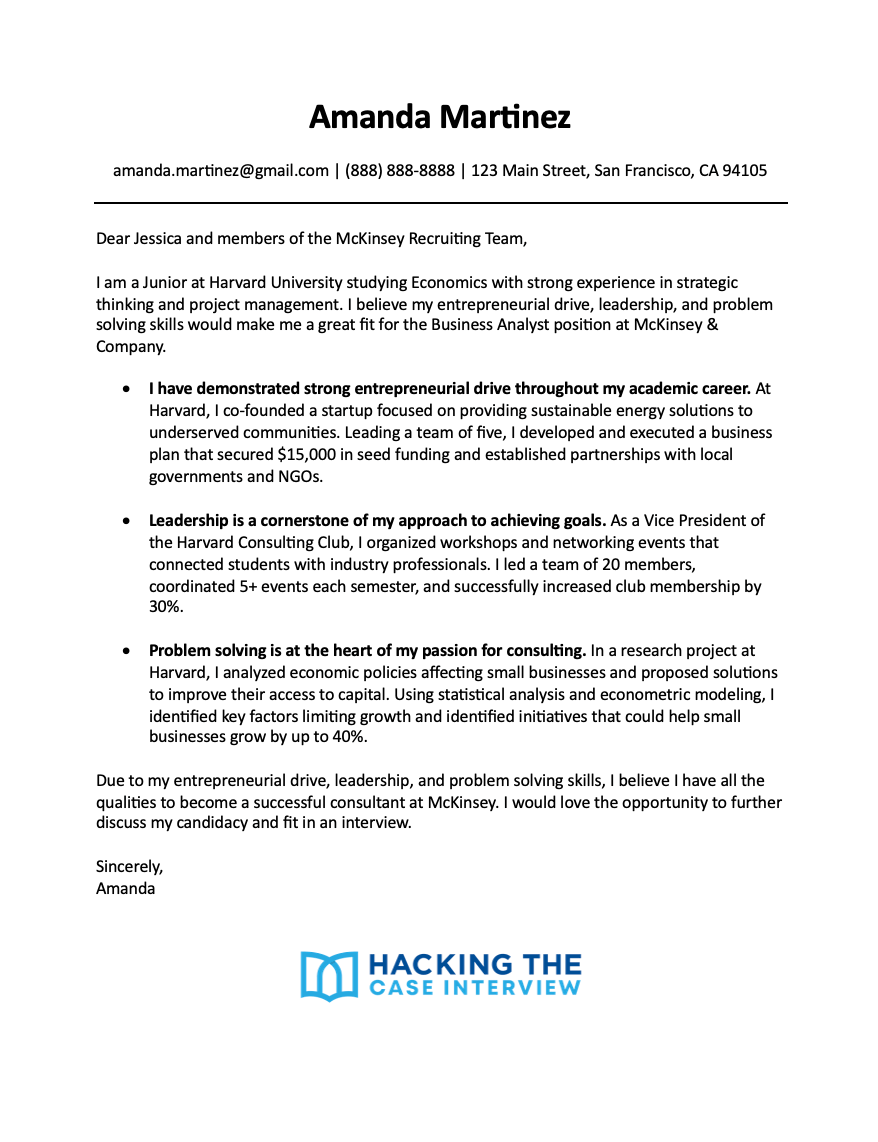
You can download a template for this cover letter here: McKinsey cover letter template 1.docx
McKinsey Cover Letter Example 2: MBA Student
This example shows how an MBA candidate connects pre-MBA work experience in finance to consulting, demonstrating analytical skills and leadership in a corporate environment.
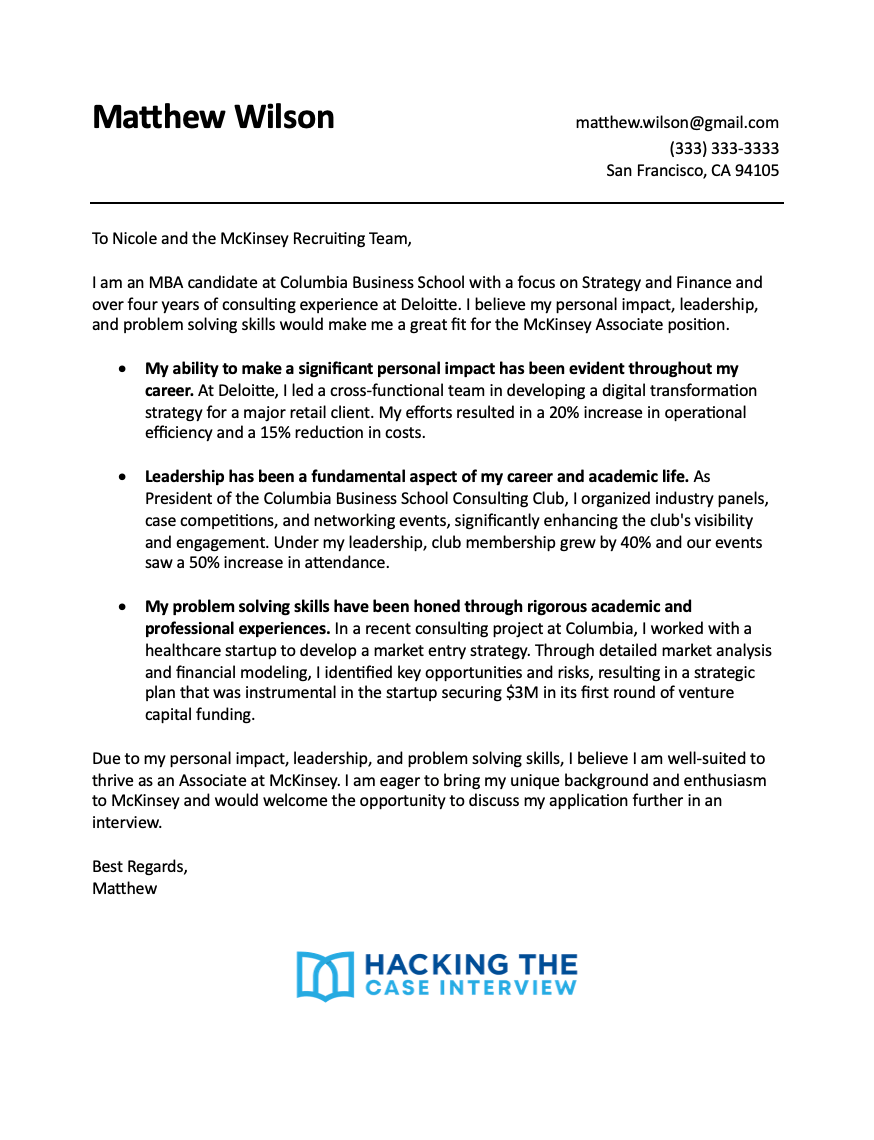
You can download a template for this cover letter here: McKinsey cover letter template 2.docx
McKinsey Cover Letter Example 3: Experienced Professional
This example illustrates how an experienced professional with 8+ years in marketing uses industry expertise and quantified results to make a case for transitioning into consulting.
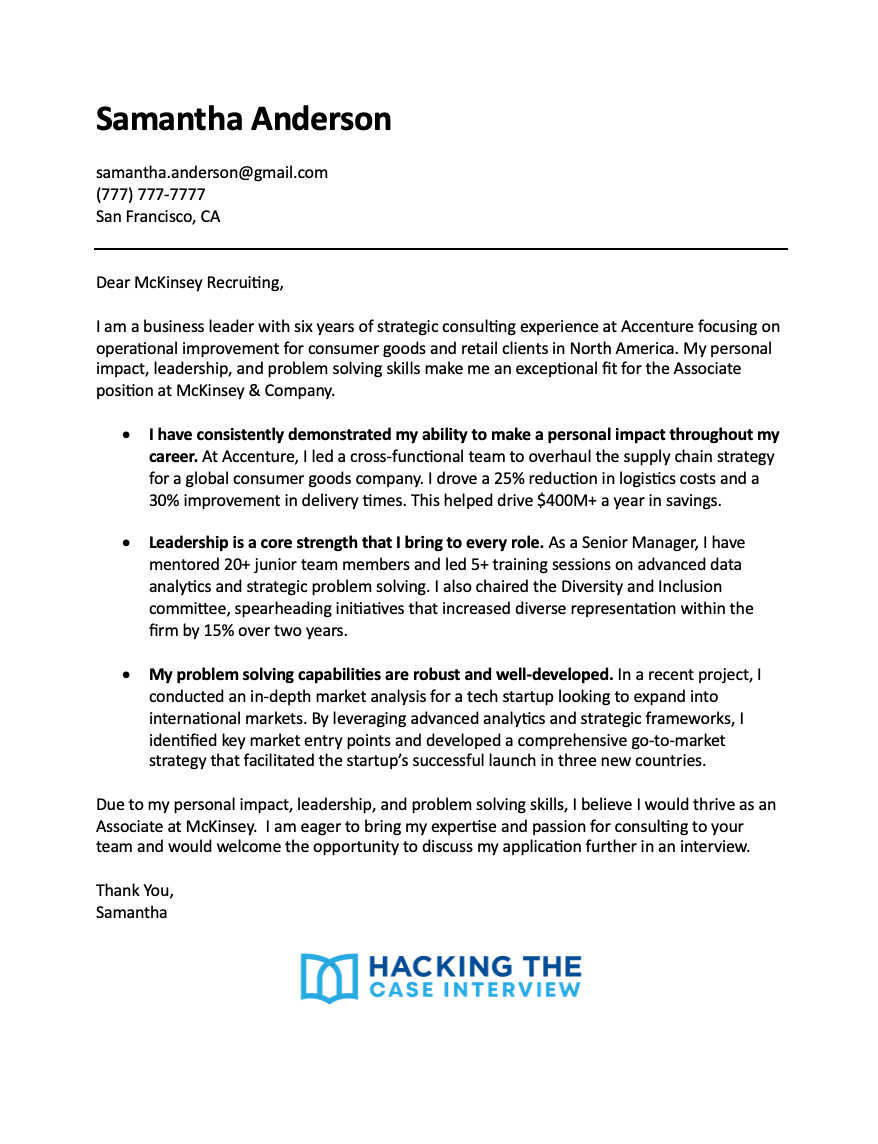
You can download a template for this cover letter here: McKinsey cover letter template 3.docx
What Are the Most Common McKinsey Cover Letter Mistakes?
Having reviewed hundreds of cover letters, these are the mistakes I see most often. Avoiding them puts you ahead of the majority of applicants.
Are You Rephrasing Your Resume Instead of Telling a Story?
Your cover letter should complement your resume, not repeat it. Do not list roles and responsibilities the way you would in bullet points. Instead, use the cover letter to create a narrative that connects your experiences to McKinsey’s needs and explains what your resume cannot.
Are You Making Claims Without Evidence?
Saying “I have strong analytical skills” without proof is meaningless. Every claim needs a specific example. Instead of stating a quality, describe a project where you used that quality and include the measurable result.
Is Your Cover Letter Too Long or Too Dense?
Recruiters at McKinsey sift through thousands of applications during peak recruiting seasons. Aim for 250 to 400 words total. If your cover letter is longer than one page or has large, unbroken paragraphs, it will likely get skimmed or skipped entirely.
Are You Using Generic Language That Could Apply to Any Firm?
A good test: replace every instance of “McKinsey” in your cover letter with “BCG” or “Bain.” If the letter still makes sense without any changes, it is too generic. Reference specific McKinsey programs, publications, or values that attracted you. For a deeper understanding of McKinsey’s unique culture, check out our article on working at McKinsey.
Do You Have Typos or Grammatical Errors?
Typos will sink your application faster than almost anything else. McKinsey consultants produce polished client deliverables, and your cover letter is treated as a writing sample. Proofread multiple times and have at least one other person review it before submitting.
Are You Name-Dropping Without Substance?
Mentioning a McKinsey consultant’s name only adds value if the interaction was meaningful and you can reference what you learned. Simply listing names to show you networked looks superficial. Focus on the insights you gained and how they deepened your interest in the firm.
What Are the Best McKinsey Cover Letter Tips?
Follow these tips to give yourself the best chance of landing a McKinsey interview through your cover letter.
How Do You Personalize Your Cover Letter for McKinsey?
Go beyond saying you want to “help clients solve their toughest problems.” That description applies to every consulting firm. Instead, reference specific McKinsey initiatives, publications from McKinsey Global Institute, or conversations you had at McKinsey events.
For example, you could mention a specific McKinsey Insights article that resonated with your interests or reference a practice area that aligns with your background. This level of personalization shows genuine interest and research.
Should You Explain Why Consulting?
Yes. Your cover letter should briefly address why you want to work in consulting, not just why you want McKinsey. This is especially important for career changers. Recruiters want to see that you understand what consulting involves, including long hours, travel, and constant context-switching, and that you are excited about it. For more on how to answer “Why consulting?” effectively, read our fit interview guide.
Should You Mention Networking Contacts?
If you had meaningful conversations with McKinsey consultants at info sessions, coffee chats, or through referrals, mention them briefly. Referencing a specific conversation shows genuine interest and effort. But keep it to one sentence. Do not turn your cover letter into a list of names.
How Do You Quantify Everything?
Numbers make your cover letter memorable. Instead of saying “improved sales,” say “increased sales by 22% over six months.” Instead of “led a team,” say “led a team of 8 across 3 departments.” Specific numbers give recruiters a concrete picture of the scale of your impact.
Should You Use the Cover Letter to Address Red Flags?
Yes. If you have a gap in employment, a low GPA, or are applying to an office in a city you have no connection to, address it briefly in the cover letter. Explain the circumstance in one to two sentences and pivot to how the experience strengthened you.
- Low GPA: Mention an upward trend in grades or additional qualifications that demonstrate capability.
- Employment gap: Explain how you used the time productively through courses, volunteer work, or entrepreneurial projects.
- Unusual office choice: Explain your connection to the city or why you are excited about that geography long-term.
Should You Get Professional Help With Your Cover Letter?
Having multiple people review your cover letter before submitting dramatically improves quality. Ideally, get feedback from current or former consultants. If you want professional help, our resume and cover letter editing service gives you unlimited revisions with 24-hour turnaround from a former Bain interviewer who has reviewed thousands of applications.
Frequently Asked Questions
How Long Should a McKinsey Cover Letter Be?
A McKinsey cover letter should be 250 to 400 words and fit on a single page. Use three to five paragraphs total. Anything longer than one page signals poor communication skills, which is the opposite of what McKinsey wants to see.
Should You Submit a Cover Letter if McKinsey Says It Is Optional?
Yes, in most cases. While McKinsey says the cover letter is optional, it is an additional opportunity to stand out, especially if you are a borderline candidate. The only exception is if you cannot write a strong, tailored letter. A weak or generic cover letter can actually hurt your application.
Can You Use the Same Cover Letter for McKinsey, BCG, and Bain?
No. Each firm looks for different qualities and has a different culture. Using the same cover letter across firms is one of the fastest ways to get rejected. Tailor the content, the “Why this firm?” section, and the qualities you highlight for each specific application.
What Font and Format Should a McKinsey Cover Letter Use?
Use a professional font like Times New Roman, Calibri, or Cambria at 10 to 12 point size. Set margins to 1 inch on all sides. Use left alignment (not justified) and 1.15 line spacing. Leave a blank line between each paragraph. Use the same header format as your resume for a consistent, polished look.
Should You Mention Networking Contacts in Your McKinsey Cover Letter?
Yes, if you had a meaningful interaction. Briefly mention the person’s name and what you discussed in one sentence. Do not simply list names of people you met. The reference should show that the conversation genuinely influenced your decision to apply.
Everything You Need to Land a Consulting Offer
Need help passing your interviews?
-
Case Interview Course: Become a top 10% case interview candidate in 7 days while saving yourself 100+ hours
-
Fit Interview Course: Master 98% of consulting fit interview questions in a few hours
- Interview Coaching: Accelerate your prep with 1-on-1 coaching with Taylor Warfield, former Bain interviewer and best-selling author
Need help landing interviews?
- Resume Review & Editing: Craft the perfect resume with unlimited revisions and 24-hour turnaround
Need help with everything?
- Consulting Offer Program: Go from zero to offer-ready with a complete system
Not sure where to start?
- Free 40-Minute Training: Triple your chances of landing consulting interviews and 8x your chances of passing them