
McKinsey Resume Format: Step-by-Step Guide
Author: Taylor Warfield, Former Bain Manager and interviewer
Last Updated: May 2, 2026
McKinsey resume format follows a strict one-page, reverse chronological layout with 0.5-inch margins, a standard font like Times New Roman or Arial at size 10, and quantified bullet points under each experience. Getting this format right is the first step toward landing a McKinsey interview because recruiters spend less than 60 seconds scanning each resume.
McKinsey receives roughly 200,000 applications every year, according to internal recruiting data shared on their careers blog. That means at least 60% of candidates get eliminated at the resume screening stage before they ever reach an interview. Your resume has to pass both an Applicant Tracking System (ATS) scan and a human reviewer in under a minute.
In this guide, I will walk you through the exact McKinsey resume format, section by section. You will learn what McKinsey reviewers actually look for, how to write bullet points that stand out, and common formatting mistakes that get resumes tossed. Everything here comes from my experience reviewing thousands of resumes at Bain and coaching hundreds of candidates through the application process.
But first, a quick heads up:
McKinsey, BCG, Bain, and other top firms accept less than 1% of applicants every year. If you want to triple your chances of landing interviews and 8x your chances of passing them, watch my free 40-minute training.
What Is the McKinsey Resume Format?
The McKinsey resume format is a clean, one-page document with five sections listed in a specific order: contact information, professional experience, extracurricular activities (for undergrads), education, and additional information. McKinsey expects reverse chronological order, consistent formatting, and zero visual distractions like colors, graphics, or multiple columns.
This format is nearly identical to what BCG and Bain expect, which means one well-crafted consulting resume can work across all three firms with minor adjustments. The key difference with McKinsey is their emphasis on leadership, entrepreneurial drive, and deep expertise in a specific area.
Here are the core formatting specifications at a glance:
Element |
McKinsey Requirement |
Page length |
Strictly one page (no exceptions unless 15+ years of experience) |
Margins |
0.5 to 1.0 inches on all sides |
Font |
Times New Roman, Arial, or Calibri |
Font size |
10pt for body text, 14 to 18pt for your name |
Layout |
Reverse chronological order |
File format |
Submit as PDF (not Word) |
Bullet points |
Every bullet starts with a past-tense action verb |
Quantification |
Every bullet includes a number or metric |
Design |
No colors, graphics, photos, or creative layouts |
What Does McKinsey Look for in a Resume?
McKinsey evaluates resumes across ten qualities. The first four are common across all top consulting firms, while the remaining six are specific to McKinsey. According to McKinsey's own careers blog, their recruiters screen for the following:
- Intelligence: High GPAs, test scores, and academic honors that demonstrate analytical ability
- High pedigree: Brand-name schools and employers that signal you are a high achiever
- Track record of success: Promotions, project completions, and measurable impact in every role
- Relevant skills: Both hard skills (data analysis, modeling) and soft skills (leadership, communication)
- Personal impact: Ability to influence and inspire others through your actions and presence
- Entrepreneurial drive: Initiative-taking, creative problem solving, and willingness to build something new
- Inclusive leadership: Fostering environments where diverse team members contribute and thrive
- Courageous change: Willingness to challenge the status quo and lead through uncertainty
- Problem solving: Analytical skills and a track record of solving complex, ambiguous problems
- Expertise: Deep knowledge in a specific industry, function, or domain
You do not need a business degree to get a McKinsey interview. McKinsey believes they can teach business skills on the job, so they hire from virtually every academic background. What matters is demonstrating these ten qualities through your resume.
How Should You Structure a McKinsey Resume?
A McKinsey resume has five sections, presented in a specific order. The order matters because recruiters scan top to bottom, and McKinsey values professional experience most. According to Glassdoor data, the average McKinsey recruiter reviews each resume in 30 to 60 seconds, so your most impressive content needs to appear first.
What Goes in the Contact Information Section?
Your contact information sits at the very top in one to two lines. Include your full name in a larger font (14 to 18pt), followed by your email, phone number, and city or state. You can also include your LinkedIn profile URL.
Do not include a photo, date of birth, gender, nationality, or full mailing address. McKinsey operates globally and follows anti-discrimination hiring practices, so personal demographics have no place on your resume. Keep this section to two lines maximum to save space for your experience.
How Should You Write the Professional Experience Section?
Professional experience is the most important section of your McKinsey resume. It should come immediately after your contact information, before education. List your jobs in reverse chronological order, starting with your most recent role.
Follow these rules for this section:
- Allocate space proportional to tenure. If you worked somewhere for three years and another place for one year, give the three-year job roughly three times the space.
- Give each job at least two bullet points. Two is the minimum needed to show depth.
- List the most impressive bullet first under each job. Reviewers often only read the first one or two bullets.
- Start every bullet with a different past-tense action verb. This shows variety in your skills.
- Include a number or metric in every single bullet. Consultants think in numbers, and quantified impact is what separates strong resumes from generic ones.
- Balance quantitative accomplishments (analyzed data, built models) with qualitative accomplishments (led teams, managed stakeholders). McKinsey wants both analytical thinkers and people leaders.
- Keep language simple and jargon-free. A reviewer from any background should understand every word on your resume.
If you have worked at a prestigious company like Goldman Sachs, Google, or a well-known startup, allocate extra space to that role. Brand recognition carries weight in consulting recruiting because it makes it easier for partners to sell your background to clients.
What Makes a Strong Extracurricular Activities Section?
This section is primarily for undergraduate students and recent graduates with limited work experience. If you have substantial professional experience (5+ years), keep this section very short or omit it entirely to free up space for your work history.
Unlike the experience section, you can order extracurriculars by impressiveness rather than chronology. Put your most notable achievement first. McKinsey specifically values activities that show entrepreneurial drive, such as founding a club, launching an initiative, or creating something new.
Follow the same bullet point rules as the professional experience section. Start with action verbs, quantify impact, and balance hard and soft skill accomplishments.
What Should the Education Section Include?
Keep your education section brief to maximize space for experience. Include your school name, degree, major, and graduation date.
Include your GPA if it is 3.5 or higher on a 4.0 scale. If your GPA is below 3.5 but you have a strong major GPA (for example, 3.7 in Economics), list the major GPA instead. If both are below 3.5, leave GPA off entirely. A missing GPA is better than a low one, since it avoids triggering an immediate negative reaction.
For test scores, include SAT (1400+), GMAT (700+), or GRE (325+ combined) if they are strong. These add instant credibility, especially for candidates from non-target schools. According to multiple McKinsey recruiters, high test scores can partially offset a lower-ranked school.
You can add one bullet summarizing your most impressive academic accomplishments, such as Dean's List, thesis awards, or academic honors. Prioritize depth over breadth. Listing "President of Consulting Club" with impact metrics is better than listing five clubs with no context.
What Goes in the Additional Information Section?
This is the final section of your resume. Keep it to two or three lines. Organize it into categories such as Skills, Languages, Certifications, and Interests.
For skills, list technical tools relevant to consulting like SQL, Tableau, Python, or R. Do not list Excel or PowerPoint because every candidate is expected to know these. For languages, include fluency level (basic, professional, fluent, native). For interests, include specific and memorable details.
Your interests line is the only part of the resume that humanizes you. In my experience, it is also the part that interviewers remember most. Instead of writing "cooking" or "travel," write "competitive barbecue judge" or "visited 30+ countries across 6 continents." Specificity makes you memorable.
How Does a McKinsey Resume Differ by Candidate Type?
The overall format stays the same, but the emphasis shifts depending on your experience level. Here is how to adjust your McKinsey resume based on whether you are an undergraduate, MBA, or experienced professional:
Element |
Undergraduate |
MBA |
Experienced Hire (5+ years) |
Section order |
Education first, then Experience |
Experience first, then Education |
Experience first, then Education |
Experience depth |
1 to 2 roles, 2 bullets each |
2 to 3 roles, 2 to 4 bullets each |
3 to 5 roles, 2 to 4 bullets each |
Extracurriculars |
Prominent section with 3+ activities |
Brief section, 1 to 2 activities |
Omit or keep to 1 line |
GPA emphasis |
Critical if 3.5+ |
Include if 3.5+ |
Optional, include only if very high |
Test scores |
SAT 1400+ or ACT 32+ |
GMAT 700+ or GRE 325+ |
Generally omit |
Summary/objective |
Not recommended |
Not recommended |
Optional if 10+ years or career changer |
Leadership focus |
Club leadership, campus initiatives |
Pre-MBA leadership + MBA impact |
Team management, P&L ownership |
One important note for experienced hires: if you have 15 or more years of experience, a two-page resume is acceptable. For everyone else, one page is non-negotiable.
What Are the Exact Formatting Rules for a McKinsey Resume?
McKinsey is known for using any formatting inconsistency as a reason to reject a resume. Attention to detail on your resume signals the attention to detail you will bring to client work. Here are the exact specifications to follow:
- One page only. No exceptions for candidates with fewer than 15 years of experience. If your resume spills onto a second page, cut content. Do not shrink font below 10pt or margins below 0.5 inches to force a fit.
- Margins of 0.5 to 1.0 inches. 0.5 inches is the minimum. Anything smaller makes your resume look cramped and signals that you cannot prioritize content.
- Standard font at size 10. Use Times New Roman, Arial, or Calibri. Do not use decorative or uncommon fonts. Your name can be 14 to 18pt. Section headings should be 11 to 12pt bold.
- Consistent formatting throughout. If one job title is bold, every job title must be bold. If one date is right-aligned, every date must be right-aligned. Inconsistency signals carelessness.
- No colors, graphics, or photos. McKinsey resumes should be black text on a white page. Multiple columns, colored headers, icons, and charts all work against you. Clean and simple wins.
- Submit as PDF. Word documents can look different on different computers. PDF preserves your formatting exactly. Name the file with your full name and the date (for example, Taylor_Warfield_Resume_March_2026.pdf).
Many top business school programs (Wharton, Kellogg, Harvard) publish resume templates that work well for McKinsey applications. If your school provides a consulting resume template, use it as your starting point. These templates are already formatted to consulting standards.
How Do You Write Bullet Points That Impress McKinsey Reviewers?
Your bullet points are the single most important content on your resume. McKinsey reviewers spend the majority of their 30 to 60 second scan reading bullet points, especially the first bullet under your most recent role. The formula for a strong bullet is: action verb + what you did + quantified impact.
Here are five before-and-after examples showing how to transform weak bullets into McKinsey-caliber ones:
Weak Bullet |
Strong Bullet |
Analyzed survey responses to identify customer improvement areas |
Led 8-person analytics team to analyze 100K+ survey responses, identifying improvement areas worth $200M in annual revenue |
Planned annual customer service budget |
Planned $500M customer service budget, resolving conflict between customer service and product teams to identify $150M in annual savings |
Managed a team on a consulting project |
Directed a team of 6 consultants on a pricing optimization project for a Fortune 500 retailer, increasing margins by 8% ($45M annually) |
Worked on cost reduction strategies |
Developed pricing model that reduced operational costs by 12%, saving $1.5M annually across 3 business units |
Responsible for client presentations |
Created and delivered 15+ client presentations to C-suite executives, winning $3.2M in follow-on project revenue |
Notice the pattern. Every strong bullet starts with a specific action verb, describes the scope or scale of the work, and ends with a quantified result. This is exactly what McKinsey recruiters are trained to look for.
Here is a curated list of consulting-specific action verbs to use on your McKinsey resume:
- Analytical skills: Analyzed, Assessed, Calculated, Evaluated, Forecasted, Modeled, Quantified, Researched, Benchmarked
- Leadership skills: Led, Directed, Managed, Oversaw, Supervised, Spearheaded, Mentored, Coached, Recruited
- Problem solving: Resolved, Designed, Developed, Restructured, Optimized, Streamlined, Implemented, Transformed
- Communication: Presented, Communicated, Negotiated, Persuaded, Authored, Published, Facilitated, Coordinated
- Impact and results: Increased, Decreased, Generated, Delivered, Achieved, Exceeded, Improved, Accelerated, Saved
If you want to learn case interview frameworks and strategies that complement your resume preparation, my case interview course covers everything you need to know in as little as 7 days.
How Is a McKinsey Resume Different from a BCG or Bain Resume?
The core format across McKinsey, BCG, and Bain is nearly identical: one page, reverse chronological, quantified bullets, standard font. However, each firm has subtle differences in what they emphasize during resume screening. Tailoring your resume to these differences can give you an edge.
Dimension |
McKinsey |
BCG |
Bain |
Top priority |
Leadership + expertise |
Intellectual curiosity + creativity |
Collaboration + team fit |
Unique emphasis |
Entrepreneurial drive, courageous change |
Creative problem solving, diverse thinking |
Work hard/play hard culture, collaborative spirit |
Resume summary |
Not required (omit unless 10+ years) |
Not required |
Not required |
ATS usage |
Yes, keyword screening |
Yes, keyword screening |
Yes, keyword screening |
Cover letter |
Generally not required |
Optional |
Generally not required |
Interests section |
Include specific, unique interests |
Include interests showing intellectual curiosity |
Include interests showing personality and team fit |
For a deeper look at the full McKinsey interview process, including what happens after your resume gets through screening, check out our complete guide.
How Does McKinsey Screen Resumes?
McKinsey uses a two-stage screening process. First, an Applicant Tracking System (ATS) scans your resume for relevant keywords and basic qualifications. Then, a human reviewer (typically a recruiter or junior consultant) evaluates the resumes that pass the ATS filter.
According to McKinsey's careers blog, the firm receives approximately 200,000 applications annually. Given the volume, the ATS eliminates a significant portion before a human ever sees the resume. To get through this filter:
- Use a simple, single-column layout with no text boxes, graphics, tables, or images that could confuse the parser.
- Incorporate keywords from the specific McKinsey job posting you are applying to, such as "problem solving," "leadership," "analytical skills," and "strategic planning."
- Use standard section headings like "Professional Experience," "Education," and "Additional Information."
- Save as a PDF to preserve formatting while remaining ATS-readable.
Once your resume reaches a human reviewer, research suggests they focus on specific areas in a predictable pattern. The first bullet under your most recent job gets the most attention, followed by your school name, GPA, and employer names. Think of it as a heat map: the top of each section draws the most eye time, so front-load your strongest content.
Having reviewed thousands of resumes myself at Bain, I can confirm this pattern. Reviewers are scanning for red flags (formatting errors, no quantification, irrelevant content) and green flags (brand-name employers, high test scores, leadership roles with measurable impact). Your goal is to maximize green flags while eliminating all red flags.
Do You Need to Tailor Your Resume for McKinsey?
Yes, but the adjustments are modest. Since McKinsey, BCG, and Bain all look for similar core qualities, you do not need to create a completely different resume for each firm. Instead, make these targeted adjustments when applying to McKinsey specifically:
- Emphasize leadership examples more heavily. McKinsey places slightly more weight on leadership than BCG or Bain. If you have to choose between including a leadership accomplishment and an analytical one, lean toward leadership for McKinsey.
- Demonstrate expertise in something specific. McKinsey values people who are the best at something, whether that is a particular industry, a technical skill, or even an extracurricular pursuit. Make sure at least one part of your resume shows depth, not just breadth.
- Mirror the job posting language. Read the specific McKinsey posting you are applying for and work relevant keywords into your bullet points naturally. This helps with ATS screening and signals that you understand what the role requires.
- Highlight entrepreneurial initiatives. If you have founded, launched, or built something new, make sure it is prominently featured. McKinsey specifically lists entrepreneurial drive as a screening criterion.
If you are applying from a non-target school or making a career switch into consulting, tailoring becomes even more important. For career changers, consider adding a brief two-line summary at the top of your resume that frames your transition into consulting terms. For non-target candidates, prioritize high test scores and quantified impact over school pedigree.
If you want professional help tailoring your resume, my resume review and editing service gives you unlimited revisions with 24-hour turnaround from someone who has screened thousands of consulting resumes.
What Are the Most Common McKinsey Resume Mistakes?
After reviewing thousands of consulting resumes, I have seen the same mistakes come up again and again. Avoiding these will immediately put your resume ahead of most candidates:
- Going over one page. This is the most common and most damaging mistake. A two-page resume signals that you cannot prioritize, which is a core consulting skill. Cut ruthlessly.
- Listing duties instead of accomplishments. Writing "responsible for managing a team" tells the reviewer nothing about your impact. Replace every duty with a quantified accomplishment.
- Missing numbers in bullet points. In my experience, roughly 70% of consulting applicant resumes have at least one bullet with no number or metric. Every bullet needs quantification, even if it is approximate.
- Inconsistent formatting. Different fonts, misaligned dates, inconsistent bolding, or varying bullet styles all suggest carelessness. McKinsey consultants produce polished client deliverables, so your resume must be polished too.
- Using jargon or abbreviations. If the average person would not understand a term, spell it out or replace it. Avoid industry acronyms like B2B, CAGR, or GTM unless they are universally known.
- Including irrelevant information. High school activities (if you are post-college), outdated certifications, or generic interests like "reading" and "travel" waste valuable space.
- Adding a photo or personal demographics. McKinsey follows structured, bias-resistant hiring practices. Including a photo, age, gender, or marital status can actually work against you.
- Using creative formatting. Colored headers, multiple columns, infographic-style layouts, and skill bar charts are all instant red flags in consulting recruiting. Keep it black and white, single column, and clean.
How Should You Proofread and Finalize Your McKinsey Resume?
Proofreading is not optional. A single typo on a McKinsey resume can get you rejected, because attention to detail is a core competency of the job. Here is the exact proofreading process I recommend:
- Read your entire resume out loud, line by line. You will catch errors that silent reading misses.
- Check that every bullet starts with a different past-tense action verb.
- Verify that every bullet contains a number or metric. Highlight quantitative bullets in blue and qualitative bullets in red to check for balance.
- Ensure formatting is perfectly consistent: same font, same sizes, same alignment, same date format throughout.
- Remove all industry jargon and abbreviations that a non-specialist would not understand.
- Have at least two other people review your resume. Ideally, one should be someone with consulting experience.
- Run a final spell check, then save as PDF and open the PDF to verify nothing shifted during conversion.
If you want expert-level resume feedback from someone who has sat in McKinsey, BCG, and Bain recruiting meetings, our consulting resume review and editing service provides done-for-you editing with unlimited revisions and 24-hour turnaround.
McKinsey Resume Example
Below is an example of a well-formatted McKinsey resume that follows all of the guidelines in this article. Notice the clean single-column layout, the quantified bullet points, and the consistent formatting throughout.
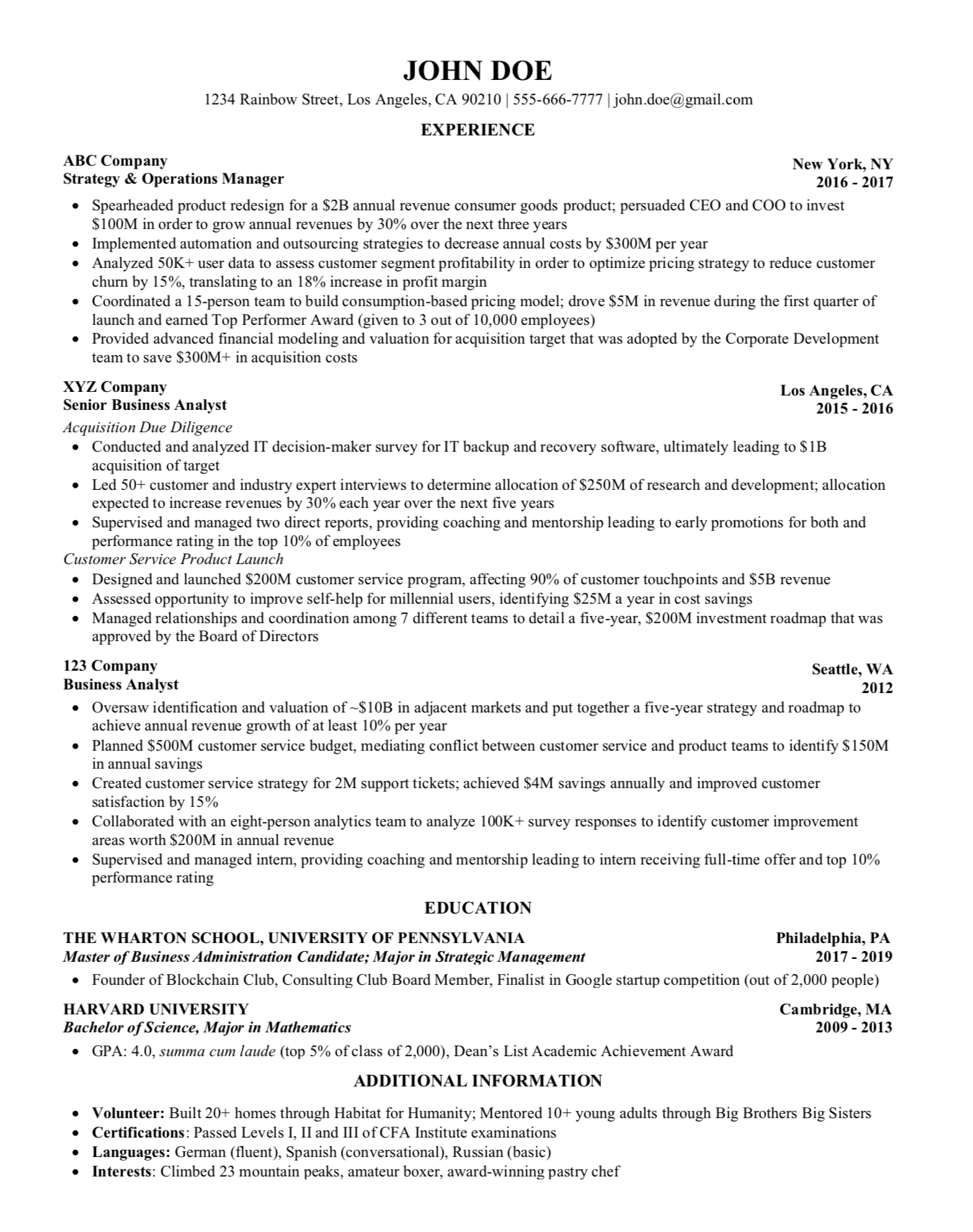
This example demonstrates all five sections in the correct order, with professional experience taking up the majority of the page. Each bullet starts with a unique action verb and includes a specific number. The education section is concise, and the interests line includes memorable, specific details.
For more examples and templates for other firms, see our complete consulting resume guide.
Frequently Asked Questions
Does McKinsey Require a Cover Letter?
McKinsey generally does not require a cover letter for most positions and programs. Their careers blog explicitly states that cover letters are not needed for most roles. However, if a specific job posting asks for one, you should submit it. When in doubt, check the application instructions for your specific position.
What GPA Do You Need for McKinsey?
There is no official GPA cutoff published by McKinsey. However, based on recruiting patterns, a GPA of 3.5 or higher on a 4.0 scale is generally considered competitive. Candidates from top target schools can sometimes get interviews with a slightly lower GPA if other parts of their resume are exceptional. If your GPA is below 3.5, strong test scores (GMAT 700+, GRE 325+) and impressive work experience can help compensate.
Can You Get into McKinsey from a Non-Target School?
Yes. McKinsey hires from a wide range of schools, though the path is harder from non-target programs. To improve your chances, focus on maximizing your GPA and test scores, building standout professional experience with quantified impact, networking with McKinsey consultants through informational interviews, and applying through multiple channels including the McKinsey careers website and any referrals you can obtain. According to McKinsey's website, they actively encourage applicants from all backgrounds.
How Long Should a McKinsey Resume Be?
One page. This is a firm rule for candidates with fewer than 15 years of experience. Even if you have an extensive background, forcing yourself to fit one page demonstrates an essential consulting skill: the ability to prioritize the most important information and cut everything else.
Should You Include a Resume Summary for McKinsey?
For most candidates, no. A resume summary or objective statement takes up valuable space that is better used for experience and accomplishments. The exception is experienced hires with 10+ years of experience or career changers who need a brief two-line frame to explain their transition. If you do include one, keep it to two sentences maximum.
Everything You Need to Land a Consulting Offer
Need help passing your interviews?
-
Case Interview Course: Become a top 10% case interview candidate in 7 days while saving yourself 100+ hours
-
Fit Interview Course: Master 98% of consulting fit interview questions in a few hours
- Interview Coaching: Accelerate your prep with 1-on-1 coaching with Taylor Warfield, former Bain interviewer and best-selling author
Need help landing interviews?
- Resume Review & Editing: Craft the perfect resume with unlimited revisions and 24-hour turnaround
Need help with everything?
- Consulting Offer Program: Go from zero to offer-ready with a complete system
Not sure where to start?
- Free 40-Minute Training: Triple your chances of landing consulting interviews and 8x your chances of passing them