
McKinsey Sea Wolf Game: How to Pass (2026)
Author: Taylor Warfield, Former Bain Manager and interviewer
Last Updated: March 15, 2026
McKinsey Sea Wolf game is the newest addition to the McKinsey Solve assessment, testing your ability to select the right microbes to clean contaminated ocean sites under strict time pressure. With an estimated pass rate of only 20 to 30%, most candidates fail this assessment before ever reaching a McKinsey case interview.
In this guide, you will learn exactly how the Sea Wolf game works across all five steps, how McKinsey scores your performance, the best time management strategies, and the most common mistakes that get candidates eliminated.
But first, a quick heads up:
McKinsey, BCG, Bain, and other top firms accept less than 1% of applicants every year. If you want to triple your chances of landing interviews and 8x your chances of passing them, watch my free 40-minute training.
What Is the McKinsey Sea Wolf Game?
The McKinsey Sea Wolf game is a 30-minute online simulation where you clean three polluted ocean sites by selecting the right combination of microbes for each one. It is part of McKinsey's Solve assessment, which is the pre-interview screening test that replaced the old Problem Solving Test (PST). You may also see it called the Ocean Cleanup game, Ocean Treatment game, or Microbe game.
McKinsey introduced Sea Wolf in late 2024 and, as of 2026, it is now a permanent part of the standard Solve test. The game was developed alongside Imbellus (now owned by Roblox) and has gone through several updates since its initial beta launch.
According to candidate reports and community data, the overall Solve assessment pass rate is estimated at just 20 to 30%. McKinsey uses percentile scoring and typically requires candidates to place in the top 25% (the fourth quartile) to move forward in the McKinsey interview process.
Where Does Sea Wolf Fit in the Solve Assessment?
As of early 2026, most candidates receive a 65-minute, two-game Solve test. The games appear in this order:
- Redrock Study: 35 minutes. A data analysis and case study exercise.
- Sea Wolf: 30 minutes. The microbe selection and ocean cleanup game.
Some candidates still receive the older 110-minute format, which adds a third game (Ecosystem Building) at the beginning. However, McKinsey has been phasing out Ecosystem Building since mid-2025. If your confirmation email says 65 minutes, expect only Redrock and Sea Wolf.
You do not need any business knowledge, biology background, or gaming experience to take the Sea Wolf game. McKinsey designed it to test five cognitive skills: critical thinking, decision making, metacognition, situational awareness, and systems thinking.
How Does the McKinsey Sea Wolf Game Work?
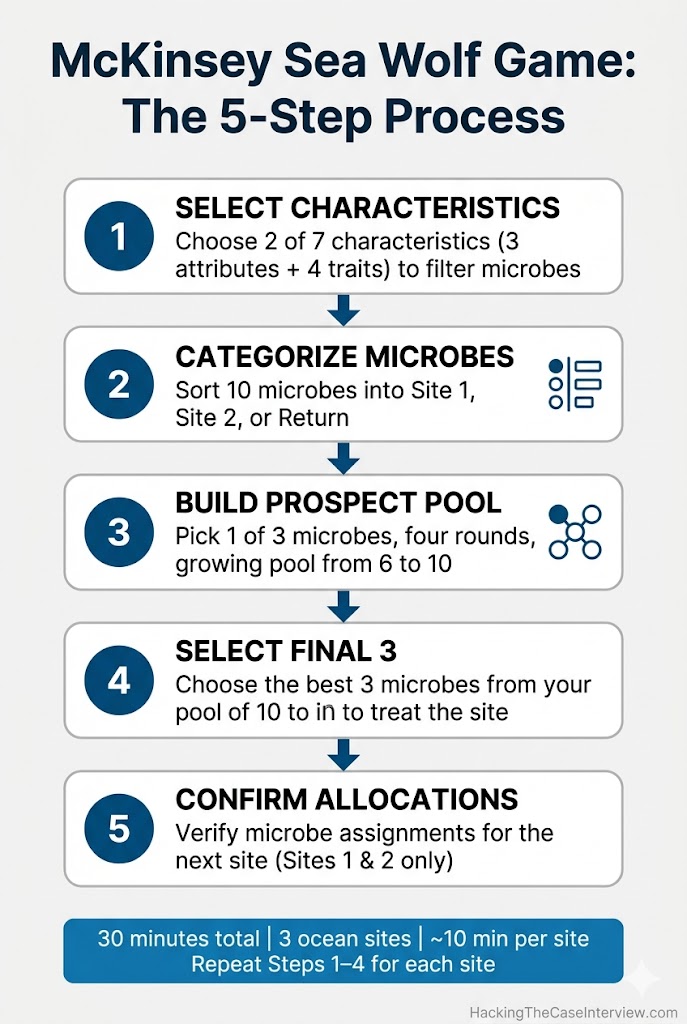
The Sea Wolf game gives you three contaminated ocean sites to clean. For each site, you go through up to five steps to select three microbes that form an effective treatment. The mechanics are identical across all three sites, but the specific attribute ranges and trait requirements change each time.
Before the timed game begins, you get an untimed tutorial that walks you through the interface and rules. Having coached hundreds of candidates through McKinsey's process, I strongly recommend spending extra time in the tutorial to fully internalize the scoring rules. Every minute you invest in the tutorial saves time during the actual game.
Here is a quick summary of all five steps:
Step |
Name |
What You Do |
Time Target |
1 |
Select Characteristics |
Choose 2 of 7 characteristics (3 attributes + 4 traits) to filter microbes |
~1 minute |
2 |
Categorize Microbes |
Sort 10 microbes into Site 1, Site 2/3, or Return |
~2 minutes |
3 |
Build Prospect Pool |
Pick 1 of 3 microbes, four times, growing pool from 6 to 10 |
~2 minutes |
4 |
Select Final 3 |
Choose the 3 best microbes from your pool of 10 to treat the site |
~4 minutes |
5 |
Confirm Allocations |
Verify or reassign microbes earmarked for the next site |
~1 minute |
You repeat Steps 1 through 4 for all three sites. Step 5 only appears after Sites 1 and 2. That means you complete roughly 14 total steps in 30 minutes.
Step 1: How Do You Select Your Two Characteristics?
When you begin a site, you see a panel with seven characteristics on the left: three numerical attributes (like Rigidity, Mobility, and Size, each rated 1 to 10) and four binary traits (like Heat Resistant or Hydrophilic). On the right, you see the Site Information panel showing the target attribute ranges and which traits are desired or undesired.
Your task is to select exactly two of these seven characteristics. This selection tells the game which data you want to see about future microbes. The key is to match your selections to the site requirements. If the site shows specific ranges for two attributes and one desired trait, pick the characteristics that give you the most useful filtering information.
This step is quick but important because it directly affects the quality of data you see in the next steps. In my experience coaching candidates, the best approach is to pick one attribute and one trait whenever the site shows both a clear attribute range and a clear desired trait. This gives you the widest range of useful information.
Step 2: How Do You Categorize the 10 Microbes?
In Step 2, you are shown 10 microbes one at a time. For each microbe, you see its attribute values and trait information. You must assign each microbe to one of three categories: the current site, the next site, or return (discard).
The Site Information panel on the right shows the requirements for both the current site and the next site. This lets you make informed decisions about where each microbe belongs. A microbe that does not fit Site 1 might be perfect for Site 2.
A critical mistake here is returning too many microbes. Only discard a microbe if it is completely unusable for either site. Remember that a microbe with one attribute outside the target range can still be valuable if it helps achieve the correct average when combined with other microbes. Based on candidate data, roughly 60 to 70% of all microbes can be filtered out in this step, but you need to think carefully before hitting return.
Step 3: How Do You Choose 4 Microbes for Your Prospect Pool?
In Step 3, you start with 6 microbes already in your prospect pool. The game then presents you with groups of 3 candidate microbes at the top of the screen. You must pick exactly 1 from each group. This happens 4 times, growing your pool from 6 to 10 microbes.
The critical mindset shift for this step is to think about portfolio optimization, not individual microbe quality. You are not looking for the single best microbe. You are looking for the microbe that will give your final pool the best chance of producing a strong three-microbe combination in Step 4.
For example, if your current pool is trending low on a particular attribute, you should pick a microbe with a high value for that attribute, even if its other characteristics are not ideal. According to candidate reports, out of 81 possible prospect pools you could create in Step 3, often only 2 to 4 will produce a treatment that scores 100% efficiency. That is an extremely narrow margin for error.
Step 4: How Do You Select the Final 3 Microbes?
This is the most important and time-consuming step. You must select 3 microbes from your pool of 10 whose averaged attributes fall within the site's required ranges and whose traits satisfy the desired/undesired requirements.
With 10 microbes and 5 characteristics each, you are working with 50 data points. This is where an Excel spreadsheet becomes essential. You can freely add and remove microbes from your selection before submitting, so take advantage of this flexibility.
The scoring rules for your final treatment are:
- The average of each attribute across your 3 chosen microbes must fall within the site's required range. Each attribute average that falls outside the range triggers a 20% penalty, up to a maximum of 60%.
- At least one of your 3 microbes must have the desired trait. Missing this triggers a 20% penalty.
- None of your 3 microbes can have the undesired trait. Having one triggers a 20% penalty.
Your default efficiency is 100%, and each violation deducts 20%. In some scenarios, the available microbes make it mathematically impossible to score 100%. Accepting 80% or even 60% and moving on is sometimes the correct decision.
If you want a structured way to master these optimization calculations quickly, my case interview course builds the same analytical thinking skills that the Sea Wolf game tests.
Step 5: How Do You Confirm Your Microbe Allocations?
After submitting your treatment for Site 1 (and later Site 2), you get one more task. Remember those microbes you assigned to the next site back in Step 2? Now you confirm or change those assignments.
Unlike Step 2, you now have full information about the next site's requirements. Use this to make better decisions. If a microbe you originally sent to Site 2 does not actually fit, reject it now. This step should be quick since you already did the initial sorting.
After Step 5, you move to the next site and repeat Steps 1 through 4 (and Step 5 again after Site 2). Site 3 does not have a Step 5 because there is no next site.
How Is the McKinsey Sea Wolf Game Scored?
McKinsey scores your Sea Wolf performance using two separate metrics: a product score and a process score. Understanding both is critical to maximizing your chances of passing.
Your product score measures how effective your final treatments are. It is calculated using the efficiency penalty rules described above. The closer your treatments are to 100% efficiency across all three sites, the higher your product score.
Your process score measures how you arrived at your answers. McKinsey tracks your mouse movements, clicks, and decision patterns to evaluate whether you used a consistent, logical approach. Random guessing or erratic behavior will lower your process score even if your final answers happen to be correct.
Scoring Rule |
Penalty |
Max Deduction |
Attribute average falls outside site range |
20% per attribute |
60% |
Missing desired trait in selection |
20% |
20% |
Undesired trait present in selection |
20% |
20% |
McKinsey compares your performance against all other candidates using percentile rankings. Based on community data and recruiter feedback, you generally need to score in the top 25% to pass. This means even a strong absolute score might not be enough if other candidates performed better.
What Is the Best Time Strategy for the Sea Wolf Game?
You have exactly 30 minutes to complete all three ocean sites. The most effective approach is to budget roughly 10 minutes per site, though well-prepared candidates report finishing each site in about 7 minutes.
Site 1 always takes the longest because you are still learning the interface and getting comfortable with the mechanics. Experienced candidates report spending up to 12 minutes on Site 1 and then completing Sites 2 and 3 in 7 to 9 minutes each.
Site |
First-Timer Budget |
With Practice |
Site 1 |
~12 minutes |
~7 minutes |
Site 2 |
~10 minutes |
~7 minutes |
Site 3 |
~8 minutes |
~7 minutes |
One of the most common reasons candidates fail Sea Wolf is spending too much time on a single site. If you hit the 12-minute mark on any site, force yourself to submit and move on. A decent score on all three sites is far better than a perfect score on one site and zeros on the others.
Here is another important time tip: the timer pauses between the Redrock and Sea Wolf games. Use this break to take a deep breath and reset mentally. After 35 minutes of intense analysis during Redrock, even a 2-minute pause can sharpen your focus for Sea Wolf.
What Are the Best Tips to Pass the McKinsey Sea Wolf Game?
Having helped candidates prepare for McKinsey's Solve assessment since its early days at Bain, I have identified the strategies that consistently separate candidates who pass from those who do not. Here are the most important ones.
Build an Excel Spreadsheet Before Test Day
McKinsey allows you to use any tools during the Solve test. You are not monitored through your webcam, and you can use a second computer, pen, paper, or spreadsheets. An Excel file designed for Step 4 can cut your calculation time from 5+ minutes to under 2 minutes per site.
Your spreadsheet should calculate the average of three selected microbes' attributes and flag whether each average falls within the site's required range. It should also track trait presence. Build this before test day and practice using it at least twice so you can enter data quickly under pressure.
Think in Averages, Not Individual Values
This is the single most important mental shift for Sea Wolf. Your final score depends on the average attribute values of your three chosen microbes, not on any individual microbe's values. A microbe with a Size of 8 when the target range is 2 to 4 seems terrible on its own. But paired with microbes of Size 1 and Size 2, the average is 3.67, which falls perfectly within range.
Candidates who eliminate microbes based on individual attributes throw away potentially valuable options. Always ask: can this microbe contribute to a good average when combined with others?
Prioritize Traits Over Attributes
Attribute averages can be adjusted by mixing high and low values. But traits are binary. A microbe either has the undesired trait or it does not. If you include even one microbe with the undesired trait in your final selection, you take an automatic 20% penalty with no way to offset it.
Similarly, at least one of your three microbes must carry the desired trait. When narrowing your selection in Steps 2 and 3, always ensure you are keeping enough microbes with the desired trait to have options in Step 4.
Stay Consistent in Your Approach
Remember that McKinsey evaluates your process score alongside your product score. This means they want to see a methodical, consistent approach throughout the game. Establish clear decision criteria in Step 1 and apply them systematically across all subsequent steps.
For example, in Step 2, decide on a clear rule: assign a microbe to the current site if it meets at least 3 of 5 criteria, send it to the next site if it meets fewer than 3 but is not completely unusable, and return it only if it fails on all counts. Apply this rule to every single microbe. Consistent logic signals to McKinsey that you think like a consultant.
Know When to Accept an Imperfect Score
Not every site allows a 100% efficiency score. Sometimes the available microbes simply make a perfect treatment impossible. When this happens, chasing perfection wastes precious minutes. Recognizing that 80% is the best achievable score and moving on quickly is a sign of strong decision making, which is exactly what McKinsey is testing.
If you want personalized feedback on developing this kind of strategic judgment under pressure, my 1-on-1 coaching helps you improve roughly 5x faster than solo practice.
What Are the Biggest Mistakes Candidates Make on the Sea Wolf Game?
Based on candidate feedback and coaching hundreds of McKinsey applicants, these are the errors I see most often.
Mistake |
Why It Hurts You |
Spending too long on Site 1 |
You run out of time for Sites 2 and 3, which count equally toward your total score |
Discarding microbes too early |
A microbe with one bad attribute can still be valuable for averaging. Only return microbes that are completely unusable |
Ignoring trait requirements |
Including even one microbe with the undesired trait costs 20% with no fix. Missing the desired trait costs another 20% |
Chasing 100% on every site |
Some sites cap at 80% or 60%. Wasting 5 extra minutes trying to find a perfect answer that does not exist is a losing strategy |
Not using Excel |
Doing mental math with 50 data points leads to errors and wastes time. An Excel solver template is a major advantage |
Skipping the tutorial |
The tutorial is untimed. Rushing through it means learning the interface during the timed game, which costs minutes you cannot afford |
Random or inconsistent decisions |
McKinsey tracks your decision process. Erratic clicks and changes without logic hurt your process score |
The most important takeaway is this: Sea Wolf rewards preparation more than raw intelligence. Candidates who practice the mechanics beforehand and bring a prepared Excel template consistently outperform those who go in cold, regardless of academic background.
If you pass the Solve assessment, your next step will be McKinsey first round interviews, which consist of case interviews and Personal Experience Interviews. Preparing for both the Solve and your interviews simultaneously is the most efficient use of your time.
Frequently Asked Questions
Can You Use Excel During the McKinsey Sea Wolf Game?
Yes. McKinsey allows you to use any external tools during the Solve assessment, including Excel, Google Sheets, calculators, pen, paper, and even a second computer. You are not monitored through your webcam. Building a spreadsheet template before test day that calculates attribute averages and checks trait requirements can save you several minutes per site.
How Long Is the McKinsey Sea Wolf Game?
The Sea Wolf game lasts 30 minutes. It is the second game in the standard 65-minute Solve assessment, following the 35-minute Redrock Study. The 30 minutes cover all three ocean sites. Budget approximately 10 minutes per site, though prepared candidates often finish each one in about 7 minutes.
What Is a Good Score on the McKinsey Sea Wolf Game?
McKinsey does not share exact scores with candidates, but they use percentile-based grading. Based on community data, you generally need to place in the top 25% of all test takers to pass. This means achieving high efficiency scores (ideally 80 to 100%) on all three sites while also demonstrating a consistent, logical approach that earns a strong process score.
Do You Need Gaming Experience for the Sea Wolf Game?
No. The Sea Wolf game does not require any video game experience, biology knowledge, or technical background. It is designed to test analytical thinking and decision making under time pressure. The interface is straightforward, and the untimed tutorial teaches you everything you need to know about how the game works.
Is the Sea Wolf Game Harder Than Redrock or Ecosystem Building?
Many candidates report that Sea Wolf is the most challenging of the three Solve games because it combines multi-variable optimization with strict time pressure. Unlike Ecosystem Building (which tests systems thinking) or Redrock (which tests data analysis), Sea Wolf requires you to perform rapid mathematical averaging under tight time constraints. The addition of Sea Wolf has increased the overall difficulty of the Solve assessment compared to earlier versions.
Can You Retake the McKinsey Solve if You Fail?
If you do not pass the Solve assessment, your application will not move forward for that recruiting cycle. You can typically reapply and retake the Solve after 12 months. Your previous Solve results are valid for 12 months, meaning if you passed within the last year, you will not need to retake it for a new McKinsey application.
How Should You Prepare for the McKinsey Sea Wolf Game?
The best preparation approach has three parts. First, learn the game mechanics and scoring rules thoroughly by studying guides like this one. Second, build an Excel spreadsheet template designed for Step 4 calculations. Third, practice with simulation exercises that replicate the actual game experience. Candidates who practice with realistic simulations consistently score higher than those who rely on reading alone. Start your Solve preparation at least one to two weeks before your test date.
For a complete McKinsey Solve breakdown covering all games (Ecosystem Building, Redrock, and Sea Wolf), read our full guide. And when you pass the Solve, prepare for your McKinsey final round interview next.
Everything You Need to Land a Consulting Offer
Need help passing your interviews?
-
Case Interview Course: Become a top 10% case interview candidate in 7 days while saving yourself 100+ hours
-
Fit Interview Course: Master 98% of consulting fit interview questions in a few hours
- Interview Coaching: Accelerate your prep with 1-on-1 coaching with Taylor Warfield, former Bain interviewer and best-selling author
Need help landing interviews?
- Resume Review & Editing: Craft the perfect resume with unlimited revisions and 24-hour turnaround
Need help with everything?
- Consulting Offer Program: Go from zero to offer-ready with a complete system
Not sure where to start?
- Free 40-Minute Training: Triple your chances of landing consulting interviews and 8x your chances of passing them