
Case Interview: The Complete Prep Guide (2026)
Author: Taylor Warfield, Former Bain Manager and Interviewer
Last Updated: March 25, 2026

Case interviews are the single biggest hurdle between you and a consulting offer at firms like McKinsey, BCG, and Bain. They test your ability to solve real business problems in 30 to 60 minutes, and roughly 85 to 92% of candidates fail them.
This guide covers everything you need to pass. You will learn what case interviews are, the exact frameworks top candidates use, the math you need, how to avoid the most common mistakes, and step by step preparation plans for any timeline. Whether you have one week or three months, you will know exactly what to do.
But first, a quick heads up:
McKinsey, BCG, Bain, and other top firms accept less than 1% of applicants every year. If you want to triple your chances of landing interviews and 8x your chances of passing them, watch my free 40-minute training.
What Changed in 2026?
This article has been updated for the current recruiting cycle. Key changes include a new section on the most common case interview mistakes and how to avoid them, a full worked case interview walkthrough showing exactly what to say at each step, a comparison table showing how McKinsey, BCG, Bain, and Deloitte run their case interviews differently, updated case interview examples and links, refreshed statistics throughout, and an expanded FAQ section.
What Is a Case Interview?
A case interview is a 30 to 60 minute exercise where you and an interviewer work together to solve a business problem. Think of it as a mini consulting project crammed into a single conversation.
These business problems mirror real challenges that companies face every day:
- How can Amazon increase its profitability?
- What should Tesla do to price its new electric vehicle?
- Should Disney open another theme park?
- How can Netflix improve customer retention?
Case interviews simulate what you will actually do as a consultant. Many cases are based on real projects that interviewers have worked on. While actual consulting engagements last 3 to 9 months, case interviews compress that problem solving into less than an hour.
You are not just answering questions. You are collaborating with the interviewer, asking them questions, walking them through your thinking, and building toward a recommendation together.
Cases can cover any industry, from healthcare to technology to retail. They can focus on any business situation, whether that is entering a new market, launching a product, or turning around a struggling company. The good news is that you do not need specialized knowledge to solve them. Cases are designed so anyone with general business knowledge can crack them.
Why Do Consulting Firms Use Case Interviews?
Consulting firms use case interviews because they are the best predictor of who will actually succeed as a consultant. According to Bain, cases simulate the consulting job closely enough that interviewers can see how you would perform as a hypothetical consultant. The skills you need to crush a case interview are the same skills you need to deliver great work for clients.
Case interviews also work as a test for fit. If you find cases interesting and energizing, you will probably enjoy consulting. If you find them tedious and boring, this might not be the right career path for you.
Expect case interviews at every management consulting firm, including McKinsey, BCG, Bain, Deloitte, Accenture, EY-Parthenon, Kearney, Oliver Wyman, LEK, and Roland Berger.
What Skills Do Case Interviews Assess?
Case interviews evaluate five key qualities:
- Logical, structured thinking: Can you break down complex problems into simpler pieces? Can you sift through data and pull out what actually matters?
- Analytical problem solving: Can you read and interpret information accurately? Can you do math calculations smoothly without getting flustered?
- Business acumen: Do you understand fundamental concepts like profit, market share, and competitive advantage? Do your conclusions make sense from a business perspective?
- Communication skills: Can you explain your thinking clearly and concisely? Are you articulate when presenting your ideas?
- Personality and cultural fit: Are you coachable? Easy to work with? Pleasant to be around?
In my experience at Bain, interviewers make their assessment within the first 10 to 15 minutes. Everything after that either confirms or challenges their initial impression.
What Are Case Interview Success Rates?
Case interviews are tough. Based on data from McKinsey, BCG, and Bain recruiting, roughly 40 to 50% of candidates pass their first round case interviews. That number drops to 20 to 30% for final round case interviews.
Overall, only 8 to 15% of candidates pass all of their case interviews and receive an offer. According to McKinsey, roughly 1 in 8 interviewees receives an offer. At some offices, the number is closer to 1 in 12.
What Are the Different Types of Case Interviews?
Not all case interviews work the same way. Understanding the different formats helps you prepare for exactly what you will face on interview day.
What Is a Candidate-Led Case Interview?
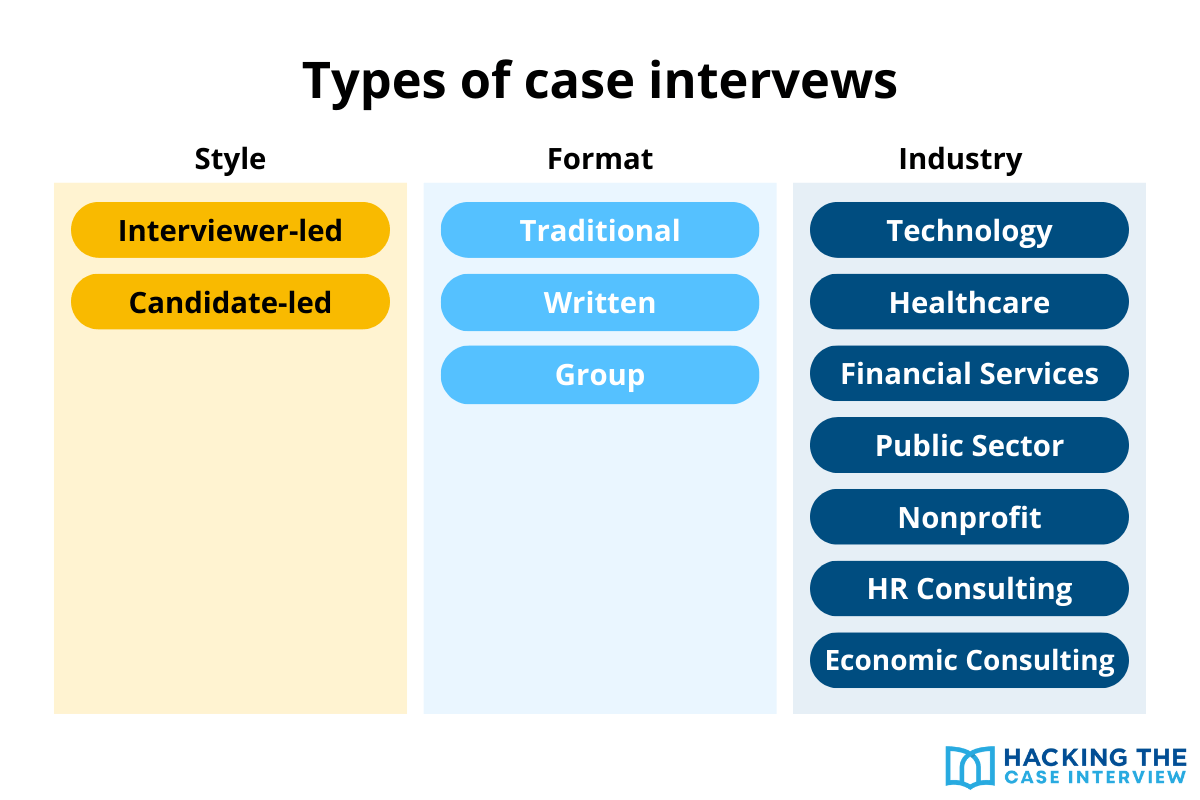
In a candidate-led case interview, you are in the driver's seat. You decide which areas of your framework to explore, what questions to answer, what analyses to run, and what the next step should be. BCG and Bain primarily use this format.
The interviewer provides the initial business problem and answers your questions along the way. But they will not tell you what to do next. That is your job.
If you go down the wrong path, the interviewer will gently steer you back on course. But you are expected to proactively drive the case forward without waiting for instructions. Check in with the interviewer frequently by asking if your approach makes sense.
What Is an Interviewer-Led Case Interview?
In an interviewer-led case interview, the interviewer controls the direction and pace of the case. They have a specific list of questions they will ask you to work through. McKinsey primarily uses this format.
After you present your framework, the interviewer will direct you to specific areas they want you to explore. Once you answer one question, they will point you to the next one.
You still need to think critically and solve problems. The difference is that you are not expected to decide what to investigate next. The interviewer has already mapped out the journey.
How Do Top Firms Run Case Interviews Differently?
Each firm has its own case interview style. This table summarizes the key differences based on publicly available information from firm websites and candidate reports.
Firm |
Format |
Rounds |
Cases per Round |
Pre-Screening Test |
Case Duration |
McKinsey |
Interviewer-led |
2 |
2 to 3 |
McKinsey Solve |
25 to 40 min |
BCG |
Candidate-led |
2 |
2 |
BCG Pymetrics |
30 to 45 min |
Bain |
Candidate-led |
2 to 3 |
2 |
Bain Online Tests |
30 to 45 min |
Deloitte |
Candidate-led |
2 to 3 |
1 to 2 |
Varies by practice |
30 to 45 min |
Oliver Wyman |
Candidate-led |
2 |
2 |
Math test |
30 to 40 min |
Kearney |
Mix |
2 |
2 |
None typically |
30 to 40 min |
What Are Industry-Specific Case Interviews?
Some consulting firms specialize in particular industries and will give you cases tailored to those sectors. The most common specializations include:
- Technology consulting case interviews focus on how companies use technology to become more productive and profitable. Firms like Accenture and Cognizant use these cases.
- Healthcare consulting case interviews can cover pharmaceutical companies, medical device manufacturers, insurance providers, and hospital systems.
- Financial services case interviews often involve banks, insurance companies, asset managers, or fintech startups.
- Public sector case interviews focus on helping government agencies solve operational or strategic challenges.
- Nonprofit case interviews involve scenarios facing charitable organizations, foundations, and NGOs.
You do not need deep industry expertise for most of these. Familiarize yourself with the basic stakeholders and dynamics of the relevant industry, and you will be prepared.
What Are Group Case Interviews?
Group case interviews put you in a team of three to six candidates all competing for the same job. Your group receives case materials and has one to two hours to work together on a recommendation.
While you work, the interviewer observes your discussions without interfering. These cases heavily emphasize teamwork. Being the loudest voice in the room will not help you. Neither will staying silent. The goal is to demonstrate that you are both effective and pleasant to work with.
In my experience, the candidates who perform best in group case interviews are the ones who help other team members contribute. If someone is quiet, draw them in. If someone is dominating, find a way to redirect diplomatically. Interviewers are evaluating whether you can make meaningful contributions while handling disagreement professionally and bringing out the best in others.
What Are Written Case Interviews?
Written case interviews give you a packet of information, typically 20 to 40 pages of charts, graphs, tables, and notes. You get one to two hours to analyze the data and create a short slide presentation.
You work alone. The interviewer leaves the room and returns when time is up to hear your presentation and ask follow-up questions. This format tests your ability to quickly synthesize large amounts of information and communicate your findings clearly under time pressure.
How Does a Case Interview Work Step by Step?
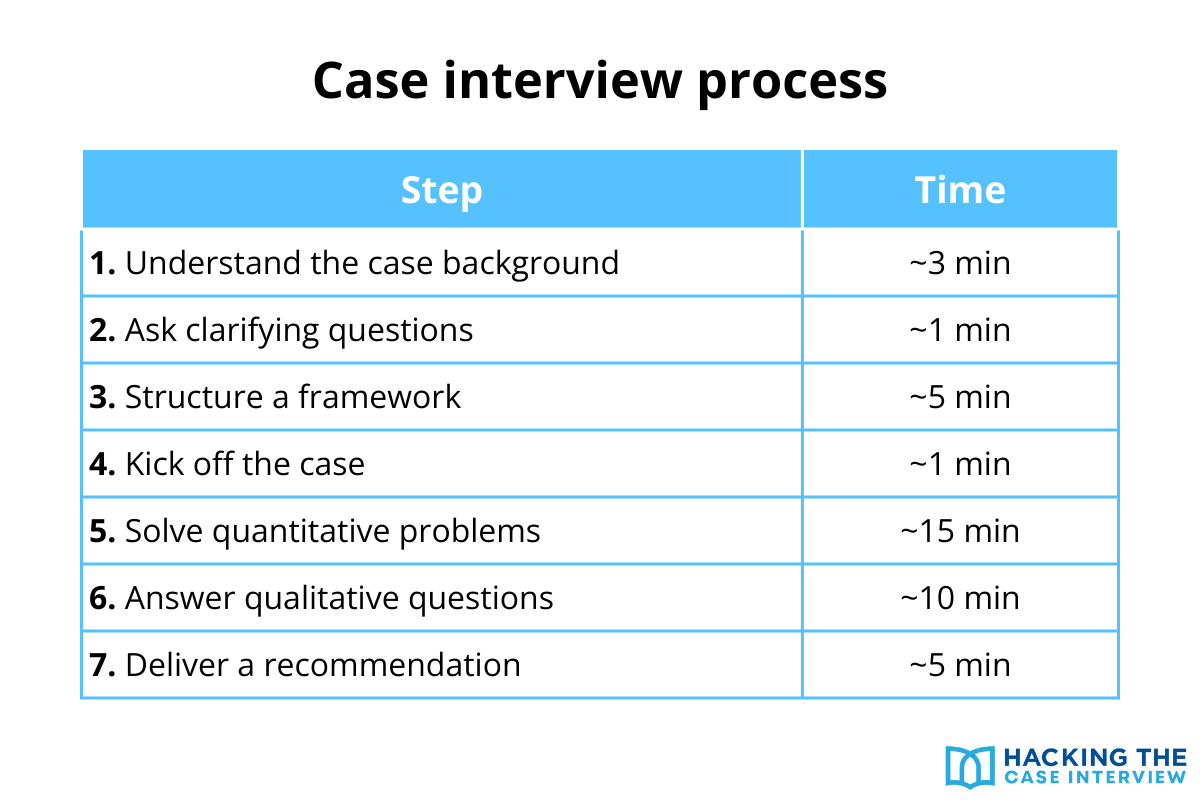
Every case interview follows the same predictable structure. Once you understand the steps, you can focus your energy on solving the problem rather than worrying about what comes next. Based on McKinsey, BCG, and Bain interview guides, there are seven distinct phases.
What Are the Seven Steps of a Case Interview?
Step 1: Understand the case background
The interviewer reads you the case background, including details about the company, the industry, and the business problem. Take notes while the interviewer speaks. Focus on capturing the company name, key numbers, and the objective of the case.
After the interviewer finishes, summarize the situation back to them in your own words. Do not parrot everything. Synthesize the key points concisely. Verifying the objective is critical. Solving the wrong problem is the fastest way to fail.
Step 2: Ask clarifying questions
You will have a chance to ask questions before diving in. Most candidates ask one to three questions here. Ask questions that strengthen your understanding of the situation, such as clarifying the company's goals, defining unfamiliar terms, or filling in missing context. You will have opportunities to ask more questions throughout the case.
Step 3: Structure your framework
Ask for a minute or two to organize your thoughts. A framework breaks the complex problem into smaller, manageable pieces. Think of it as your roadmap for solving the case. Identify the three or four major areas you need to investigate to reach a confident recommendation.
Do not use memorized frameworks. Interviewers spot them immediately. Instead, build a custom framework tailored to the specific case.
Step 4: Kick off the case
In a candidate-led case, propose which area of your framework to explore first and explain your reasoning. In an interviewer-led case, the interviewer directs you to specific questions. Either way, you are now in the core of the case.
Step 5: Solve quantitative problems
Before crunching any numbers, lay out your approach. Walk the interviewer through the structure of your calculation. Talk through your math out loud. After completing a calculation, connect your answer back to the case objective.
Step 6: Answer qualitative questions
You will face open-ended questions that test your business judgment. You might be asked to brainstorm ideas, evaluate risks, or give your opinion on a strategic issue. Structure your answers even when the question is qualitative. Always tie your answer back to the case objective.
Step 7: Deliver your recommendation
State your recommendation upfront. Then provide the two or three strongest reasons that support it. Finally, mention what next steps you would take if you had more time. Be decisive. Do not waffle between options.
Full Case Interview Walkthrough Example
Here is what a strong case interview performance looks like from start to finish. In my experience interviewing candidates at Bain, this is the level of structure and communication that earns top scores.
The prompt
"Our client, Coca-Cola, is a large manufacturer and retailer of non-alcoholic beverages with annual revenues of roughly $30 billion and an operating margin of roughly 30%. They are looking to grow and are considering entering the beer market in the United States. Should they enter?"
Step 1: Synthesize and verify
What you say: "To make sure I understand correctly, our client Coca-Cola is a large non-alcoholic beverage company. They are looking to grow and our objective is to determine whether or not they should enter the U.S. beer market. Is that right?"
Step 2: Ask clarifying questions
What you say: "Is Coca-Cola looking to specifically grow revenues or profits?" [Interviewer: Profits.] "Is there a particular financial target?" [Interviewer: They want to grow annual profits by $2 billion within 5 years.]"
Step 3: Build your framework
What you say: "To decide whether Coca-Cola should enter the beer market, I want to look into four main areas. First, market attractiveness: Is this a large, growing, profitable market? Second, the competitive landscape: How tough is competition and can Coca-Cola capture meaningful share? Third, Coca-Cola's capabilities: Do they have the expertise, distribution, and resources to succeed? Fourth, expected profitability: Will they actually achieve the $2 billion profit target within five years?"
Steps 5-6: Solve problems
The interviewer might ask you to estimate the U.S. beer market size. A strong response:
What you say: "I will start with the U.S. population of roughly 320 million. About 75% are of legal drinking age, giving us 240 million. If 75% of those drink beer, that is 180 million beer drinkers. Assuming 250 beers per person per year at $2 per beer, the market size is roughly $90 billion."
Then connect it: "Given Coca-Cola's $30 billion in revenue, a $90 billion market represents a massive opportunity. But I would want to understand margins and competitive dynamics before drawing conclusions."
Step 7: Deliver the recommendation
What you say: "I recommend that Coca-Cola should not enter the U.S. beer market for three reasons. First, beer margins are only 10%, significantly below Coca-Cola's 30% operating margin. Second, the market is highly concentrated across all categories, which means high barriers to entry. Third, there are few production synergies, meaning Coca-Cola would face significant upfront investment in new equipment, raw materials, and training. For next steps, I would want to quantify the expected annual profit and confirm that it falls short of the $2 billion target."
This walkthrough covers roughly 80% of what a typical case interview looks like. The specific questions will vary, but the structure and communication style remain the same.
How Are Case Interviews Evaluated?
Most firms use a four-point scale. A score of 4 means you definitely passed. A 3 means you barely passed. A 2 means you barely missed the bar. A 1 means you definitely should not pass.
Each interviewer gives you scores across the five dimensions plus an overall score. At the end of the interview day, all interviewers gather to decide which candidates move forward.
Here is what is interesting. A candidate who receives a 4 and a 2 often advances over a candidate who receives two 3s. A 2 might represent an off performance, but the 4 shows top-tier potential. Two 3s suggest consistent mediocrity. Any 1 on your scorecard and you are typically out.
What Are the Most Important Case Interview Frameworks?
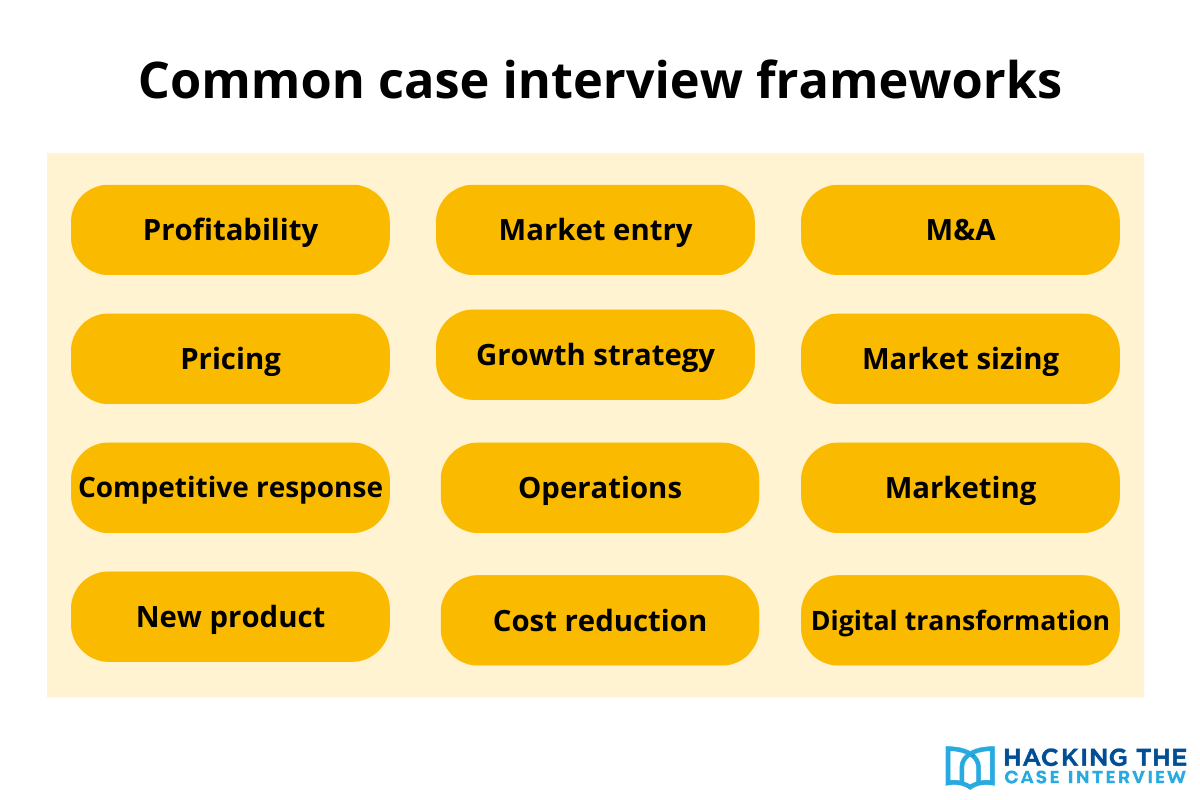
A framework is a tool for breaking down complex problems into smaller, manageable pieces. The best frameworks are tailored to the specific case. Memorized, cookie-cutter frameworks make you look like you cannot think critically. According to a survey of over 260 MBB interviews, 90% of cases fell into one of ten question types. These are the most important frameworks to understand.
If you want to learn these frameworks quickly and see them applied to real cases, my case interview course walks you through proven strategies that 3,000+ candidates have used to land offers at McKinsey, BCG, and Bain.
How Do You Solve Profitability Cases?
Profitability cases are the most common type. A typical prompt: "An electric car manufacturer has recently seen declining profits. What should they do?"
Profitability frameworks work in two stages. First, identify what is driving the profit change quantitatively. Then figure out why it is happening qualitatively.
On the quantitative side, start with Profit = Revenue minus Costs. Revenue breaks down into Price times Quantity. If revenue is declining, is it because you are selling fewer units or selling at lower prices? If it is quantity, dig deeper. Is the drop concentrated in a specific product line, geography, or customer segment?
Costs break into Variable Costs (raw materials, hourly labor, shipping) and Fixed Costs (rent, salaries, insurance). Which cost categories have increased? Variable costs typically change with production volume while fixed costs stay constant regardless of output.
On the qualitative side, look at customers (have their needs changed?), competitors (have new players entered?), and the broader market (new technologies or regulations?). In one Bain case I worked on, a client's profits had dropped 15% not because of internal issues, but because a competitor had launched a cheaper alternative that captured 20% of the market. Understanding the qualitative "why" is just as important as finding the quantitative "what."
Once you understand both the what and the why, brainstorm solutions and prioritize based on impact and ease of implementation.
How Do You Solve Market Entry Cases?
Market entry cases are the second most common type. For you to recommend entering a market, four statements generally need to be true:
- The market is attractive. Consider market size, growth rate, and average profit margins.
- Competition is manageable. How many players are there? How much market share does each hold?
- The company has the capabilities to compete. Are there significant capability gaps? Can it leverage existing synergies?
- The entry will be profitable. What are expected revenues and costs? How long until breakeven?
Notice the logical flow. Start with whether the market is worth entering. Then assess whether you can win. Then confirm execution capability. Finally verify the numbers work.
If you are leaning toward recommending entry, think through the entry strategy. Should the company enter immediately or wait? Should it target the entire market or start with a subset? Should it build capabilities internally, acquire a company, or partner with someone?
If you are leaning against entry, consider alternatives. Is there another market that might be more attractive? Are there better uses for the capital?
How Do You Solve M&A Cases?
M&A cases come in two flavors: a company acquiring for strategic reasons, or a private equity firm acquiring as an investment.
Four statements need to be true to recommend an acquisition: the target's market is attractive, the target company is attractive, the acquisition generates meaningful synergies, and the price is right.
Synergies deserve special attention. Revenue synergies include access to new customer segments, cross-selling opportunities, and new distribution channels. Cost synergies include eliminating redundancies, consolidating functions, and increasing buying power.
If you are leaning toward recommending the deal, explore the risks. How will competitors react? Will integration be difficult? If you are leaning against, consider what alternatives exist.
How Do You Solve Pricing Cases?
Pricing cases ask you to determine the optimal price. There are three fundamental approaches:
- Cost-based pricing sets your floor. Calculate all costs and add a margin.
- Value-based pricing sets your ceiling. Quantify the benefits the product provides to customers.
- Competition-based pricing helps you find the right spot between floor and ceiling.
Most pricing answers involve a mix of all three approaches.
How Do You Solve Growth Strategy Cases?
Growth strategy cases ask how a company can increase revenues, profits, or customers. Think about growth through two categories:
- Organic growth comes from internal efforts: improving products, entering new segments, expanding geographically, or launching new products.
- Inorganic growth comes from external actions: acquisitions, joint ventures, or partnerships.
When solving growth cases, start by clarifying what metric the company wants to grow and by how much. Then systematically evaluate organic options before moving to inorganic ones.
How Do You Solve Market Sizing Questions?
Market sizing questions ask you to estimate the size of a particular market. There are two main approaches.
- Top-down starts with a large number and breaks it down. Example: Start with the U.S. population (320 million), estimate the percentage that uses the product, estimate purchase frequency, and multiply by average price.
- Bottom-up starts small and builds up. Example: Start with one person's annual spending, then scale to the relevant population.
Use round numbers to keep math manageable. Segment your population when different groups have different behaviors. And always sense check your answer against benchmarks.
What Other Frameworks Should You Know?
Beyond the core five, you should be familiar with these additional framework types:
Competitive Response Framework
Competitive response cases ask how a company should react when a competitor makes a strategic move. Structure your response around three questions: What is the competitor doing and why? What is the impact on your client? What are the response options?
You generally have four response options: do nothing (if the threat is minor), match the competitor's move (when you cannot differentiate), differentiate further (when you can offer something the competitor cannot), or counterattack in a different area (responding where you have an advantage).
Operations Framework
Operations cases focus on improving how a company produces goods or delivers services. There are four common types: production optimization (increase output using Output = Rate times Time), process improvement (break the process into steps and identify bottlenecks), cost cutting (segment costs and prioritize reductions), and forecasting (estimate demand and find the optimal balance).
Marketing Framework
Marketing cases use the classic structure of 5 C's (Company, Collaborators, Customers, Competitors, Context) plus STP (Segmentation, Targeting, Positioning) plus 4 P's (Product, Place, Promotion, Price). For most marketing cases, you will not use all of these elements. Pick the pieces most relevant to the question at hand.
New Product Framework
New product cases are similar to market entry cases. Assess whether the product targets an attractive market segment, meets customer needs and beats competitors, can be successfully launched, and will be profitable. If you recommend launching, think through the go-to-market strategy.
Cost Reduction Framework
Cost reduction cases ask you to help cut expenses. The key principle: do not cut everything equally. Identify business-critical expenses that cannot be touched, then focus on the largest discretionary items. Prioritize based on impact, feasibility, and risk.
Digital Transformation Framework
Digital transformation cases are becoming more common as technology consulting grows. Understand the business problem first. Do not jump to technology solutions. Then assess current state, evaluate technology options, and analyze implementation feasibility. The build-buy-partner decision often comes up.
What Math Do You Need for Case Interviews?
Case math shows up in every single case interview. The good news is that it is basic: addition, subtraction, multiplication, division, percentages, and simple business formulas. The challenge is doing straightforward calculations under pressure without making careless mistakes.
What Math Concepts Come Up Most Often?
Before diving into formulas, make sure you are comfortable with the fundamental math concepts that come up repeatedly.
Percentages come up constantly. A percentage is simply a number expressed out of 100. The percent change formula is essential: Percent Change = (New Value minus Old Value) divided by Old Value. For example, if revenue grew from $80 million to $100 million, the percent change is ($100M minus $80M) divided by $80M, which equals 25%.
Weighted averages account for different proportions. If laptops have a 20% margin and make up 70% of revenue, while services have a 60% margin and make up 30% of revenue, the overall margin is (20% times 70%) plus (60% times 30%) = 32%.
Expected value is the sum of possible outcomes multiplied by their probabilities. If there is a 40% chance of $120 million in sales and a 60% chance of $40 million, the expected value is (40% times $120M) plus (60% times $40M) = $72 million.
Linear equations with one unknown are common. If a company's revenues grew 60% to $100 million, what were revenues last year? Set up: 1.6x = $100M. Solve: x = $62.5M.
What Formulas Should You Memorize for Case Interviews?
These are the formulas that come up most frequently. Having coached hundreds of candidates, I can tell you that candidates who memorize these formulas save 2 to 3 minutes per case.
Category |
Key Formulas |
Profit |
Profit = Revenue - Costs Revenue = Price x Quantity Costs = Variable Costs + Fixed Costs Profit Margin = Profit / Revenue |
Breakeven |
Breakeven Quantity = Fixed Costs / (Price - Variable Cost) |
Investment |
ROI = Profit / Investment Cost Payback Period = Investment Cost / Annual Profit |
Market Share |
Market Share = Company Revenue / Total Market Revenue |
Operations |
Output = Rate x Time Utilization = Output / Maximum Output |
Growth |
Rule of 72: Doubling Time = 72 / Growth Rate |
What Are the Best Mental Math Strategies?
Speed and accuracy matter equally. These strategies will make you faster without sacrificing correctness.
- Round numbers strategically. Use 320 million for the U.S. population instead of 331 million. The slight precision loss is worth the massive simplification.
- Use abbreviations. Write K for thousands, M for millions, B for billions. K times K equals M. K times M equals B. This prevents zero errors, the most common mistake.
- Build percentages from 10%. Finding 10% is easy: move the decimal. Then 5% is half of 10%, 15% is 10% plus 5%, and 1% is a tenth of 10%.
- Break down complex multiplications. Instead of 25 times 104, calculate 25 times 100 = 2,500 plus 25 times 4 = 100, totaling 2,600.
- Structure before calculating. Lay out your approach and get the interviewer's buy-in before doing any math. This prevents wasted effort and creates a roadmap.
- Talk through your work. Narrate calculations out loud. If you go silent and announce a wrong answer, the interviewer cannot help. If you talk through each step, they can nudge you back on track.
- Sense check constantly. After each calculation, ask if the answer is roughly the right magnitude. If you are multiplying 125 million by 24, your answer should be in the billions.
What Other Skills Do You Need for Case Interviews?
Beyond frameworks and math, several foundational skills separate average candidates from excellent ones. In my experience coaching candidates, these are the skills that most people underestimate.
What Is MECE and Why Does It Matter?
MECE stands for Mutually Exclusive, Collectively Exhaustive. It is the gold standard for structuring your thinking, originally developed at McKinsey.
Mutually exclusive means your categories do not overlap. Collectively exhaustive means your categories cover everything. MECE frameworks prevent duplicate work, guarantee completeness, and produce better brainstorming.
The easiest way to be MECE is the "X and Not X" approach. Revenue versus costs. Internal versus external. Fixed versus variable. Math formulas also work: Profit = Revenue minus Costs is inherently MECE.
What Is a Hypothesis-Driven Approach?
A hypothesis is an educated guess at the answer based on current information. State it as early as possible, typically right after presenting your framework.
Without a hypothesis, you guess randomly and jump between topics with no connecting logic. With a hypothesis, you proceed systematically. Each question gets you closer to confirming or revising your answer.
Do not panic when your hypothesis is wrong. Even excellent candidates get their initial hypothesis wrong about half the time. Simply revise based on new information.
How Should You Take Notes During a Case Interview?
Good note-taking is an underrated case interview skill. A simple technique that works well: turn your paper landscape and draw a vertical line to divide it into two sections. Use the left two-thirds for your framework and analysis. Use the right one-third for notes on the case background and key data points.
Keep your math on a separate sheet. Calculations get messy, and you want your framework page to stay clean and readable.
After each question you answer, jot down a brief takeaway. When it is time to deliver your recommendation, you will have a ready-made list of supporting points.
How Should You Communicate During a Case Interview?
State the main point first, then support it. Use signposting: "I want to explore three areas. Let me start with market attractiveness." Number your points: "There are three reasons. First... Second... Third..."
Be concise. Say what you need to say and stop. Think out loud so the interviewer can follow your reasoning and catch errors early. Check in periodically by asking if your approach makes sense.
How Do You Build Business Acumen for Case Interviews?
Business acumen is your intuition for how businesses work. It helps you form better hypotheses, ask sharper questions, and propose realistic solutions. According to BCG, interviewers look for candidates who demonstrate genuine business judgment, not just analytical skill.
Understand how companies make money. Revenue comes from selling products or services. Profit depends on the spread between price and cost. Growth can come from selling more, charging more, or entering new markets.
Understand competitive dynamics. Companies compete on price, quality, convenience, brand, or some combination. Sustainable competitive advantages come from things competitors cannot easily copy. Market structure affects profitability: fragmented markets with many competitors typically have lower margins than concentrated ones.
The best way to build business acumen is to read business news regularly and think about the logic behind everyday businesses. Why does Costco charge membership fees? Why do airlines oversell flights? This kind of thinking builds the intuition that interviewers reward.
What Is Drill-Down Analysis?
Drill-down analysis starts broad and progressively narrows focus until you find the root cause. This is one of the most valuable consulting skills and one that interviewers specifically look for.
Start at the highest level. Revenue is down. Break it into components. Is it price or volume? Volume. Break volume into components. Which product, region, or segment? Business travel in Asia.
Then investigate why. Each level gets more specific. Decompose the problem into MECE categories at each step. Look for the outlier. If three regions are growing and one is declining, focus on the declining one.
Keep asking "why" at each level. Finding that business class sales are down is not the answer. It is the starting point for asking why. Know when to stop: once you have identified something specific enough to act on, you have gone deep enough.
What Are the Most Common Case Interview Mistakes?
Having interviewed and coached hundreds of candidates, I see the same mistakes repeatedly. Based on feedback from interviewers across McKinsey, BCG, and Bain, these are the errors that cost candidates the most points.
1. Using Memorized Frameworks
Interviewers have seen the same textbook frameworks thousands of times. When you present a generic "market size, competition, company, product" framework for every case, it signals that you cannot think critically. Build a custom framework tailored to each specific case.
2. Doing Math Without Stating Your Approach First
Jumping straight into calculations without laying out your approach is a red flag. If your method is wrong, you waste minutes on unnecessary math. Always walk the interviewer through your plan before crunching numbers.
3. Solving the Wrong Problem
Roughly 10% of candidates misidentify the case objective, according to interviewer reports. Always verify the objective with the interviewer before building your framework. "Just to confirm, our goal is to determine whether the client should enter this market. Is that correct?"
4. Going Silent for Too Long
Silence longer than 30 seconds makes interviewers uncomfortable. If you need time to think, say so: "Let me take 30 seconds to organize my thoughts." Better yet, think out loud so the interviewer can follow your reasoning.
5. Not Connecting Answers to the Case Objective
Calculating a number and moving on without explaining what it means is a missed opportunity. After every quantitative answer, tie it back: "This $90 billion market size suggests a significant opportunity, but I need to understand margins before making a recommendation."
6. Being Too Broad or Too Narrow
Some candidates create frameworks with seven or eight buckets, which is unmanageable. Others create only two, which is too shallow. Aim for three to four framework buckets, each with two to four supporting questions.
7. Ignoring the Interviewer's Cues
Interviewers drop hints. If they say "that is an interesting area, but let us focus on something else," they are redirecting you. Follow their lead. Fighting the interviewer's direction never ends well.
8. Weak Recommendations
Ending with "it depends" or waffling between two options signals indecisiveness. Take a clear stance, support it with two to three reasons, and suggest next steps. A wrong recommendation with strong logic is better than no recommendation at all.
9. Poor Time Management
Spending 15 minutes perfecting your framework leaves too little time for analysis and recommendations. A good rule of thumb: spend 2 minutes on your framework, 20 to 25 minutes on the core analysis, and 3 to 5 minutes on your recommendation.
10. Not Practicing Out Loud
Many candidates read case books silently but never practice speaking their answers out loud. Case interviews are verbal exercises. You need to build the muscle of articulating structured thoughts in real time. Practice with a partner, or at minimum, talk through cases out loud by yourself.
Where Can You Find Case Interview Examples and Practice Cases?
Practicing with real case examples is essential. According to candidate surveys, top performers complete 30 to 50 full practice cases before their interviews. Here are the best free case interview examples organized by firm.
McKinsey Case Interview Examples
BCG Case Interview Examples
Bain Case Interview Examples
Deloitte Case Interview Examples
Other Firm Case Interview Examples
How Should You Prepare for Case Interviews?
The right preparation plan depends on your timeline. Candidates typically spend 60 to 80 hours preparing for case interviews. Exceptional candidates with strong business and communication skills might need as little as 4 weeks. Those lacking a business background could require 12 weeks.
How Many Practice Cases Do You Need?
Based on candidate data, top performers complete 30 to 50 full practice cases before their interviews. But how you practice matters more than how many cases you do. Practicing with a partner and getting specific feedback after each case accelerates improvement far more than solo practice.
A common breakdown that works well: 5 solo cases to learn the mechanics, 15 to 20 cases with a peer partner, and 3 to 5 cases with an experienced coach or former consultant.
1-Week Case Interview Prep Plan
One week is tight, but you can make meaningful progress with four to six hours per day. Here is the breakdown.
- Day 1: Learn the fundamentals. Start with a structured course or book to understand how case interviews work. Learn the basic case types: profitability, market entry, pricing, and growth strategy. Understand the difference between candidate-led and interviewer-led formats.
- Day 2: Master framework building. Practice creating custom frameworks for 10 different case prompts. Time yourself. You should be able to structure a case in 60 to 90 seconds. Your frameworks should be MECE and tailored to the specific question.
- Day 3: Drill case math. Work through mental math drills until you are comfortable with percentages, growth rates, and large number multiplication. Practice the common formulas. Do at least 30 math problems. Speed matters, but accuracy matters more.
- Day 4: Practice full cases. Work through 4 to 6 full cases using case books or firm websites. For each case, pause before looking at the answer and try to solve it yourself. Practice speaking your answers out loud.
- Days 5-6: Live practice. Find a practice partner and do at least 3 live cases. Trade roles so you also practice giving cases. Live practice reveals weaknesses that solo practice misses. Focus on communication, pacing, and staying structured under pressure.
- Day 7: Light review and rest. Review your notes and frameworks in the morning. Do one final practice case to build confidence. Then stop. Rest the afternoon before your interview. Cramming until the last minute increases anxiety and rarely helps.
What to expect with one week of prep: You will have a solid foundation and can perform reasonably well. You will not be as polished as someone who prepared for months, but focused preparation beats scattered preparation every time.
1-Month Case Interview Prep Plan
One month gives you time to build real skill. Dedicate one to two hours per day on weekdays and more on weekends.
- Week 1: Build your foundation. Complete a comprehensive case interview course or work through a full case interview book. Learn all major case types, common frameworks, and the overall interview process. Practice building custom frameworks for 20 different case prompts. Start mental math drills daily, spending 15 to 20 minutes per session.
- Week 2: Develop case skills. Work through 10 to 15 full cases. Mix up case types so you see profitability, market entry, M&A, pricing, and operations cases. After each case, identify what went well and what did not. Continue daily math practice. Start practicing out loud.
- Week 3: Live practice and feedback. Shift focus to live practice. Aim for at least 6 live cases with practice partners. After each case, get specific feedback: What did you do well? Where did you lose structure? Did your math have errors? Was your recommendation clear? Consider one coaching session this week.
- Week 4: Polish and refine. Continue live practice with 4 to 6 more cases. Focus on smooth delivery, confident communication, and clean synthesis. Do lighter practice the last two days. Get good sleep before interview day.
What to expect with one month of prep: You will be well-prepared and competitive with most candidates. Your frameworks will be solid, your math will be reliable, and you will have enough case reps to handle surprises.
3-Month Case Interview Prep Plan
Three months allows you to build deep expertise and enter interviews with genuine confidence.
- Month 1: Foundation and skill building. Weeks 1 to 2: Complete a comprehensive case interview course. Learn all frameworks, case types, and methodologies. Build your mental math foundation with daily practice. Work through 10 to 15 solo cases. Weeks 3 to 4: Increase case volume to 15 to 20 cases. Start live practice with partners, aiming for two to three sessions per week. Begin reading business news regularly.
- Month 2: Volume and refinement. Weeks 5 to 6: Ramp up live practice to three to four sessions per week. Work through 20 more cases across all types. Focus on speed and efficiency. Weeks 7 to 8: Target your weak spots intensively. If certain case types give you trouble, drill them specifically. Get coaching feedback to ensure you are improving in the right direction.
- Month 3: Mastery and confidence. Weeks 9 to 10: Focus on handling curveballs, unusual case types, and stress scenarios. Practice in conditions that simulate real interviews: timed, with strangers, early in the morning. Weeks 11 to 12: Reduce to two live practice sessions per week. Review all notes and frameworks. Prepare for behavioral questions and firm-specific research.
What to expect with three months of prep: You will enter interviews as a top-tier candidate. Your frameworks will feel natural, your math will be fast and accurate, and you will have seen enough cases that few things surprise you. Three months of consistent preparation puts you in the top 10% of candidates.
What Is the Difference Between First Round and Final Round Case Interviews?
What Should You Expect in First Round Interviews?
First round interviews typically consist of two back-to-back interviews lasting 30 to 60 minutes each. Students usually interview on campus or nearby. Working professionals interview at the office they are applying to. Some firms conduct first rounds over phone or video.
Case performance is by far the most important factor, driving roughly 80% of the first round scoring. Unless your personality raises red flags, fit will not prevent you from advancing. Be polite and friendly, and you will pass the fit component.
Cases in first rounds are predictable. Expect profitability and market entry cases with clear structures. The interview typically flows like this: small talk, one or two fit questions, the case, and your questions for the interviewer.
What Should You Expect in Final Round Interviews?
Final round interviews are longer and more intense. Expect three back-to-back interviews lasting 40 to 60 minutes each, conducted by principals and partners who could become your supervisors or colleagues.
Passing cases is still required, but fit becomes significantly more important, accounting for roughly 50% of the final round scoring. Your interviewers have a personal stake in who joins their office. They are asking: Can I see this person as a future consultant? Would I want this person on my team?
One of your interviews will focus heavily on fit. The interviewer may spend more than half the time on behavioral questions, leaving only a short mini-case.
Final round cases are less predictable. You will see a wider variety including pricing, growth strategy, M&A, competitive response, and operational improvement. You may also encounter conversational cases (more like brainstorming discussions) or stress cases (intentional pressure to see how you handle it).
For stress cases, stay calm. Know it is intentional. Talk through your thoughts out loud. Acknowledge feedback and keep searching for better answers. Never directly attack the interviewer's points.
What Are the Best Case Interview Resources?
What Are the Best Case Interview Books?
Books provide structured frameworks and practice cases you can work through at your own pace. Three books dominate the case interview prep space.
- Hacking the Case Interview by Taylor Warfield: Our top recommendation. Written by a former Bain manager and interviewer, it provides a modern, practical approach with frameworks designed to be customized rather than memorized. The book covers everything from structuring to math to delivering recommendations, with clear examples throughout.
- Case Interview Secrets by Victor Cheng: Strong content on hypothesis-driven problem solving. Cheng's emphasis on leading with a hypothesis and testing it throughout the case is valuable. The book can be lengthy, but it is worth reading for a second perspective on case strategy.
- Case in Point by Marc Cosentino: Contains an extensive collection of frameworks, but interviewers have seen these frameworks thousands of times. Candidates who memorize Case in Point frameworks often come across as rigid. The book can help you understand case categories, but do not rely on it for your actual framework approach.
Books are best for building foundational knowledge. They are affordable and let you study on your own schedule. However, they cannot replicate the interactive nature of real interviews, so combine book learning with live practice.
What Online Courses and Tools Work Best?
Our case interview course is the most efficient way to prepare. It covers frameworks, math, and practice cases in a format designed to get you interview-ready in days rather than months. With a reported 82% offer rate among students, it delivers results efficiently.
For targeted skill practice, platforms offering math drills and framework-building exercises can complement a structured course. For finding practice partners, online forums and matching platforms connect you with other candidates globally.
What YouTube Channels Help with Case Interview Prep?
YouTube offers free video content showing case interviews in action. Watching others solve cases helps you understand pacing, communication style, and what a strong performance looks like.
- Hacking the Case Interview posts case walkthroughs, framework explanations, and tips for specific firms.
- Several other channels feature former McKinsey and BCG interviewers conducting mock cases. Their videos show realistic interview dynamics and include detailed feedback.
Watching two to three mock case interview videos is a great first step before you start practicing yourself. It gives you a mental model of what good looks like.
What Forums and Communities Are Most Helpful?
Forums connect you with other candidates and people who have been through the process. Wall Street Oasis has an active consulting forum with discussions on specific firms and interview experiences. Reddit's r/consulting covers careers broadly, and Glassdoor contains interview reviews with actual questions candidates received.
When Should You Consider Coaching?
Coaching provides personalized feedback from experienced consultants. It is most valuable when you are struggling with specific weaknesses, preparing for final rounds, or want expert feedback on your performance.
If you would like to work with me, check out my one-on-one case coaching services. Sessions cover case practice, feedback, and personalized improvement plans.
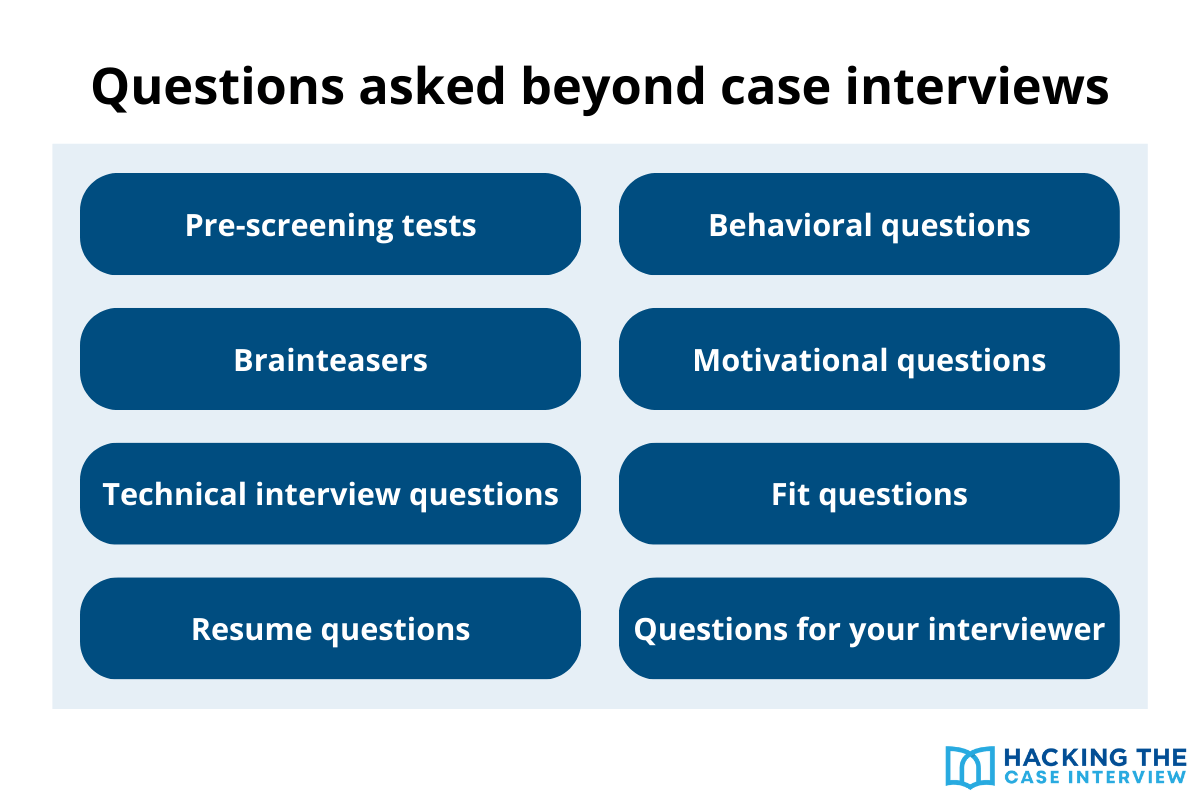
What Else Do You Need to Prepare for Beyond Case Interviews?
Case interviews are the toughest part, but they are not the only thing you will face. Many candidates spend hundreds of hours on cases but neglect these other components.
What Pre-Screening Tests Might You Face?
McKinsey Solve is a 70-minute assessment with two ecology-themed exercises: ecosystem building and a case study called Redrock. You create food chains, balance species populations, and answer analytical questions. Both your final answers and your problem-solving process are scored.
BCG Pymetrics is a 20 to 30 minute assessment with 12 mini-games measuring cognitive traits like decision making, risk tolerance, attention, and learning. BCG uses it as an inclusion tool, but strong performance adds a positive data point to your application.
Bain SOVA is a psychometric assessment that evaluates cognitive abilities, personality traits, and situational judgment, scoring candidates on both accuracy and speed. It consists of roughly 75 questions across five sections, takes 60–75 minutes to complete, and is taken at home with a calculator, scratch paper, and pen permitted.
Oliver Wyman and LEK both have quantitative assessments. You cannot fully prepare for these like traditional tests, but familiarizing yourself with the format helps.
What Resume and Personal Story Questions Will You Get?
"Tell me about yourself" is asked at the start of most interviews. Structure your answer in three parts: a strong opening that summarizes your expertise, brief highlights of your most impressive experiences, and a connection to why you are interested in consulting. Keep it under two minutes.
How Should You Prepare for Behavioral Questions?
No consulting interview guide is complete without covering behavioral interviews. Prepare six to eight diverse stories covering leadership, teamwork, problem solving, and resilience.
If you want to be fully prepared for 98% of fit interview questions in just a few hours, my fit interview course covers exactly what interviewers look for and how to structure your answers.
Use the SPAR method: Summary (one sentence overview), Problem (the challenge), Action (what you did), and Result (the outcome). Keep answers to two to three minutes.
What Motivational and Fit Questions Should You Expect?
"Why consulting?" and "Why this firm?" assess your genuine interest. For both, state that consulting or the firm is your top choice, provide three specific reasons, and reiterate your enthusiasm.
For strengths, pick something relevant to consulting and illustrate with a brief example. For weaknesses, be honest, explain what you have done to improve, and reflect on progress. For future aspirations, show ambition and explain how consulting helps you reach your goals.
What Questions Should You Ask at the End?
Every interviewer saves time for your questions. This is your chance to connect personally and leave a positive impression.
Prioritize personal questions focused on the interviewer. People enjoy talking about themselves, and genuine interest builds rapport. Good questions include: What was your most challenging case? What do you enjoy most about your job? Looking back at your first year, what would you have done differently?
If personal questions do not fit the dynamic, ask intelligent questions about consulting or the firm: What qualities make consultants most successful here? What advice would you give an incoming consultant?
Avoid questions you could answer with a Google search, questions that assume you will get the job, and complex hypothetical questions. Never say "I do not have any questions." That signals disinterest.
What About Brainteasers and Technical Questions?
Consulting brainteasers are puzzles designed to test creative thinking and problem solving under pressure. Top firms like McKinsey, BCG, and Bain rarely use them anymore, but other firms like Accenture sometimes do.
Technical interview questions only appear for specialized roles. Generalist consulting positions at strategy firms do not include them. You will encounter technical questions when applying for technology consulting, specialized practice areas, or implementation roles.
Frequently Asked Questions
How long does a case interview last?
A typical case interview lasts 30 to 45 minutes. First round cases tend to be shorter (25 to 35 minutes), while final round cases can run 40 to 60 minutes. The case portion itself takes most of the time, with 5 to 10 minutes allocated to fit questions at the beginning.
How many case interviews will I have?
Most firms conduct two rounds of interviews. First rounds typically include two back-to-back interviews. Final rounds include three, though some firms have two or four. Across both rounds, expect a total of four to six case interviews.
Can I use a calculator in a case interview?
No. Case interviews require mental math. Firms like McKinsey and BCG specifically test your ability to do calculations under pressure without a calculator. This is why mental math practice is such an important part of preparation.
What happens if I get the math wrong?
A single math error will not necessarily fail you. Interviewers understand that mental math under pressure is difficult. What matters more is your approach, your ability to catch errors through sense checking, and how you recover if the interviewer points out a mistake. Stay calm, acknowledge the error, and correct it.
Do I need business experience to pass case interviews?
No. Case interviews are designed so that anyone with general business knowledge can solve them. You do not need an MBA or business background. Candidates from engineering, science, humanities, and other non-business fields regularly receive offers from top firms. What you do need is structured thinking, comfort with basic math, and practice.
How long does it take to prepare for case interviews?
Most candidates spend 60 to 80 hours preparing, equivalent to 6 to 8 weeks. Exceptional candidates with strong business and communication skills might need as little as 4 weeks. Those without a business background could require up to 12 weeks. The key is consistent, focused practice rather than cramming.
What is the hardest part of a case interview?
For most candidates, the hardest part is structuring a custom framework under time pressure. Creating a MECE, tailored framework in 60 to 90 seconds while managing nerves is a skill that requires significant practice. The second hardest part is doing mental math quickly and accurately while talking through your work.
Everything You Need to Land a Consulting Offer
Need help passing your interviews?
-
Case Interview Course: Become a top 10% case interview candidate in 7 days while saving yourself 100+ hours
-
Fit Interview Course: Master 98% of consulting fit interview questions in a few hours
- Interview Coaching: Accelerate your prep with 1-on-1 coaching with Taylor Warfield, former Bain interviewer and best-selling author
Need help landing interviews?
- Resume Review & Editing: Craft the perfect resume with unlimited revisions and 24-hour turnaround
Need help with everything?
- Consulting Offer Program: Go from zero to offer-ready with a complete system
Not sure where to start?
- Free 40-Minute Training: Triple your chances of landing consulting interviews and 8x your chances of passing them