
Deloitte Resume: The Complete Guide (2026)
Author: Taylor Warfield, Former Bain Manager and interviewer
Last Updated: March 23, 2026

A Deloitte resume needs to showcase intelligence, a track record of results, and skills that match what Deloitte’s recruiters specifically value. With an acceptance rate estimated around 3.7% and roughly 60% of applicants screened out at the resume stage, getting this document right is the difference between an interview and a rejection email.
In this guide, I’ll walk you through exactly what Deloitte looks for, how to write each section of your resume, the action verbs and keywords that pass ATS filters, and the most common mistakes that get resumes tossed. Having screened thousands of resumes during my time at Bain, I know what makes a consulting resume land in the “yes” pile.
But first, a quick heads up:
McKinsey, BCG, Bain, and other top firms accept less than 1% of applicants every year. If you want to triple your chances of landing interviews and 8x your chances of passing them, watch my free 40-minute training.
What Changed in 2026?
This article has been fully updated for 2026. Key changes include new sections on ATS optimization and Deloitte’s Applicant Tracking System, a curated list of 30+ action verbs organized by skill type, a comparison table for tailoring your resume across Deloitte’s service lines (Consulting vs. Advisory vs. Tax vs. Audit), and dedicated guidance for target school vs. non-target school applicants. Updated GPA thresholds now reflect Deloitte’s publicly listed requirement of 3.0 cumulative minimum with 3.4 preferred.
What Does Deloitte Look for in a Resume?
Deloitte resume reviewers evaluate candidates on four core qualities plus several Deloitte-specific attributes. According to Deloitte’s own careers page, the firm requires a minimum 3.0 cumulative GPA and prefers 3.4 or higher for most consulting roles. Strategy and Monitor positions are even more competitive, with most successful candidates holding a 3.5 GPA or above.
The four core qualities Deloitte looks for are:
- Intelligence: High GPAs, test scores (SAT, GMAT, GRE), and academic honors. These signal that you can handle the analytical rigor of consulting work.
- High pedigree: Prestigious universities and brand name employers. Consulting firms value pedigree because it makes selling projects to clients easier.
- Track record of success: Promotions, completed projects, and measurable impact. Deloitte wants evidence that you deliver results in whatever you do.
- Relevant skills: Both hard skills (data analysis, financial modeling, problem solving) and soft skills (leadership, communication, managing teams).
You do not need a business degree or business work experience to get an interview. Deloitte believes they can teach business knowledge on the job, so they focus on hiring intelligent, driven people from any background.
Beyond these four qualities, Deloitte’s careers website highlights additional attributes they specifically screen for:
- Communication: Clear, concise expression and the ability to quickly build relationships across diverse teams.
- Achievement orientation: Drive, determination, and a commitment to meeting objectives.
- Commercial awareness: Interest in business and knowledge of current issues affecting Deloitte’s clients.
- Adaptability: Flexibility in the face of changing client needs, project requirements, and team dynamics.
- Problem solving: Ability to analyze complex situations, break them down, and generate sound solutions.
- Planning and organization: Attention to detail, time management, and effective project ownership.
In my experience screening resumes at Bain, the candidates who stood out were the ones who mapped their bullet points directly to these qualities. Every line on your resume should prove at least one of them.
Do You Need to Tailor Your Resume for Deloitte?
Yes, but you do not need to start from scratch. The core qualities Deloitte looks for are similar to what any consulting firm values. However, making a few targeted adjustments can meaningfully improve your chances.
Here is how to tailor your resume for Deloitte:
- Emphasize communication, adaptability, and problem solving. Deloitte weights these more heavily than some other firms. Devote more bullet points to experiences that showcase flexibility and clear communication.
- Demonstrate adaptability. Highlight experiences where you responded to changing conditions, unclear requirements, or ambiguous problems. Show that you have worked on a variety of projects across quantitative and qualitative skill sets.
- Incorporate keywords from the specific job posting. Deloitte uses Applicant Tracking Systems (ATS) to filter resumes before a human ever sees them. Scan the job description for terms like “collaborative mindset,” “client delivery,” or “data-driven decision-making” and weave them naturally into your bullets.
- Address role-specific requirements. If you are applying to an international office, note your language proficiency. If the role is specialized in a particular industry or function, emphasize matching experiences. These details can also be highlighted in your Deloitte cover letter.
A common question is whether keyword tailoring matters for on-campus applicants. It matters most for candidates applying from non-target schools or applying off-cycle, where ATS filtering is more likely to play a role.
How Should You Tailor Your Resume for Different Deloitte Service Lines?
Deloitte is not a single business. The firm operates across Consulting, Risk and Financial Advisory, Tax, and Audit. Each service line looks for different skills and keywords on your resume. The table below breaks down what to emphasize for each:
Focus Area |
Consulting |
Financial Advisory |
Tax |
Audit |
Key Skills |
Strategic thinking, leadership, structured problem solving, client communication |
Financial modeling, valuation, due diligence, risk assessment |
Tax compliance, tax planning, regulatory knowledge, research skills |
Attention to detail, GAAP/IFRS knowledge, data accuracy, analytical rigor |
ATS Keywords |
Business transformation, project management, cross-functional teams, strategic initiatives |
Valuation, due diligence, financial reporting, market research, quantifiable results |
Tax provision, ASC 740, transfer pricing, tax reform, compliance |
Internal controls, SOX compliance, audit procedures, financial statements |
Ideal Background |
Consulting internships, case competitions, student consulting clubs, leadership roles |
Finance or accounting internships, corporate finance coursework, financial modeling experience |
Tax internships, accounting degree, CPA progress, tax research projects |
Audit internships, accounting degree, CPA progress, data analytics experience |
If you are applying to Deloitte Consulting specifically, the rest of this guide is tailored primarily for you. However, the formatting, structure, and core principles apply across all service lines.
How to Write a Deloitte Resume Section by Section
There are five major sections on a Deloitte resume: contact information, professional experience, extracurricular activities, education, and additional information. Here is exactly how to write each one.
What Should Your Contact Information Section Include?
The first line of your resume should be your full name in a larger font size (at least 18pt) with all letters capitalized. The second line should contain your email, phone number, city/state, and LinkedIn profile URL, all on one line.
According to Deloitte’s own recruiting tips, including a LinkedIn hyperlink is recommended. Keep this section to two lines maximum to save space for your accomplishments.
Should You Include a Professional Summary?
A professional summary is optional. If you have several years of experience, a 1 to 2 sentence summary highlighting your background, skills, and consulting motivation can give recruiters immediate context. For example: “Results-driven analyst with 4 years of experience in data analytics and process improvement. Track record of delivering measurable cost savings for Fortune 500 clients.”
If you are a current student with limited experience, skip the summary and use that space for your accomplishments instead.
How Should You Write Your Professional Experience Section?
This is the most important section of your Deloitte resume. Place it before education unless you are a current student with less than one year of work experience.
List your work experience in reverse chronological order (most recent first). Allocate space roughly proportional to how long you held each role. The exception is brand name employers like Goldman Sachs or Google, which deserve extra space because consulting firms heavily value prestige.
Each role should have 3 to 5 bullet points. Lead each bullet with a strong action verb in the past tense. Every bullet must include a number or metric. In my experience, the single biggest difference between resumes that get interviews and resumes that do not is quantified impact.
Use the XYZ bullet formula: Accomplished [X] as measured by [Y] by doing [Z]. This structure forces you to include the result, the metric, and the method in every bullet.
Here is a before and after example:
- Before: Analyzed survey responses to identify customer improvement areas.
- After: Led an 8-person analytics team to analyze 100K+ survey responses, identifying improvement areas worth $200M in annual revenue.
Balance your bullets equally between quantitative accomplishments (analyzing data, building models, reducing costs) and qualitative accomplishments (leading teams, managing stakeholders, communicating findings). Deloitte wants consultants who can both crunch numbers and lead client relationships.
Keep every bullet simple and jargon free. A resume reviewer from a different industry should understand every word. Avoid technical abbreviations, internal acronyms, and buzzwords with unclear meanings.
If you have only had one job over a long period, consider separating your bullets by project or engagement. This makes it easier for the reviewer to scan and digest your accomplishments.
What Should Your Education Section Include?
Keep this section short to leave more room for your experience. List your school name, degree, major, and graduation date.
Include your GPA if it is 3.0 or higher. According to Deloitte’s job postings, a 3.0 cumulative GPA is required and 3.4 is preferred. For Deloitte Monitor or strategy roles, successful candidates typically have a 3.5 or above. If your GPA is below 3.0, leave it off your resume, though Deloitte may ask for it during the application.
Include high standardized test scores (SAT above 1400, GMAT above 700, GRE above 325). List academic honors, Dean’s List, scholarships, and relevant coursework if they strengthen your profile. A Deloitte recruiter quoted on the firm’s careers page advises including your GPA if it is above 3.2.
How Should You Present Extracurricular Activities?
This section is most important for current students with limited work experience. For experienced hires, you can fold relevant activities into your Additional Information section or omit this section entirely.
Organize activities by impressiveness, not chronology. List your most impressive accomplishment first. Follow the same bullet writing rules: start with a verb, quantify impact, balance quantitative and qualitative achievements.
Leadership roles matter far more than membership. Being president of a consulting club with measurable results (organized a case competition with 200+ participants) is significantly stronger than listing “Member, Consulting Club.”
What Goes in the Additional Information Section?
This section should be concise. Organize it into categories:
- Skills: List technical skills relevant to consulting such as SQL, Tableau, Python, R, or Alteryx. Do not list Excel or PowerPoint. Everyone is expected to know those.
- Languages: List languages with fluency levels (basic, proficient, professional, fluent). Order from most to least proficient.
- Certifications: Include relevant designations like CFA, CPA, or Six Sigma.
- Interests: This is often the only part of the resume that a reviewer remembers. Include specific, memorable interests that make great conversation starters. “Competitive salsa dancer” is far better than “dancing.”
What Are the Best Action Verbs for a Deloitte Resume?
Starting every bullet with a strong action verb is one of the easiest ways to make your resume sound more impactful. Deloitte’s own recruiting team recommends using action verbs that show ownership and initiative. Here are 30+ verbs organized by skill type:
Analytical / Quantitative |
Leadership / Management |
Communication / Client |
Analyzed, Calculated, Quantified, Modeled, Forecasted, Evaluated, Assessed, Optimized, Automated, Diagnosed |
Led, Managed, Directed, Supervised, Coordinated, Launched, Founded, Mentored, Delegated, Mobilized |
Presented, Advised, Negotiated, Persuaded, Collaborated, Facilitated, Influenced, Communicated, Drafted, Recommended |
Use a different verb for each bullet on your resume. Repeating the same verb (e.g., “Managed” three times) signals a narrow skill set. Variety shows the breadth of your capabilities.
How to Format a Deloitte Resume
Content matters most, but poor formatting can disqualify an otherwise strong resume. According to Deloitte recruiters, formatting is the first thing they notice. Here are the rules:
- One page maximum. No exceptions. If your resume is longer, make your content more concise. Even experienced hires should aim for one page unless they have 7+ years of highly relevant experience.
- Margins of 0.5 to 1 inch. Half-inch margins give you the most content space without making the page look cramped.
- Standard font. Use Times New Roman, Arial, or Calibri. No decorative or creative fonts. A body font size of 10 to 11pt keeps your resume readable.
- Reverse chronological order. Most recent experience first. This is the format Deloitte expects.
- Consistent formatting throughout. Same font sizes, alignment, date formats, and spacing across all sections. Inconsistency signals carelessness.
- Submit as PDF. PDF preserves your formatting across all devices and operating systems. Include your full name and the date in the file name (e.g., “John_Smith_Resume_March_2026.pdf”).
How Does Deloitte’s ATS Filter Your Resume?
Deloitte uses an Applicant Tracking System to scan and filter resumes before a recruiter ever reads them. According to industry data, over 75% of resumes are rejected by ATS before reaching a human reviewer. Here is how to make sure yours gets through:
- Use standard section headers. “Professional Experience,” “Education,” and “Skills” are recognized by ATS software. Creative headers like “My Journey” or “What I Bring” will confuse the parser.
- Avoid images, graphics, tables, and columns. ATS software cannot reliably read content inside tables or multi-column layouts. Stick to a simple, single-column format.
- Mirror job posting language. If the job description says “cross-functional collaboration,” use that exact phrase in your bullets. ATS systems match keywords from the posting to your resume.
- Do not use headers or footers for critical information. Some ATS systems skip header and footer content entirely. Your name and contact info should be in the body of the document.
How Does the Resume Differ for Target School vs. Non-Target School Applicants?
If you attend a Deloitte target school (a school where Deloitte actively recruits on campus), your resume will be reviewed by a committee of 4 to 8 analysts, associates, and managers who likely graduated from your school. In this case, lead with your professional experience, since every resume in your pile will have the same school name at the top.
If you attend a non-target school, lead with your education section so the reviewer immediately sees your academic credentials. Compensate for school recognition with stronger GPA, test scores, and brand name work experience. For more on the application strategy, check out our guide on management consulting networking.
ATS keyword optimization is especially critical for non-target applicants, since your resume is more likely to go through automated screening rather than a committee review. Networking to secure a referral can help bypass the ATS entirely.
How Does the Resume Differ for Campus Hires vs. Experience Hires?
For campus hires (current students or recent graduates), Deloitte’s own recruiting team recommends highlighting internships, leadership positions, volunteer work, and your GPA (if above 3.2). Keep it to one page and include an Extracurricular Activities section.
For experience hires (professionals with 2+ years of work experience), focus on measurable results and client-facing accomplishments. Remove old internships if they are no longer relevant. Your professional experience section should dominate the page. GPA becomes less important the further you are from graduation, and Deloitte places more emphasis on professional achievement for experienced candidates.
How to Proofread and Edit a Deloitte Resume
Your first draft is never your final draft. Follow this checklist to catch the mistakes that get resumes rejected:
- Read out loud line by line. You will catch awkward phrasing and typos that you would miss reading silently.
- Verify every bullet is quantified. If a bullet has no number, either add one or cut the bullet.
- Check the balance of quantitative vs. qualitative bullets. Color-code them if it helps. You should have roughly equal numbers of each.
- Remove all jargon and buzzwords. Replace “synergized cross-functional deliverables” with clear, specific language anyone can understand.
- Confirm consistent formatting. Same verb tense, same date format, same bullet style, same margins on every line.
- Get feedback from at least 2 to 3 other people. Career services advisors, classmates who have worked in consulting, and alumni at consulting firms are all excellent reviewers.
If you want professional help, my resume review and editing service provides done-for-you editing with unlimited revisions and 24-hour turnaround from someone who has been on the other side of the recruiting process.
What Does a Strong Deloitte Resume Look Like?
Here is what an optimized Deloitte resume includes at a glance:
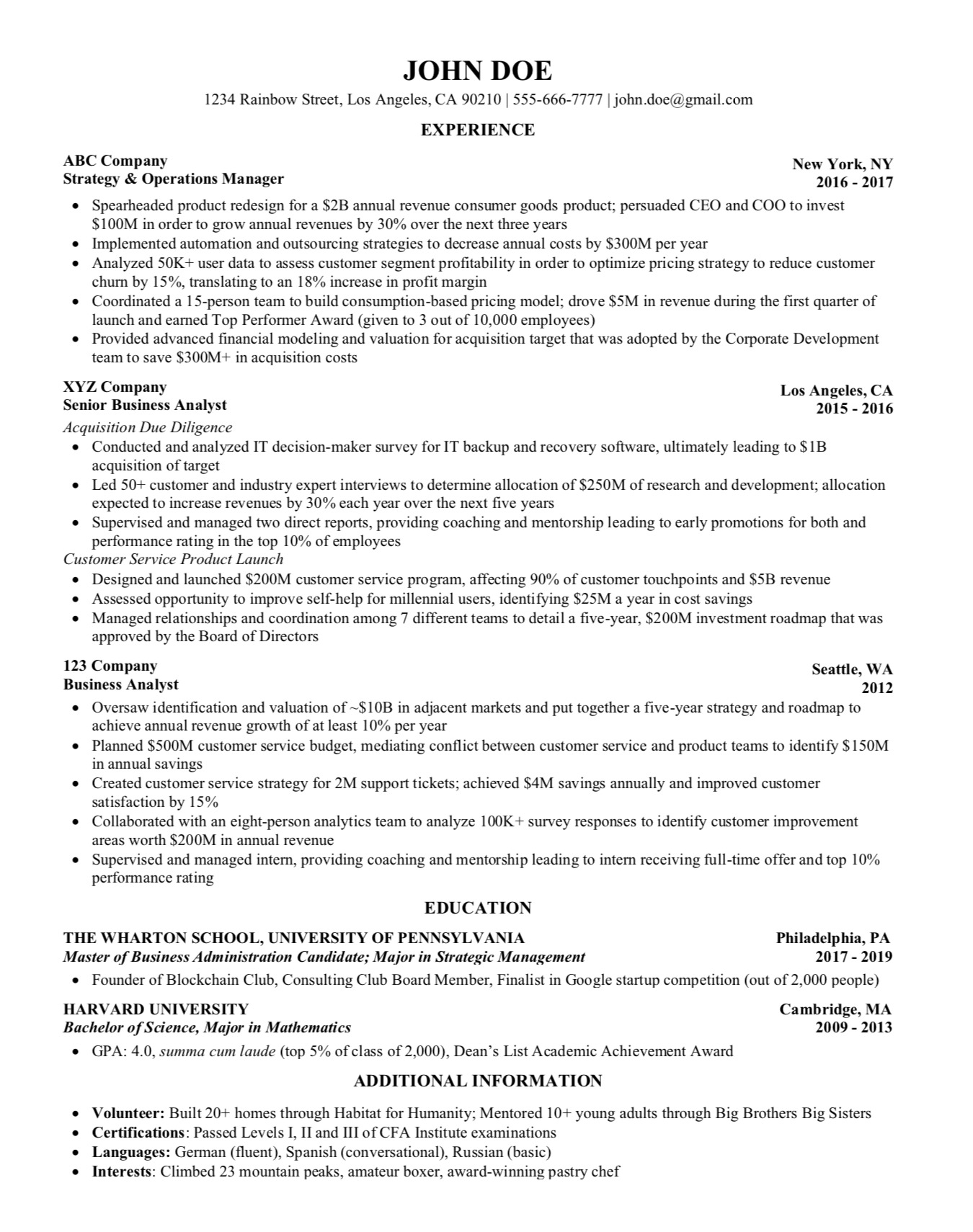
- Full name in large font with contact info on one line below it
- Professional experience in reverse chronological order with 3 to 5 quantified bullets per role using the XYZ formula
- Education with GPA (3.0+), test scores, and relevant honors
- Additional information with skills, languages, and memorable interests
- One page, clean formatting, standard font, submitted as PDF
Notice that the strongest resumes tell a clear story: here is what I accomplished, here is how much it mattered, and here is what it says about my ability to succeed at Deloitte. Every bullet earns its place on the page.
What Are the Most Common Deloitte Resume Mistakes?
After reviewing thousands of consulting resumes, these are the mistakes I see most often:
- No quantified achievements. Listing duties instead of results is the number one reason resumes get rejected. “Responsible for managing a team” tells the reviewer nothing about your impact.
- Resume exceeds one page. Consulting firms view this as a sign of poor prioritization. If you cannot be concise on paper, recruiters worry you will not be concise with clients.
- Generic language. Buzzwords like “team player” and “results-oriented” without evidence are meaningless. Replace them with specific examples.
- Not tailored to Deloitte. Using the same resume for every firm without adjusting keywords, skills, or emphasis to match Deloitte’s values and job posting signals low effort.
- Ignoring Deloitte’s culture and values. Deloitte places strong emphasis on cultural fit. Your resume should reflect qualities like collaboration, integrity, and a commitment to making an impact. To learn more about the firm’s culture, check out our article on why Deloitte.
- Spelling and grammar errors. A single typo can end your candidacy. Consulting is a detail-oriented profession, and your resume is the first evidence of your attention to detail.
- Omitting key sections. Missing contact details, education, or a skills section makes your resume look incomplete and signals carelessness.
- Formatting that breaks ATS. Fancy graphics, multi-column layouts, or creative fonts may look good on screen but get mangled by Applicant Tracking Systems.
Frequently Asked Questions
What GPA Do You Need for Deloitte?
Deloitte requires a minimum 3.0 cumulative GPA and prefers 3.4 or higher according to their published job postings. For Deloitte Monitor and strategy consulting roles, most successful applicants have a 3.5 GPA or above. If your GPA is below 3.0, networking and strong work experience become critical to getting past the screening stage.
Should a Deloitte Resume Be One Page?
Yes. One page is the standard for consulting resumes at Deloitte and virtually every other top firm. The only exception is for very senior experienced hires with 7+ years of directly relevant consulting experience, and even then, most recruiters prefer one page.
Does Deloitte Use an Applicant Tracking System?
Yes. Deloitte uses ATS software to screen resumes before human review. To pass the filter, use standard section headers, mirror keywords from the job posting, stick to a simple single-column format, and avoid images or graphics that the parser cannot read.
Do You Need Consulting Experience to Get a Deloitte Interview?
No. Deloitte hires candidates from a wide range of backgrounds including engineering, economics, liberal arts, and the military. What matters is demonstrating transferable skills like problem solving, leadership, analytical ability, and measurable impact. Frame your experience in terms of results and skills, not industry-specific titles.
Should You Include a Cover Letter with Your Deloitte Resume?
Deloitte typically does not require a cover letter, but having one ready is a good practice. A well-written cover letter can differentiate you from an equally qualified candidate. If you do include one, keep it brief and focused on why you want to work at Deloitte specifically. For more guidance, see our Deloitte cover letter guide.
What Is the Deloitte Resume Review Process?
At target schools, a committee of 4 to 8 Deloitte employees (usually alumni from your school) reviews resumes and decides who gets interview slots. At non-target schools, resumes typically go through ATS screening first, then a recruiter review. In both paths, the committee is looking for the same core qualities: intelligence, results, skills, and cultural fit.
Everything You Need to Land a Consulting Offer
Need help passing your interviews?
-
Case Interview Course: Become a top 10% case interview candidate in 7 days while saving yourself 100+ hours
-
Fit Interview Course: Master 98% of consulting fit interview questions in a few hours
- Interview Coaching: Accelerate your prep with 1-on-1 coaching with Taylor Warfield, former Bain interviewer and best-selling author
Need help landing interviews?
- Resume Review & Editing: Craft the perfect resume with unlimited revisions and 24-hour turnaround
Need help with everything?
- Consulting Offer Program: Go from zero to offer-ready with a complete system
Not sure where to start?
- Free 40-Minute Training: Triple your chances of landing consulting interviews and 8x your chances of passing them